1. Early Life and Background
Anthony Ervin's early life was shaped by a diverse family heritage and an academic environment that fostered his unique philosophical outlook, which profoundly influenced his approach to swimming and life.
1.1. Early Life and Family
Anthony Lee Ervin was born on May 26, 1981, in Hollywood, California, or Burbank, California, and was raised in Valencia, Santa Clarita, California. His family heritage is notably diverse; his mother is of Ashkenazi Jewish and European descent, while his father is of African-American and Native American/Indian-American descent. As a youth, Ervin honed his swimming skills at the Canyons Aquatic Club and competed on the swim team for Hart High School.
1.2. Education
Ervin pursued his higher education at the University of California, Berkeley, where he swam under the guidance of Hall of Fame Head Coach Nort Thornton. He earned his bachelor's degree in English in 2010. Following his undergraduate studies, he continued his academic pursuits at Berkeley, working towards a graduate degree in sport, culture, and education.
1.3. Personal Beliefs and Philosophy
Ervin identifies himself as a Zen Buddhist and has actively engaged in Zen meditation. This philosophical approach has been central to his personal development and his ability to navigate life's challenges. He has openly discussed his experience with Tourette syndrome, a neurological disorder characterized by involuntary tics. Ervin describes his tics as an "itch that constantly wants to be scratched" and notes that as a young adult, he would often attract negative attention due to his symptoms. Remarkably, he attributes his success in swimming, particularly in high-pressure Olympic finals, to his Tourette syndrome. He explains that swimming helped him manage his facial tics from a young age, and the condition taught him how to cope with anxiety, which proved beneficial during his competitive career.
2. Swimming Career
Anthony Ervin's swimming career is marked by early Olympic glory, a significant hiatus, and an unprecedented comeback that redefined expectations in the sport. His unique swimming style, despite not being physically blessed for short distances, contributed to his success.
2.1. 2000 Sydney Olympics
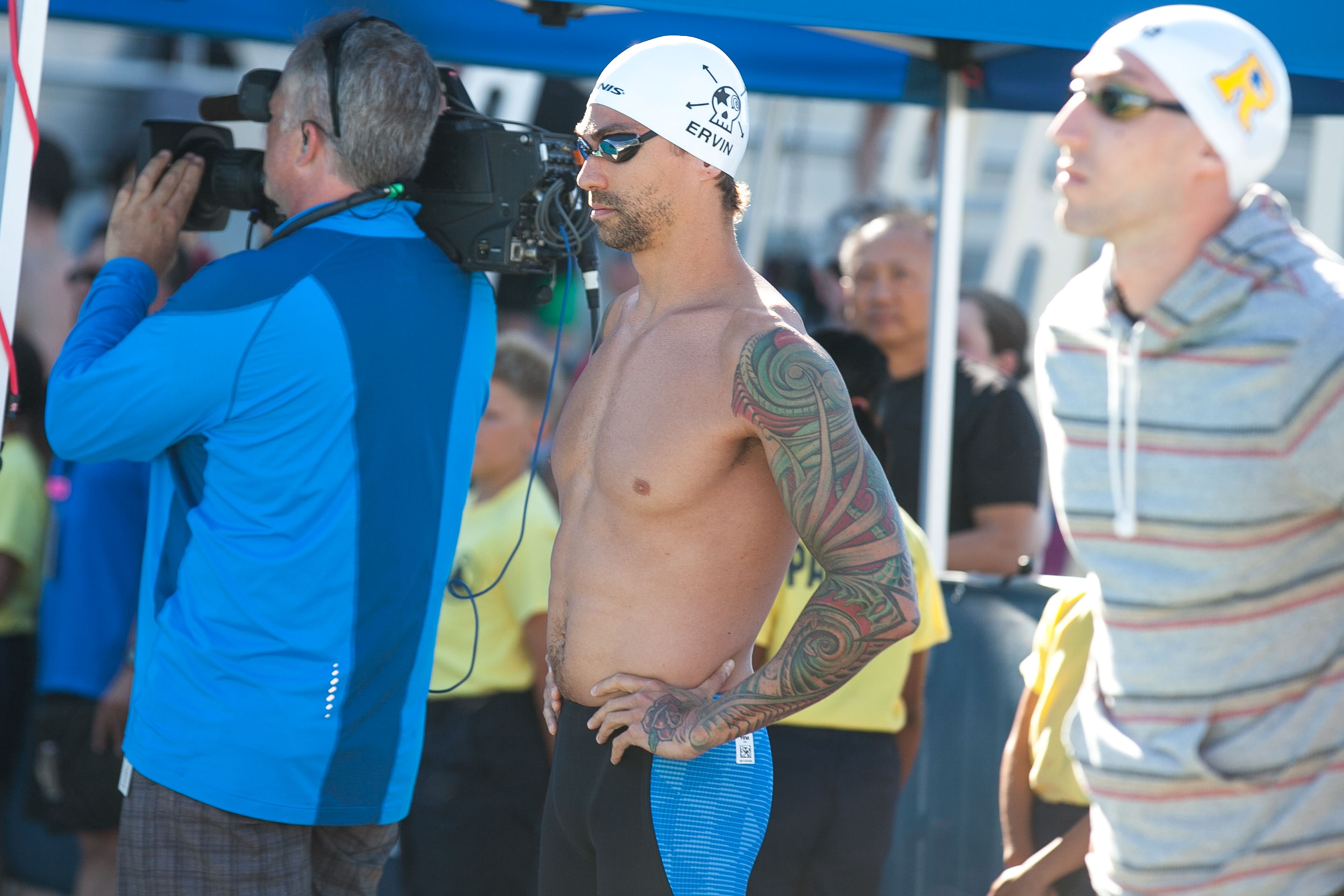
Ervin made his Olympic debut at the 2000 Summer Olympics in Sydney, Australia, after a strong performance at the 2000 United States Olympic Trials in Indianapolis. At the trials, he secured his place on the US Olympic team by finishing fifth in the 100-meter freestyle with a time of 49.29 seconds, qualifying him for the 4×100-meter freestyle relay. He also finished second in the 50-meter freestyle with a time of 21.80 seconds, just behind Gary Hall Jr..
At the Sydney Games, Ervin earned two medals. In the 4×100-meter freestyle relay, he swam the leadoff leg in 48.89 seconds, the second-fastest leadoff split in the race. The American team, comprising Ervin, Gary Hall Jr., Neil Walker, and Jason Lezak, secured a silver medal with a time of 3:13.86, finishing narrowly behind Australia, who set a new world record of 3:13.67. In the highly anticipated 50-meter freestyle final, Ervin achieved a remarkable feat by tying Gary Hall Jr. for the gold medal, both clocking a time of 21.98 seconds. This victory held particular historical significance as Ervin became the second swimmer of African descent, after Anthony Nesty of Suriname, to win an individual gold medal in Olympic swimming, and the first United States citizen of African descent to do so. Following his gold medal race, a reporter asked Ervin about his experience as the first African-American swimmer to win gold. Reflecting on this moment in a 2012 interview, Ervin humorously remarked, "I didn't know a thing about what it was like to be part of the black experience. But now I do. It's like winning gold and having a bunch of old white people ask you what it's like to be black. That is my black experience."
2.2. World and Pan Pacific Championships (2001-2003)
Following his Olympic success, Ervin continued to excel on the international stage. At the 2001 World Aquatics Championships in Fukuoka, Japan, he clinched two gold medals, dominating both the 50-meter freestyle and the 100-meter freestyle events, notably defeating prominent swimmers like Ian Thorpe and Pieter van den Hoogenband in the latter. He also participated in the 4x100-meter freestyle relay, though the United States team was disqualified in that event. In 2002, Ervin competed at the 2002 Pan Pacific Swimming Championships in Yokohama, Japan, where he earned two silver medals in the 50-meter freestyle and the 4x100-meter freestyle relay.
2.3. Career Hiatus and Personal Struggles
In 2003, at the age of 22, Anthony Ervin made the abrupt decision to retire from competitive swimming. The years that followed were marked by significant personal struggles. He disengaged from the sport and explored various interests, including learning guitar and delving deeper into Buddhism. During this period, he also battled severe drug and alcohol addiction, a struggle so profound that at times he found it difficult to leave his sofa for days, and he even contemplated suicide.
In a remarkable act of philanthropy and detachment from his past achievements, Ervin auctioned off his 2000 Olympic gold medal on eBay in 2005. The proceeds from the sale were donated to aid the survivors of the devastating 2004 Indian Ocean earthquake and tsunami. This period of his life underscores his resilience and his capacity to overcome profound adversity, ultimately leading him back to the sport he had once left behind.
2.4. Comeback and 2012 London Olympics
After nearly a decade away from competitive swimming, Ervin began training again in 2011, signaling an extraordinary comeback. Twelve years after his last Olympic appearance, he successfully qualified for his second United States Olympic team at the 2012 United States Olympic Trials in Omaha, Nebraska. He finished second in the men's 50-meter freestyle with a personal best time of 21.60 seconds, just one-hundredth of a second behind Cullen Jones.
At the 2012 Summer Olympics in London, Ervin competed in the 50-meter freestyle final, where he placed fifth with a time of 21.78 seconds. His return to the Olympic stage at 31 years old was a testament to his perseverance. Furthermore, Ervin, along with Cullen Jones and Lia Neal, made history by being part of the first US Olympic swim team to include more than one African-American swimmer.
2.5. Later Career (2013-2021)
Ervin continued his impressive comeback in the years following the 2012 Olympics. At the 2013 US National Championships, he qualified for the 2013 World Aquatics Championships in Barcelona, placing second in the 50-meter freestyle (21.70 seconds) and third in the 100-meter freestyle (48.49 seconds). In Barcelona, he contributed to the United States' silver medal in the 4×100-meter freestyle relay, where his split of 47.44 seconds was the fastest among the American swimmers. In his individual 50-meter freestyle event, he entered the final as the second seed with a personal best semi-final time of 21.42 seconds, ultimately finishing sixth in the final with 21.65 seconds.
In 2014, Ervin earned two more silver medals at the 2014 Pan Pacific Swimming Championships in Gold Coast, Australia.
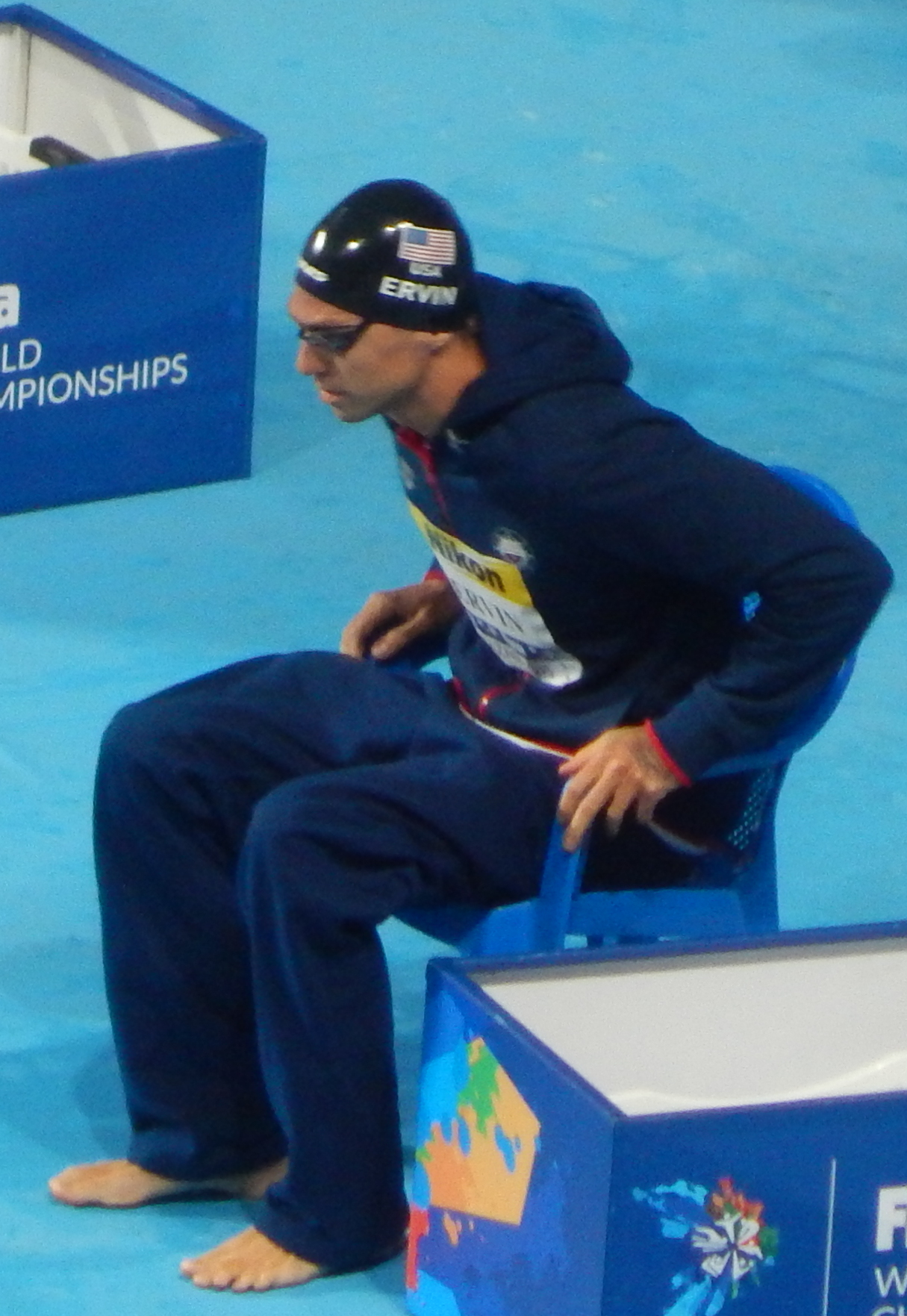
His career reached another pinnacle at the 2016 Summer Olympics in Rio de Janeiro. In the 50-meter freestyle final, Ervin won the gold medal with a time of 21.40 seconds, defeating Florent Manaudou of France. At 35 years old, this victory made him the oldest individual Olympic gold medalist in swimming history, surpassing Michael Phelps. He also earned another gold medal as part of the 4×100-meter freestyle relay team, having swum in the morning heats.
In 2017, Ervin participated in the torch lighting ceremony at the 2017 Maccabiah Games in Israel. He had a highly successful showing, winning three gold medals in the 50-meter freestyle (22.05 seconds), the 100-meter freestyle (49.76 seconds), and the 4×100-meter medley relay (with the American team clocking 3:41.82). He also secured a silver medal in the 4×100-meter freestyle relay. During a special 4x50m relay race featuring American and Israeli all-star teams, Ervin, alongside fellow American Olympic champions Lenny Krayzelburg and Jason Lezak, and masters swimmer Alex Blavatnik, swam a time of 1:48.23, defeating the Israeli Olympians.
Ervin continued to compete, attempting to qualify for the 2020 Summer Olympics (held in June 2021 due to the COVID-19 pandemic) at the 2020 USA Swimming Olympic Trials in Omaha, Nebraska. He swam the 50-meter freestyle, finishing 23rd overall with a time of 22.61 seconds in the heats, and did not qualify for the Tokyo Games. In December 2021, during the 2021 World Short Course Championships in Abu Dhabi, United Arab Emirates, Ervin conducted a swim clinic for young swimmers alongside Germany's Florian Wellbrock.
2.6. Swimming Style
As a short-distance swimmer, Ervin was not naturally blessed with a physique typically advantageous for the sport. Despite being less proficient at the start, which is a crucial element in competitive swimming, his primary strengths lay in his remarkable speed to reach top velocity and his exceptional maximum swimming speed, which he leveraged as his key weapons in races.
2.7. Personal Best Times
As of September 21, 2017, Anthony Ervin's personal best times in key swimming events are:
| Stroke | Distance | Course | Time | Year | Competition | City (Country) |
|---|---|---|---|---|---|---|
| Freestyle | 50m | Long Course | 21.40s | 2016 | 2016 Summer Olympics | Rio de Janeiro (Brazil) |
| Freestyle | 100m | Long Course | 48.33s | 2001 | 2001 World Aquatics Championships | Fukuoka (Japan) |
| Freestyle | 50m | Short Course | 20.85s | 2012 | FINA Swimming World Cup 2012 | Berlin (Germany) |
| Freestyle | 100m | Short Course | 46.33s | 2013 | FINA Swimming World Cup 2013 | Singapore (Singapore) |
| Butterfly | 50m | Short Course | 24.50s | 2012 | FINA Swimming World Cup 2012 | Moscow (Russia) |
3. Personal Life and Social Impact
Anthony Ervin's life extends beyond the swimming pool, encompassing his complex identity, his journey of overcoming health challenges and addiction, and his active engagement in social causes.
3.1. Racial and Cultural Identity
Ervin's identity is shaped by his unique and diverse heritage. He is of African-American and Native American/Indian-American descent on his father's side, and of Ashkenazi Jewish and European descent on his mother's side. He was born in Hollywood, California, and raised in Valencia, Santa Clarita, California. Ervin has publicly expressed pride in his multifaceted background, stating in July 2017, "I'm proud to be American and I'm proud to be a Jew. I didn't choose either one and I'm going to stick to the country I was born in." This blend of cultural and racial identities has informed his self-perception and public persona throughout his career.
3.2. Health and Overcoming Challenges
A significant aspect of Ervin's personal journey involves his experience with Tourette syndrome. He has described the condition as having symptoms that felt like an "itch that constantly wanted to be scratched," which sometimes drew negative attention. However, Ervin uniquely attributes his success in swimming to his Tourette syndrome, explaining that the sport helped him manage his facial tics from a young age. He believes that the condition forced him to learn coping mechanisms for anxiety early in life, which proved invaluable when competing in high-stakes Olympic finals.
Beyond Tourette's, Ervin has openly shared his struggles with drug and alcohol addiction, which led to his initial retirement from swimming in 2003. His candidness about this period, including contemplating suicide and being largely disengaged from daily life, highlights a profound journey of recovery and personal growth. His ability to return to elite competition after overcoming such significant personal battles stands as a testament to his mental fortitude and resilience.
3.3. Social Activism and Statements
Anthony Ervin has used his platform to advocate for social causes and make public statements. In October 2017, he notably knelt during the National Anthem prior to a competition in Brazil, a gesture of protest against racial injustice and police brutality in the United States, aligning with similar actions taken by other athletes.
He has also actively contributed to raising awareness about Tourette syndrome. From 2017 to 2018, Ervin served as a youth ambassador for the Tourette Association of America, working to empower young people living with the condition and sharing his story to inspire others.
In a more innovative approach to supporting his athletic career, Ervin utilized crowdfunding to finance his participation in competitions like the FINA Swimming World Cup. This method allowed him to secure the necessary funds for travel and expenses, showcasing his resourcefulness and adaptability in navigating the financial challenges of professional swimming.
4. Works and Media
Anthony Ervin has shared his unique life story and experiences through literary works, particularly his memoir. His public profile has also included features in popular media, such as on the cover of Rolling Stone magazine.
4.1. Memoir "Chasing Water"
In the spring of 2016, Ervin co-authored his memoir, Chasing Water: Elegy of an Olympian, with Constantine Markides. The book, published by Akashic Books, delves into his life story, including his early success, his struggles with addiction, his hiatus from swimming, and his eventual comeback. The memoir received critical acclaim, earning The Buck Dawson Authors Award from the International Swimming Hall of Fame in 2018, recognizing its significant contribution to sports literature.
5. Awards and Recognition
Anthony Ervin's career has been marked by numerous accolades and recognitions, acknowledging both his athletic achievements and his broader impact.
5.1. Major Awards and Honors
Ervin' has received several prestigious honors throughout his career. In 2003, he was inducted into the Southern California Jewish Sports Hall of Fame, recognizing his early contributions and achievements in swimming. His memoir, Chasing Water, was honored with The Buck Dawson Authors Award by the International Swimming Hall of Fame in 2018, further cementing his legacy beyond the pool.
5.2. Historical Significance and Impact
Anthony Ervin holds a significant place in swimming history. He was the second swimmer of African descent and the first United States citizen of African descent to win an individual Olympic gold medal in swimming, breaking barriers and paving the way for future generations. His shared gold medal in the 50-meter freestyle at the 2000 Sydney Olympics, followed by his historic solo gold in the same event at the 2016 Rio Olympics, 16 years later, underscores his remarkable longevity and resilience. At 35 years old, he became the oldest individual Olympic gold medalist in swimming, a testament to his enduring dedication and peak performance.
Beyond his Olympic achievements, Ervin also held the men's 50-meter freestyle (short course) world record from March 23, 2000, to January 28, 2001. His journey, marked by triumph, personal struggle, and an inspiring comeback, has made him a powerful symbol of perseverance and human spirit, influencing not only the sport of swimming but also broader societal conversations about identity, mental health, and overcoming adversity.