1. Early life and Education
Nik Abdul Aziz's early life and extensive religious and academic pursuits laid the foundation for his influential career as both a spiritual and political leader.
1.1. Birth and family background
Nik Abdul Aziz was born on 10 January 1931, in Kampung Pulau Melaka, a village in Kota Bharu, Kelantan, which was then part of British Malaya. He was the second of nine children. He was raised by his father, Tok Kura, who worked as an aspiring blacksmith and was also a religious teacher. His father, Tuan Guru Haji Nik Mat Raja Banjar, provided his initial education at their home in Pulau Melaka.
1.2. Religious education and academic pursuits
Nik Abdul Aziz's extensive Islamic studies began in traditional pondok schools, first in his home state of Kelantan, and later in Terengganu. He spent three months in 1936 at the National School of Kedai Lalat in Kelantan and also studied at Pondok Tok Kenali in Kubang Kerian, Kelantan, and Pondok Tok Guru Haji Abbas in Besut, Terengganu.
His higher education took him abroad, where he pursued advanced Islamic knowledge. He studied for five years at Darul Uloom Deoband in Uttar Pradesh, India, starting in 1952. He also attended Lahore University in Pakistan in 1957. He then enrolled at Al-Azhar University in Egypt, where he earned a Bachelor of Arts in Arabic Studies and a Master of Arts in Islamic jurisprudence. During his time at Al-Azhar, he was a civilian witness to the Arab-Israeli Conflict.
Upon his return from Egypt, Nik Abdul Aziz dedicated himself to teaching, serving at various religious schools in Kelantan, including his father's pondok. He also actively taught at mosques and pondoks across Kelantan and other states, earning him the respected moniker "Tok Guru" (Master Teacher) among Malaysians. He was known for his ability to communicate in multiple languages, including Arabic, Urdu, English, and Tamil. Even in his later years, he remained committed to disseminating Islamic knowledge, often leading the Fajr (dawn) prayers and delivering short lectures at a local mosque near his home.
2. Political career
Nik Abdul Aziz's political career was marked by his long tenure as a Member of Parliament and Menteri Besar of Kelantan, as well as his significant role as the Spiritual Leader of PAS, where he navigated complex political alliances and challenges.
2.1. Entry into PAS and early political activities
Nik Abdul Aziz joined the PAS in 1967. His entry into politics was swift, as he contested and won the Kelantan Hilir parliamentary seat by-election in the same year. He continued to hold this seat, which was later renamed Pengkalan Chepa, until 1986.
In 1982, he became a key figure in a movement by younger PAS members seeking to reform the party's leadership. Following PAS's loss in the 1978 Kelantan state elections, Nik Abdul Aziz, then the PAS state commissioner, openly questioned the leadership of party president Asri Muda. This internal pressure ultimately led to Asri's resignation during the PAS Muktamar (General Assembly) that year.
2.2. Parliamentary service
Nik Abdul Aziz served as a Member of Parliament for a total of 19 years. He represented the Kelantan Hilir constituency from 1967 to 1974, and subsequently the Pengkalan Chepa constituency from 1974 to 1986. His parliamentary service provided him with a platform to engage in federal politics before he shifted his focus to state-level governance.
2.3. Menteri Besar of Kelantan
After stepping down from federal politics, Nik Abdul Aziz successfully contested and won a seat in the Kelantan State Assembly in the 1986 general elections. His political fortunes soared in the 1990 general election, when PAS managed to regain control of Kelantan from the ruling Barisan Nasional coalition. In recognition of his leadership within the party in the state, Nik Abdul Aziz was appointed Menteri Besar of Kelantan on 22 October 1990, succeeding Mohamed Yaacob. He held this position for 23 years, making him one of Malaysia's longest-serving state chief ministers.
His administration in Kelantan was re-elected four times, in 1995, 1999, 2004, and 2008, demonstrating his enduring popularity and the strong support for PAS in the state. Throughout the 1990s, his government frequently found itself at odds with the federal government, then led by Prime Minister Mahathir Mohamad, particularly over the role of Islam in Malaysia. Nik Abdul Aziz notably rejected communal politics, a stance that distinguished him from the racially exclusive ruling party, UMNO.
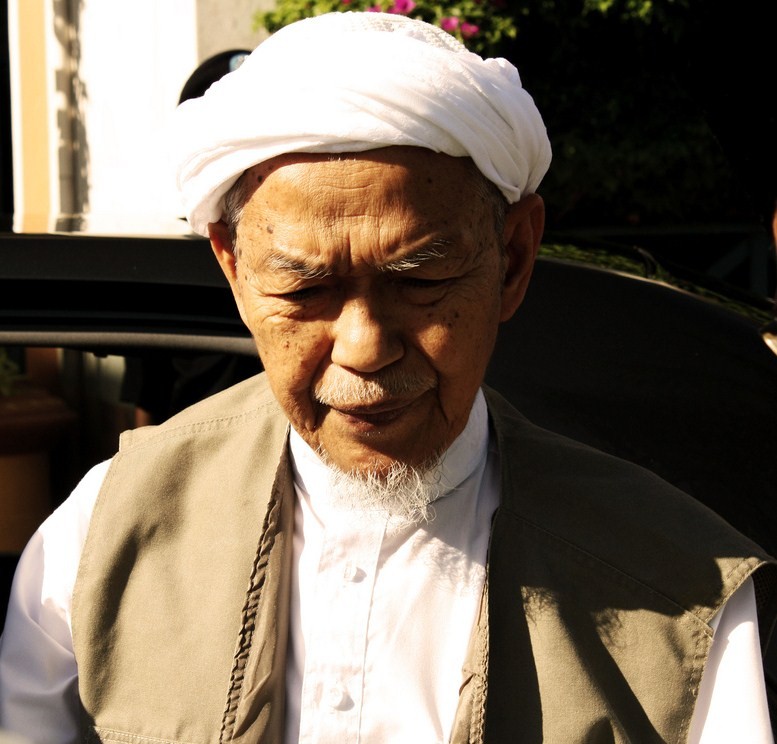
His governance was characterized by a commitment to integrity and a simple lifestyle. He was known for his piety and often wore robes and turbans. He famously stated that he would pray in darkness in his office to avoid using government funds for personal comfort. His personal residence was a modest village house, unfenced and without security guards, reflecting his rejection of extravagance and his desire to live like the common people. In 2008, the Anti-Corruption People's Movement (GERAK) recognized his efforts against corruption by presenting him with an award for being the "Cleanest Chief Minister" in Malaysia, acknowledging his clean record during his 18 years in office. He retired from the post of Menteri Besar on 6 May 2013, and was succeeded by his former deputy, Ahmad Yakob.
2.4. PAS Spiritual Leader
In addition to his role as Menteri Besar, Nik Abdul Aziz assumed the highly influential position of Mursyidul Am (Spiritual Leader) of PAS in 1991, succeeding Yusof Rawa. This role positioned him as the ultimate ideological authority within the party, profoundly shaping its direction and policies until his death on 12 February 2015. He was also the Head of the Ulama Wing of PAS from 1971 to 1995 and the Kelantan PAS Commissioner from 1978 to 2013. His successor as Spiritual Leader was Haron Din.
2.5. Political alliances and stances
Nik Abdul Aziz's approach to political alliances was often pragmatic, aiming to strengthen the opposition bloc against the long-ruling Barisan Nasional. He was instrumental in PAS's participation in various opposition coalitions, including Angkatan Perpaduan Ummah (1990-1996), Barisan Alternatif (1999-2004), and Pakatan Rakyat (2008-2015). His racially progressive stances and rejection of communal politics made PAS appealing to non-Malay and non-Muslim electoral bases, which was crucial for forming these multicultural coalitions.
His stance on cooperation with UMNO was a recurring theme in his political career. In May 2013, he publicly declared his strong opposition to any cooperation between PAS and UMNO as long as he was alive. He viewed UMNO as a secular party whose principles did not align with Islamic governance. However, in September 2019, after his death, PAS president Abdul Hadi Awang claimed that Nik Abdul Aziz had, in fact, consented to cooperation with UMNO during his lifetime, a claim made as PAS and UMNO formally signed the Muafakat Nasional charter of alliance.
Nik Abdul Aziz's willingness to forge alliances, even with parties ideologically distant from PAS, was exemplified by his controversial statement in 1999 regarding cooperation with the DAP. He famously stated, "If DAP sincerely wants to help PAS, we will accept. We will even accept Satan if he wants to help," a metaphor for his readiness to work with anyone for the sake of Islam, provided they accepted the conditions of the opposition coalition. He also likened UMNO to "orangutans" and, on another occasion, to the "Ayah Pin" deviant sect and communists, reflecting his strong opposition to their political ideology.
3. Ideology and Philosophy
Nik Abdul Aziz's ideology and philosophy were deeply rooted in his Islamic scholarship, guiding his vision for governance and his progressive social views.
3.1. Islamic governance and Sharia law
Nik Abdul Aziz was a staunch advocate for the establishment of Islamic governance and the implementation of Sharia law in Malaysia. He believed that the principles of the Quran and Hadith should form the foundation of national administration. His advocacy for Sharia law for all Malay Muslims was a consistent theme throughout his political career and often drew both support and criticism. He argued that a government based on Islamic principles would ensure justice and welfare for all citizens.
3.2. Social and racial perspectives
Despite his strong Islamic views, Nik Abdul Aziz was notable for his progressive and inclusive approach to social and racial issues. He openly rejected communal politics, a stark contrast to the dominant narrative of racial exclusivity promoted by parties like UMNO. He commanded significant support from non-Muslims in Malaysia, playing a leading role in increasing PAS's popularity among these communities.
He emphasized social equity and democratic development, advocating for an inclusive society where non-Muslims and minorities were treated fairly. He believed that Islam promoted universal values of justice and compassion that extended beyond ethnic or religious lines. This inclusive stance was a key factor in PAS's ability to form multi-ethnic and multi-religious political coalitions, such as Pakatan Rakyat, which sought to challenge the traditional racial divisions in Malaysian politics.
4. Controversies and Criticisms
Nik Abdul Aziz's outspoken nature and strong religious convictions occasionally led to controversies, particularly concerning his views on women, religious terminology, and political opponents.
4.1. Statements on women and gender issues
Nik Abdul Aziz drew significant criticism for several controversial statements and actions related to women's rights and gender roles. In 1999, he caused a stir by suggesting that beautiful women should not enter public office, reasoning that "women blessed with beautiful looks usually marry rich husbands even if they don't have a job," and that this policy would provide "fair opportunities for less attractive women." This remark was met with strong condemnation from women's organizations in Malaysia, including "Sisters in Islam," who accused him of sexism and demanded a retraction of his views, which they saw as reducing women to mere sexual objects.
His administration in Kelantan also implemented policies that restricted public entertainment and performances, which were deemed illegal between 1998 and 2005. He justified these measures by stating that "women are exploited by those who seek their own interests" and that "Islam forbids entertainment that corrupts the heart." While public performances for men were allowed from September 30, 2005, women remained restricted.
Further controversy arose from his remarks on women's attire and safety. In 2003, he reportedly stated that "women wearing lipstick could lead to rape." This sentiment was echoed in a 2015 report by Fox News, where he was quoted suggesting that women would be at a lower risk of rape if they refrained from using lipstick and perfume. He was also recorded in 2012 stating that "fashionable and sexy-dressing women deserved to be raped," a comment that sparked widespread outrage. His administration also banned snooker for 15 years, citing moral concerns.
4.2. Religious and political remarks
Nik Abdul Aziz's comments on religious terminology and political opponents often generated public debate. In 2012, when a Christian newspaper in Malaysia used the Arabic term "Allah" for "God" in its Bible, Nik Abdul Aziz initially stated that non-Muslims could use the word, citing its pre-Islamic origins. This stance caused significant internal division within PAS. To restore party unity, he later retracted his statement, clarifying that while the word "Allah" could be used by non-Muslims, they must specify that "Allah" refers to "God," and that its use by adherents of other religions was generally inappropriate.
He was also known for his strong rhetoric against political opponents, particularly UMNO. In 2012, during the PAS Muktamar, he controversially claimed that UMNO was an "apostate party" because it rejected and belittled Islam in its party policies. He argued that if UMNO rejected Islam as its foundation, then it had no religion at all, and that anyone, even a religious scholar, who deliberately rejected Islam was an apostate. In 2013, he controversially likened recipients of the 1Malaysia People's Aid (BR1M), a government financial assistance program, to "animals" being lured with food, stating that providing money was not the Islamic way of teaching, which should focus on imparting knowledge.
He also made other contentious remarks, such as claiming that "God uses abusive language" and that "God is a ruffian," and that "choosing between UMNO and PAS is like choosing between adultery and marriage."
4.3. Personal controversies
Beyond his public statements, Nik Abdul Aziz faced controversies stemming from his personal life and family. In 2001, his son, Nik Adli, was detained under Malaysia's Internal Security Act (ISA). Nik Adli was accused of terrorist activities, including planning jihad, possessing weapons, and being a member of Kumpulan Mujahidin Malaysia (KMM), an Islamist extremist group. He was held without trial for five years before his release in 2006.
Nik Abdul Aziz was also accused of nepotism when his son-in-law, Ariffahmi, was appointed as the CEO of PMBK. While Nik Abdul Aziz defended the appointment based on Ariffahmi's high educational qualifications and extensive engineering experience, Ariffahmi eventually resigned from the position.
5. Personal life and Health
Nik Abdul Aziz's personal life was characterized by a profound sense of piety and simplicity, which resonated deeply with his followers. Despite his demanding public roles, he maintained a humble lifestyle.
5.1. Family and lifestyle
Nik Abdul Aziz was married to Puan Sri Tuan Sabariah Tuan Ishak in 1963. Together, they had 10 children-five sons and five daughters-including two prominent figures, Nik Omar and Nik Abduh.
He was widely recognized as a deeply pious and ascetic leader. He consistently wore traditional robes and a turban. He famously stated that he would turn off the lights in his office when praying to avoid using government funds for his personal benefit, underscoring his commitment to frugality and public service. His home was a simple village house, unfenced and without security guards, reflecting his desire to live like the common people and his rejection of material extravagance. Before becoming Menteri Besar, he was an active religious teacher, and even in his later years, he continued to spread Islamic knowledge, often leading the Fajr (dawn) prayers and giving short lectures at a mosque just meters from his home.
5.2. Health issues
In his later years, Nik Abdul Aziz faced significant health challenges. He suffered from heart problems, high blood pressure, and gastric issues. In late 2004, he was hospitalized after experiencing a heart attack. In 2007, he was admitted to Universiti Sains Malaysia Hospital (HUSM) due to exhaustion.
He openly acknowledged his deteriorating health but emphasized that his physical ailments did not diminish his mental acuity or his dedication to public service. He famously stated, "I admit that physically, my body has heart problems. But my mind is still sharp to think and make evaluations or decisions." Despite these health difficulties, he continued to serve as Menteri Besar until 2013 and remained the Spiritual Leader of PAS until his death in 2015. In the two years leading up to his passing, his health further declined due to prostate cancer.
6. Death and Legacy
Nik Abdul Aziz's death marked the end of an era in Malaysian politics, leaving behind a complex and influential legacy that continues to shape the country's political landscape.
6.1. Death and funeral
Nik Abdul Aziz retired as Menteri Besar of Kelantan after the 2013 Malaysian general election, with PAS retaining control of the state and Ahmad Yakob succeeding him. Over the subsequent two years, his health deteriorated significantly due to prostate cancer. He passed away on 12 February 2015, at 9:40 PM Malaysia Standard Time, at his residence in Kampung Pulau Melaka, Kota Bharu. He was 84 years old.
The news of his death prompted a massive outpouring of grief and respect. The following day, more than 10,000 people attended his funeral prayers at Masjid Tok Guru, his local mosque, reflecting his widespread popularity and the deep reverence he commanded. His death also triggered a by-election for the Chempaka state assembly seat.
6.2. Assessment and influence
Nik Abdul Aziz's political career and leadership left a profound and lasting influence on Malaysian politics and society. He was widely regarded as a beacon of integrity and simplicity, earning him the "Cleanest Chief Minister" award in 2008 from GERAK for his efforts against corruption. His influence extended beyond Malaysia, as he was listed among "The 500 Most Influential Muslims" in the world in 2009.
His progressive stances on race and his rejection of communal politics were instrumental in broadening PAS's appeal beyond its traditional Malay-Muslim base, enabling the formation of multi-ethnic coalitions like Pakatan Rakyat. He championed an inclusive vision of Islamic governance that emphasized social justice and equality for all citizens, including non-Muslims.
However, his legacy is also marked by controversies stemming from his conservative interpretations of Islamic law, particularly concerning women's rights and public morality, which drew significant criticism from human rights advocates and women's organizations. His strong rhetoric against political opponents also generated considerable debate.
His death had a significant impact on the direction of PAS. The party subsequently purged like-minded progressives, who then splintered to form the National Trust Party, and PAS itself shifted further right towards Malay supremacism. This transformation underscored the unique and moderating influence Nik Abdul Aziz had exerted on the party's ideology and political strategy during his lifetime.
7. Writings
Nik Abdul Aziz Nik Mat was also an active writer, contributing several books that reflected his intellectual and theological perspectives. His notable works include:
- Kenapa saya tidak masuk Kristian? (Why I Did Not Convert to Christianity?) (Pustaka Aman Press, 1967)
- Air Mata di Mahsyar (Tears in the Day of Judgment) (Dewan Muslimat Sdn Bhd, 1994)
- Insan, Ingatlah! Sebuah panduan menuju hati yang tenang (Human, Remember! A Guide to a Tranquil Heart) (Nufair Street Sdn Bhd, 2006)
- Telaga Budi: Himpunan Kata-Kata Hikmah Nik Abdul Aziz Nik Mat (Well of Wisdom: A Collection of Nik Abdul Aziz Nik Mat's Words of Wisdom) (Anbakri Publika)
- Kezuhudan Umar Abdul Aziz, Kesederhanaan Nik Abdul Aziz: Dua Tokoh Unik di Dua Zaman (The Asceticism of Umar Abdul Aziz, The Simplicity of Nik Abdul Aziz: Two Unique Figures in Two Eras) (Rijal Media)
- Bertemu Janji Allah: Menyingkap Kisah Mashyar yang Menyayat Hati (Meeting Allah's Promise: Unveiling the Heart-Wrenching Story of the Day of Judgment) (Anbakri Publika)
- Tundukkan Hati: Rahsia Keikhlasan Hidup Di Dunia Fana (Subdue the Heart: The Secret of Sincerity in This Fleeting World) (AnBakri Publika)
8. Election results
| Year | Constituency | Candidate | Votes | Pct | Opponent(s) | Votes | Pct | Ballots cast | Majority | Turnout | ||
|---|---|---|---|---|---|---|---|---|---|---|---|---|
| 1967 | P016 Kelantan Hilir | Nik Abdul Aziz Nik Mat (PAS) | 11,855 | 57.97% | Tengku Noor Asiah Tengku Ahmad (UMNO) | 8,596 | 42.03% | 20,737 | 3,259 | 74.84% | ||
| 1969 | Nik Abdul Aziz Nik Mat (PAS) | 13,635 | 60.73% | Mohamed Salleh Ibrahim (UMNO) | 8,817 | 39.27% | 23,183 | 4,818 | 74.64% | |||
| 1974 | P017 Pengkalan Chepa | Nik Abdul Aziz Nik Mat (PAS) | 13,243 | 73.88% | Umar Ibrahim (IND) | 4,682 | 26.12% | 19,278 | 8,561 | 62.10% | ||
| 1978 | Nik Abdul Aziz Nik Mat (PAS) | 11,897 | 54.53% | Muhammad Noor Ali (UMNO) | 9,919 | 45.47% | N/A | 1,978 | N/A | |||
| 1982 | Nik Abdul Aziz Nik Mat (PAS) | 16,759 | 59.48% | Hassan Harun (UMNO) | 11,417 | 40.52% | 28,907 | 5,342 | 78.73% | |||
| 1986 | P023 Bachok | Nik Abdul Aziz Nik Mat (PAS) | 16,347 | 49.59% | Mohd. Zain Abdullah (HAMIM) | 16,617 | 50.41% | 33,627 | 270 | 80.08% | ||
| Year | Constituency | Candidate | Votes | Pct | Opponent(s) | Votes | Pct | Ballots cast | Majority | Turnout | ||
|---|---|---|---|---|---|---|---|---|---|---|---|---|
| 1986 | N04 Semut Api | Nik Abdul Aziz Nik Mat (PAS) | 6,233 | 60.36% | Hafsah Osman (UMNO) | 4,094 | 39.64% | 10,754 | 2,139 | 74.97% | ||
| 1990 | Nik Abdul Aziz Nik Mat (PAS) | 9,504 | 79.10% | Wan Mat (UMNO) | 2,511 | 20.90% | 12,341 | 6,993 | 76.22% | |||
| 1995 | N05 Chempaka | Nik Abdul Aziz Nik Mat (PAS) | 7,851 | 72.80% | Yusuf Isa (UMNO) | 2,934 | 27.20% | 11,413 | 4,917 | 74.80% | ||
| 1999 | Nik Abdul Aziz Nik Mat (PAS) | 8,649 | 74.48% | Ropli Ishak (UMNO) | 2,302 | 19.82% | 11,801 | 6,347 | 78.26% | |||
| 2004 | Nik Abdul Aziz Nik Mat (PAS) | 7,889 | 65.10% | Ruhani Mamat (UMNO) | 4,195 | 34.62% | 12,407 | 3,694 | 81.47% | |||
| 2008 | Nik Abdul Aziz Nik Mat (PAS) | 9,514 | 64.13% | Nik Mohd Zain Omar (UMNO) | 5,265 | 35.49% | 15,077 | 4,249 | 84.62% | |||
| 2013 | Nik Abdul Aziz Nik Mat (PAS) | 12,310 | 67.92% | Wan Razman Wan Abdul Razak (UMNO) | 5,810 | 32.06% | 18,360 | 6,500 | 85.94% | |||
9. Honours and Awards
Nik Abdul Aziz Nik Mat received numerous state and federal honours and awards throughout his distinguished career, recognizing his significant contributions to public service.
- Malaysia

Officer of the Order of the Defender of the Realm (KMN) (1974) 
Commander of the Order of Loyalty to the Crown of Malaysia (PSM) - Tan Sri (2023 - posthumously)
- Kelantan
- Justice of the Peace (JP) (1968)

Knight Grand Commander of the Order of the Life of the Crown of Kelantan (SJMK) - Dato' (1995) - Dato' Bentara Setia (2010)