1. Overview
Yi Jae-gak, also known as Prince Uiyang (의양군 이재각Uiyanggun Yi Jae-gakKorean), was a prominent member of the Jeonju Yi clan and an official of the Korean Empire who later became a controversial figure during the Japanese colonial period. Born in Hanseong (modern-day Seoul) in 1874, he was a descendant of Crown Prince Sado (later honored as Jangjo) and a cousin of Emperor Gojong. He passed the civil service examination in 1891 and held various significant government and military positions within the Korean Empire, including serving as a special envoy to the United Kingdom for Edward VII's coronation, where he became the first Korean to visit Niagara Falls. He also served as the first and third president of the Korean Red Cross. Following the annexation of Korea by Japan in 1910, he was ennobled as a Marquess by the Japanese government and received substantial financial compensation, leading to his posthumous designation as a pro-Japanese collaborator by various Korean historical commissions.
2. Early Life and Background
2.1. Lineage and Birth
Yi Jae-gak was born on April 4, 1874 (February 18, 1874, by the lunar calendar) in Hanseong, Joseon. He was a member of the Jeonju Yi clan, the royal house of the Joseon Dynasty and later the Korean Empire. His father was Prince Wanpyeong Yi Seung-ung (완평군 이승응Wanpyeonggun Yi Seung-eungKorean, 1836-1909). Yi Jae-gak's lineage traced back to Crown Prince Sado (later Jangjo), through his third son Eunjeon-gun. His adoptive grandfather, Punggyegun Yi Dang, was the second son of Eun-eon-gun, who was Crown Prince Sado's second son. Although his biological grandfather, Yi Dosik, was an eighth-generation descendant of Prince Gyeongchang, the ninth son of King Seonjo, his father's adoption into the Punggyegun's line made Yi Jae-gak a fourth cousin to Emperor Gojong, placing him within the close royal family.
2.2. Education and Early Career
Yi Jae-gak demonstrated early academic promise. In 1891, he passed the civil service examination (Gwanggwasi Jin-sa) with a Byeong-gwa ranking (42nd place in the Mun-gwa Byeolsi). Following his success, he began his career in government service. He was appointed as a Ga Juseo in Seungjeongwon and later served as a Biseowonrang. By October 15, 1895, he was appointed as a Jongcheok Jipsa, a position for royal relatives. In 1898, he served as a Daechuk (chief officiant) for the Jeonjakrye and Jakheonrye ceremonies at Gyeonghyojeon. His early career also included roles such as Secretary of the Bibyeonsa, a Third-Class Member of the Junchuwon, Si-gangwon Si-dokgwan, and in 1899, he became the Imperial Crown Prince's Si-gangwon Bu-jeomsa and a Hongmungwan Bu-haksa.
3. Activities during the Korean Empire
Yi Jae-gak held numerous significant positions within the Korean Empire, contributing to its administration, diplomatic efforts, and humanitarian initiatives.
3.1. Official Appointments and Titles
Yi Jae-gak's career saw a steady progression through various official appointments and ennoblements. On September 21, 1899, he was ennobled as Uiyang Dojeong (의양도정Uiyang DojeongKorean). This was followed by a special promotion on November 17 of the same year, when he was ennobled as Prince Uiyang (의양군UiyanggunKorean). On November 28, 1899, he was appointed as a Special Official of the Gungnaebu (Imperial Household Department) and a Senior Imperial Appointee (4th grade). He was also appointed Daebu of the Myeongheon Taehu Palace on March 29, 1901, and again as a Special Official of the Gungnaebu on June 6, 1901, serving as a First-Class Imperial Appointee. In January 1903, he concurrently held the position of Jeonseonsa Jejo (Director of the Royal Kitchen). He was re-appointed Jongcheok Jipsa on January 2, 1904. On February 13, 1905, he was appointed Jongjeongwon Gyeong (Head of the Imperial Clan Office) as a Third-Class Imperial Appointee. On August 25, 1910, he was promoted to Jong1pum, the highest rank.
3.2. Diplomatic Missions and Overseas Visits
Yi Jae-gak played a notable role in the Korean Empire's diplomatic efforts. In 1902, he was appointed as a Special Envoy to the United Kingdom to attend the coronation of Edward VII. He led a delegation that included Special Envoy Yi Jong-eung, Protocol Officer Go Hui-gyeong, and Councilor Kim Jo-hyeon. The delegation departed Hanseong on April 17, 1902, and arrived in Vancouver, Canada, on May 14. During their journey, facilitated by the British Royal Family, Yi Jae-gak and his entourage visited Niagara Falls on May 20, 1902, making him the first Korean to witness the natural wonder. Yi Jong-eung even composed a commemorative poem about the experience. The records of this diplomatic mission were largely forgotten until they were publicly disclosed in 1994 by Yi Jong-eung's great-granddaughter.
After returning to Korea, Yi Jae-gak was sent as a Special Envoy to Japan on March 16, 1905, to celebrate Japan's victory in the Russo-Japanese War. He stayed in Japan for one month and was awarded the Order of the Paulownia Flowers by the Japanese government on April 1, 1905. Upon his return, he reported to Emperor Gojong about his journey, including his observations of Niagara Falls, the Red Sea, and Sri Lanka.
3.3. Role in the Korean Red Cross
Yi Jae-gak was instrumental in the early development of humanitarian efforts in Korea. On July 24, 1905, he was appointed as the first president of the Korean Red Cross (then known as the Red Cross Society). However, he was removed from this office on July 12, 1906, and was temporarily replaced by Prince Uichin Yi Kang. He briefly served as the interim head of the Red Cross on January 18, 1907, before being re-appointed as the president on April 24, 1907. He continued in this role until the Korean Red Cross was dissolved following the annexation of Korea in October 1910.
3.4. Other Official Roles
Beyond his diplomatic and humanitarian roles, Yi Jae-gak held various other significant positions. On September 22, 1904, he was appointed as the Director of Artillery in the Ministry of Military, contributing to the modernization of the Korean army. On April 22, 1907, he received the rank of Major General (Yukgun Chamjang). He was also appointed as the president of the civilian organization Sang-gong Geunmusah in 1908. In July 1908, he was appointed as Cheoljong Janghwangje Jejuseosagwan. In January 1909, he accompanied Emperor Sunjong during his southern tour to cities such as Daegu, Busan, and Masan, serving as his escort. On January 22, 1919, he was appointed Sulleung Hyangwon and Jongcheok Jipsa. He also served as Jongcheok Jipsa during the state funeral of Emperor Gojong in 1919 and again during Emperor Sunjong's death in 1926, participating in the Sanneungdogam and Binjeondogam.
4. Activities during the Japanese Colonial Period
4.1. Ennoblement and Compensation
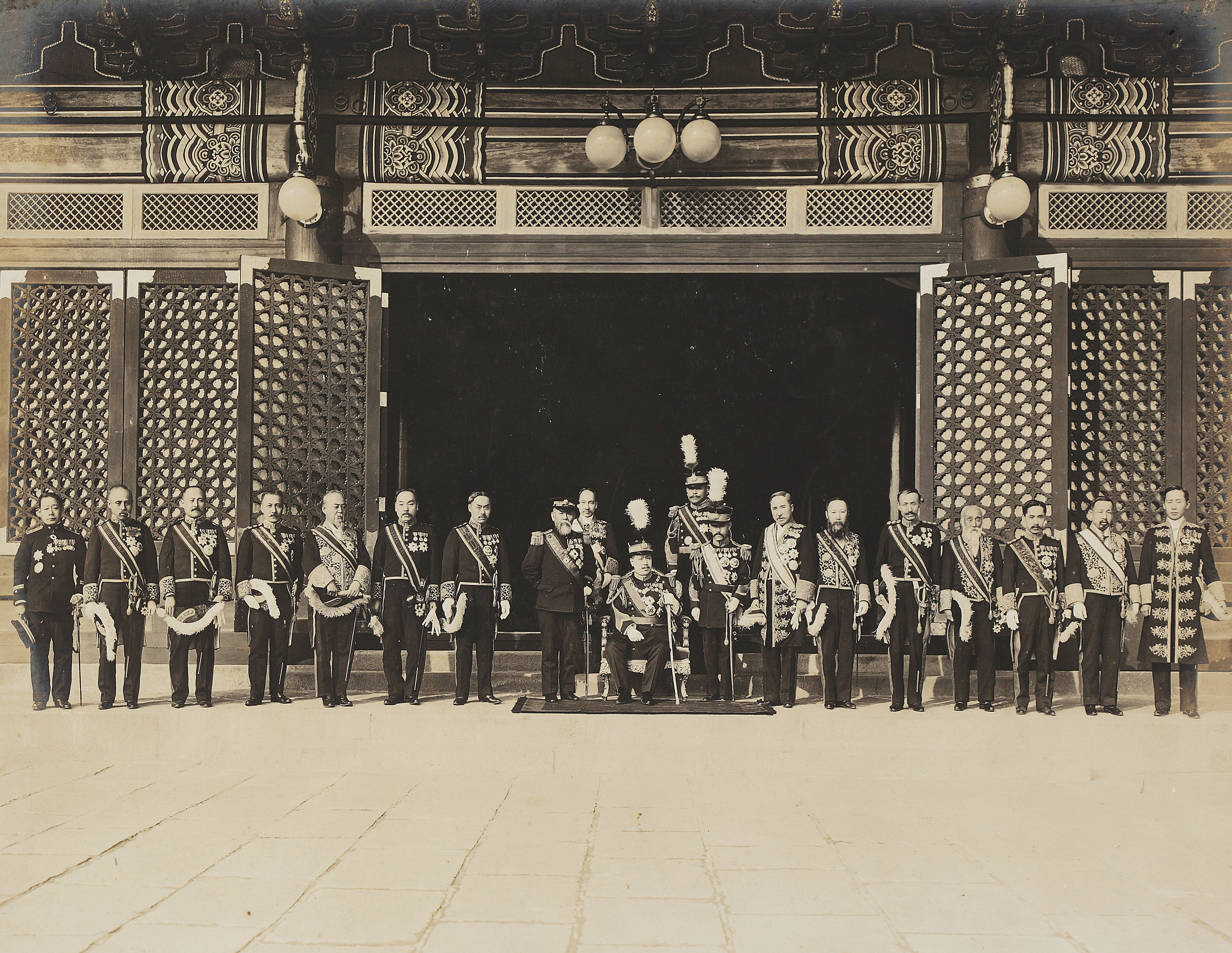
Following the annexation of Korea by Japan on October 16, 1910, Yi Jae-gak was ennobled as a Marquess (侯爵KōshakuJapanese) under the Japanese imperial peerage system for Korean aristocrats. This title was granted under the "Joseon Aristocracy Ordinance" by the Japanese government. In 1911, he received a substantial sum of 168.00 K KRW from the Japanese government as "annexation merit" compensation. The Japanese government also accorded him the treatment of a Major General in the Imperial Japanese Army, providing him with a uniform and an escort officer. He continued to participate in ceremonial duties, such as the state funeral of Emperor Gojong in 1919 and the funeral of Emperor Sunjong in 1926.
5. Honors and Awards
Yi Jae-gak received numerous honors and awards from both the Korean Empire and the Empire of Japan throughout his career, reflecting his service and affiliations.
- Korean Empire:**
- Taegukjang (태극장TaegukjangKorean) on April 12, 1904
- Order of the Plum Blossom (이화대수장IhwadaesujangKorean) on March 25, 1905
- Order of the Auspicious Stars (서성대훈장SeoseongdaehunjangKorean) on January 21, 1907
- Order of the Golden Ruler (금척대수장GeumcheokdaesujangKorean) on August 27, 1910
- Order of the Auspicious Phoenix (서봉장SeobongjangKorean) - his wife, Lady Yu, received this order on August 27, 1909.
- Empire of Japan:**
- Order of the Paulownia Flowers (勲一等旭日桐花大綬章Kun'ittō Kyokujitsu Tōka DaijushōJapanese) on April 1, 1905
- Imperial Crown Prince's Visit to Korea Commemorative Medal (皇太子渡韓記念章Kōtaishi Tokan Kinen-shōJapanese) on April 18, 1909
- Imperial Enthronement Commemorative Medal (大礼記念章Tairei Kinen-shōJapanese) on November 10, 1915
He was also granted the court rank of Shōsanmi (正三位Shōsanmi (Junior Third Rank)Japanese) by the Japanese government on January 16, 1931.
6. Family Relations
Yi Jae-gak's family background is complex due to adoptions within the royal clan.
- Adoptive Grandfather:** Punggyegun Yi Dang (풍계군 이당Punggyegun Yi DangKorean), the second son of Eun-eon-gun, who was the second son of Crown Prince Sado. Punggyegun was adopted as the heir of his half-uncle, Eunjeon-gun, Crown Prince Sado's third son.
- Biological Grandfather:** Yi Dosik (이도식Yi DosikKorean).
- Father:** Prince Wanpyeong Yi Seung-ung (완평군 이승응Wanpyeonggun Yi Seung-eungKorean, 1836-1909), son of Yi Dosik, adopted into the lineage of Punggyegun.
- Mother:** Unnamed.
- Siblings:**
- Elder brother: Inyanggun Yi Jae-geun (인양군 이재근Inyanggun Yi Jae-geunKorean, 1857-1896).
- Elder brother: Yi Jae-hyeon (이재현Yi Jae-hyeonKorean, 1870-?), adopted into the family of his biological granduncle Yi Nak-eung, a descendant of Prince Gyeongchang.
- Younger brother: Yeyangjeong Yi Jae-gyu (예양정 이재규Yeyangjeong Yi Jae-gyuKorean, 1877-?).
- Wives:**
- Lady Yu (정부인 유씨Jeongbuin Yu-ssiKorean, 1871-?), daughter of Do-sa Yu Deok-su. She received the Order of the Auspicious Phoenix.
- Another unnamed wife.
- Son:** Yi Deok-yong (이덕용Yi Deok-yongKorean, 1923-1952), who inherited his father's Marquess title from the Japanese government.
7. Death and Posthumous Evaluation
7.1. Death
Yi Jae-gak died on May 11, 1935, at the age of 62, in Keijō (present-day Seoul), then part of Korea, Empire of Japan. His death marked the end of a life that spanned the late Joseon Dynasty, the Korean Empire, and a significant portion of the Japanese colonial period.
7.2. Historical Evaluation and Pro-Japanese Activities
Yi Jae-gak's legacy is largely defined by his controversial actions during the Japanese colonial period, which led to his designation as a pro-Japanese collaborator in modern South Korea. While his family reportedly lived a wealthy life in Gyeongseong (Seoul) during the colonial era, their fortune and lineage were said to have dwindled after Korea's liberation in 1945. His villa in Samcheong-dong, Seoul, was destroyed during the Korean War.
In 2002, Yi Jae-gak was included in the "List of 708 Pro-Japanese Collaborators." He was also selected for inclusion in the "Preliminary List of Pro-Japanese Collaborators" compiled by the Research Institute for Pro-Japanese Activities in 2005, which later formed the basis for the Dictionary of Pro-Japanese Collaborators. Furthermore, in 2007, the Presidential Committee for the Investigation of Pro-Japanese Collaborators (PCIC) officially listed him among the "195 Pro-Japanese Anti-National Collaborators." His son, Yi Deok-yong, who inherited the Marquess title, was also included in the Research Institute for Pro-Japanese Activities' list, further cementing the family's association with collaboration during the colonial period. These evaluations critically assess his acceptance of a Japanese peerage and financial compensation, viewing them as acts that undermined Korean sovereignty and supported colonial rule.