1. Early Life and Background
Maurice Garin's early life was characterized by his family's move from Italy to France and his initial work as a chimney sweep, before he embraced French nationality and a cycling career.
1.1. Birth and Family
Maurice Garin was born on March 3, 1871, in Arvier, located in the French-speaking Aosta Valley in northwestern Italy, close to the French border. He was the first son of Maurice-Clément Garin and Maria Teresa Ozello. The surname Garin was common in his native village, "Chez-les-Garin," where five of the seven families shared the name. His parents had a large family, comprising four daughters and five sons.

1.2. Early Work and Naturalization
In 1885, when Maurice was 14, his family left Arvier to seek work on the other side of the Alps, moving closer to the Belgian border. Maurice initially worked as a chimney sweep. By the age of 15, he was living in Reims, France, continuing his trade as a chimney sweep. He later moved to Charleroi in Belgium, but by 1889, he was back in France, settling in Maubeuge.
Tragedy struck his family in 1889 with the death of his younger brother, Joseph-Isidore, followed shortly by his father's death in Arvier. Maurice, along with his brothers François and César, remained in northern France. In 1895, the three brothers opened a cycle shop on the boulevard de Paris in Roubaix. His younger brothers, César and Ambroise, also became professional cyclists. Maurice Garin purchased his first bicycle in 1889 for 405 FRF, an amount equivalent to two weeks' wages for a forge worker at the time. He initially had little interest in competitive racing but was known for riding fast enough around town to be nicknamed le fou, or "the madman." In 1902, Garin moved to Lens, Pas-de-Calais, where he would live for the remainder of his life. He officially adopted French nationality on December 21, 1901, after previously being thought to have naturalized in 1892.
2. Cycling Career
Maurice Garin's cycling career evolved from amateur victories to professional dominance in long-distance races, culminating in his historic Tour de France win and subsequent controversy.
2.1. Amateur Career
Garin embarked on his racing journey in northern France in 1893. The secretary of the cycling club in Maubeuge encouraged him to enter a local race, the 200 124 mile (200 km) Maubeuge-Hirson-Maubeuge event. Despite struggling with the sun, Garin finished fifth, which inspired him to pursue more races. His first official victory came later that year in the Namur-Dinant-Givet race in Belgium. For this race, he sold his initial bicycle and acquired a lighter one, weighing 35 lb (16 kg) but equipped with pneumatic tires, for 850 FRF (approximately €3,000 at 2008 values). During the 63 mile (102 km) race, while leading in Dinant, he suffered a puncture. Resourcefully, he spotted a soigneur with a spare bicycle intended for a rival, rested his own bike against a bridge wall, and took the spare, riding off to victory. He crossed the finish line ten minutes ahead of the field, returning the borrowed bicycle and retrieving his own the following day.
2.2. Early Professional Career
Garin's transition to professional cycling occurred somewhat by chance. He arrived at a race in Avesnes-sur-Helpes, 16 mile (25 km) from his home, only to discover it was exclusively for professional riders. Undeterred, he waited for the official start, then raced after the participants, passing all of them. Despite two falls, he finished ahead of the field. The enthusiastic crowd, witnessing his unofficial triumph, raised 300 FRF (approximately €1,050 at 2008 values) for him after the organizers refused to award him the 150 FRF due to the official winner. This impromptu victory propelled him into the professional ranks.
His first true professional win was a 24-hour race held in Paris in 1893, on the Champ de Mars near the Eiffel Tower. In this endurance event, riders competed behind pacers. The race, held in February, was exceptionally cold, causing many riders to withdraw. Garin demonstrated remarkable resilience, covering 436 mile (701 km) within 24 hours, finishing an impressive 30 mile (49 km) ahead of the only other competitor to complete the race. While many of his rivals relied on strong red wine for sustenance, Garin adhered to a distinct diet, reportedly consuming:
- 19 L hot chocolate
- 7 L tea
- Mixed champagne and coffee
- 5 L tapioca
- 4.4 lb (2 kg) rice
- 45 cutlets
- 8 hardboiled eggs
- Oysters
In 1894, he won another 24-hour race in Liège, Belgium, and in 1895, he set an hour record for cycling behind pacers.
2.3. Major Classic Victories
Garin achieved significant success in several prestigious one-day and long-distance road races. In the inaugural Paris-Roubaix in 1896, he secured third place, finishing 15 minutes behind the winner, Josef Fischer. His chances for second were hampered by a crash involving two tandems, one of which was ridden by his pacers, which knocked him over. The race historian Pascal Sergent noted that Garin "finished exhausted and Dr Butrille was obliged to attend the man who had been run over by two machines."

He won Paris-Roubaix in 1897, famously overcoming the Dutchman Mathieu Cordang in the final two kilometers of the velodrome at Roubaix. As the two champions entered the velodrome, they were met with immense excitement. Sergent described the dramatic finish: "As the two champions appeared they were greeted by a frenzy of excitement and everyone was on their feet to acclaim the two heroes. It was difficult to recognise them. Garin was first, followed by the mud-soaked figure of Cordang. Suddenly, to the stupefaction of everyone, Cordang slipped and fell on the velodrome's cement surface. Garin could not believe his luck. By the time Cordang was back on his bike, he had lost 328 ft (100 m). There remained six laps to cover. Two miserable kilometers in which to catch Garin. The crowd held its breath as they watched the incredible pursuit match. The bell rang out. One lap, there remained one lap. 1093 ft (333 m) for Garin, who had a lead of 98 ft (30 m) on the Batave." Garin held on to a slender two-meter lead for a legendary victory, while Cordang wept tears of disappointment.
Garin clinched his second Paris-Roubaix title in 1898, this time with a dominant 20 minutes lead. In 1901, he won the second edition of Paris-Brest-Paris, covering 0.8 K mile (1.21 K km) in 52 hours, 11 minutes, and 1 second, finishing nearly two hours ahead of Gaston Rivierre. He notably chased down fellow Frenchman Lucien Lesna, who had a two-hour lead at Brest after riding the first 373 mile (600 km) at 17 mph (28 km/h). Lesna, exhausted and suffering from the heat, eventually gave up with 124 mile (200 km) remaining after Garin passed him at Mayenne. Garin's finish time was 19 hours and 11 minutes faster than Charles Terront's record set ten years prior. In 1902, Garin added the Bordeaux-Paris title to his achievements, a challenging 311 mile (500 km) race originating from southwestern France.
2.4. Tour de France Participation
Maurice Garin's participation in the early Tour de France races defines a critical chapter in his career and the history of cycling.
2.4.1. 1903 Tour de France Victory
The inaugural 1903 Tour de France was created by the newspaper L'Auto to promote itself against its larger rival, Le Vélo, which sold 80,000 copies daily. L'Autos initiative arose partly because some of Le Vélos advertisers disagreed with the paper's support for Alfred Dreyfus, a soldier accused of selling secrets. The editor of L'Auto, Henri Desgrange, initially envisioned a five-week race from May 31 to July 5. However, this proved too daunting for potential participants, with only 15 riders initially entering. Desgrange responded by shortening the race to 19 days and offering a daily allowance to attract more competitors.
The race commenced at the Au Reveil Matin café at a crossroads in Montgeron, south of Paris. It traversed France in six stages, covering a total distance of 1.5 K mile (2.43 K km), concluding in Ville-d'Avray, another Paris suburb. One of the stages, from Nantes to Paris, was particularly grueling, stretching 293 mile (471 km). Sixty riders began the race, each paying an entry fee of 10 FRF (approximately €87.50 in 2008 values). Of these, only 21 managed to finish.
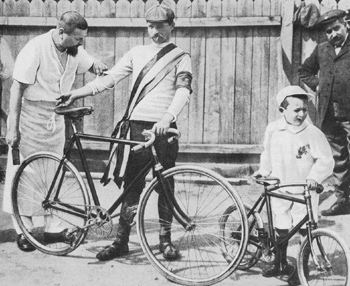
Maurice Garin emerged as the dominant victor, completing the race in 94 hours, 33 minutes, and 14 seconds. He finished an astonishing 2 hours, 49 minutes, and 21 seconds ahead of the second-place rider, Lucien Pothier, with Fernand Augereau coming in third. For his overall victory, Garin received 3.00 K FRF (approximately €10,500 at 2008 values), and his total winnings, including other prizes, amounted to 6.13 K FRF (approximately €21,500 at 2008 values). While the iconic yellow jersey was not yet used, Garin wore a green armband as the leader.
Following his triumph, a large procession was organized in Lens, the town that adopted Garin, with notable figures from the region participating. Reflecting on his monumental achievement, Garin provided a written statement to Henri Desgrange, stating: "The 1.6 K mile (2.50 K km) that I've just ridden seem a long line, grey and monotonous, where nothing stood out from anything else. But I suffered on the road; I was hungry, I was thirsty, I was sleepy, I suffered, I cried between Lyon and Marseille, I had the pride of winning other stages, and at the controls I saw the fine figure of my friend Delattre, who had prepared my sustenance, but I repeat, nothing strikes me particularly." He concluded by noting that "one single thing sticks in my memory: I see myself, from the start of the Tour de France, like a bull pierced by banderillas, who pulls the banderillas with him, never able to rid himself of them."
2.4.2. 1904 Tour de France and Disqualification
Maurice Garin initially claimed victory in the 1904 Tour de France, winning by a narrow margin over Lucien Pothier. However, this edition of the race was marred by widespread controversy and allegations of cheating, leading to a significant scandal. The intense passion among spectators escalated into violence, with some felling trees to block rivals and physically assaulting riders at night, notably outside Saint-Étienne. Garin himself became a victim of this mob violence; during the climb of the col de la République outside Saint-Étienne, supporters of a regional rider named Faure attacked the Italian rider Gerbi, throwing him to the ground and beating him, resulting in a broken finger. A group of fanatics wielding sticks and shouting insults also set upon other riders, including Maurice and César Garin, with Maurice being struck in the face with a stone. This erupted into general chaos, with shouts of "Up with Faure! Down with Garin! Kill them!" ultimately requiring intervention and pistol shots from arriving cars to allow the riders to proceed. Reflecting on the tumultuous race, Garin famously declared, "I'll win the Tour de France provided I'm not murdered before we get to Paris."
Misconduct was not limited to spectators; widespread cheating among riders was also reported. Nine riders were expelled during the race for various offenses, including riding in or being pulled by cars. There were also claims that the race organizers had unfairly permitted Garin to break rules, such as receiving food in unauthorized areas, allegedly due to his sponsor, La Française, having a financial stake in the race.
The Union Vélocipédique Française (UVF), the French cycling union, launched a comprehensive investigation after the race, interviewing dozens of competitors and witnesses. In December 1904, the UVF took drastic action, disqualifying all stage winners and the top four overall finishers: Maurice Garin, Lucien Pothier, César Garin, and Hippolyte Aucouturier. While the UVF never publicly stated the precise details of what transpired, the official records and specific justifications for the disqualifications were lost when Tour archives were moved south in 1940 to evade the German invasion and were never recovered. Stories circulated about various forms of cheating, including riders spreading tacks on the road to cause punctures, poisoning rivals, or being threatened by competitors wielding revolvers. Tales of Garin himself taking a train during the race were also recounted by a cemetery attendant who, as a boy, heard Garin tell these stories in his old age. As a result of the investigation, Garin was stripped of his 1904 title and banned from competitive cycling for two years. This ban effectively ended his professional career, as he was 34 at the time and never regained his former prominence in the peloton. Despite the controversy, Garin was considered the strongest rider of his era, a "little and stubborn rider of formidable consistency" who won "all the races that mattered," described as "intelligent, crafty, instinctive and calculating."
3. Retirement and Later Life
After his professional cycling career, Maurice Garin transitioned into new ventures, maintaining an interest in the sport while experiencing the natural changes of aging.
3.1. Retirement Activities
Following his ban from cycling, Maurice Garin retired from professional competition and dedicated himself to running his garage and service station located at 116 rue de Lille in Lens, Pas-de-Calais. This garage continues to exist today, although it has undergone significant changes since Garin's time. An unnamed contemporary recalled Garin as "Le Père Garin" (Father Garin), a dated term of respect, who would sit outside his garage in good weather under the sign for Antar fuel and oil. The recollection highlights that Garin was not seen as an "adulated hero" or a "rich champion" in his retirement; he continued working at his service station, and there were no special celebrations in his honor during his lifetime. Television crews did not seek interviews with him until his death in 1957, and the street where he lived was never renamed in his honor.
Despite his retirement from racing, Garin maintained a keen interest in cycling. He made only one return visit to his birthplace in Arvier, in 1949, specifically to witness the Tour de France passing through. After World War II, he even established a professional cycling team under his own name. Dutch cyclist Piet van Est notably won the Bordeaux-Paris race in both 1950 and 1952 while riding in Garin's team's distinctive red and white jersey. In 1953, on the 50th anniversary of the Tour de France, Garin was among several former stars invited to the finish line as part of the celebratory events.
3.2. Later Life and Declining Health
In his later years, Maurice Garin's health began to decline. He notably experienced memory confusion and disorientation. His biographer, Franco Cuaz, recounted that Garin would often wander through Lens, asking aloud, "Where is the control? Where is the control?" as his mind seemed to relive moments from the early Tours de France, specifically recalling the hotels where riders would sign their check sheets. This confusion sometimes led him to the town's police station, from where he would be escorted back home. He was frequently found far from his residence, without knowing his location or destination.
4. Death and Legacy
Maurice Garin passed away in 1957, leaving behind a complex legacy as a pioneering cyclist whose career was marked by both historic triumphs and notable controversies. His contributions to the sport continue to be recognized through various tributes and historical assessments.
4.1. Death
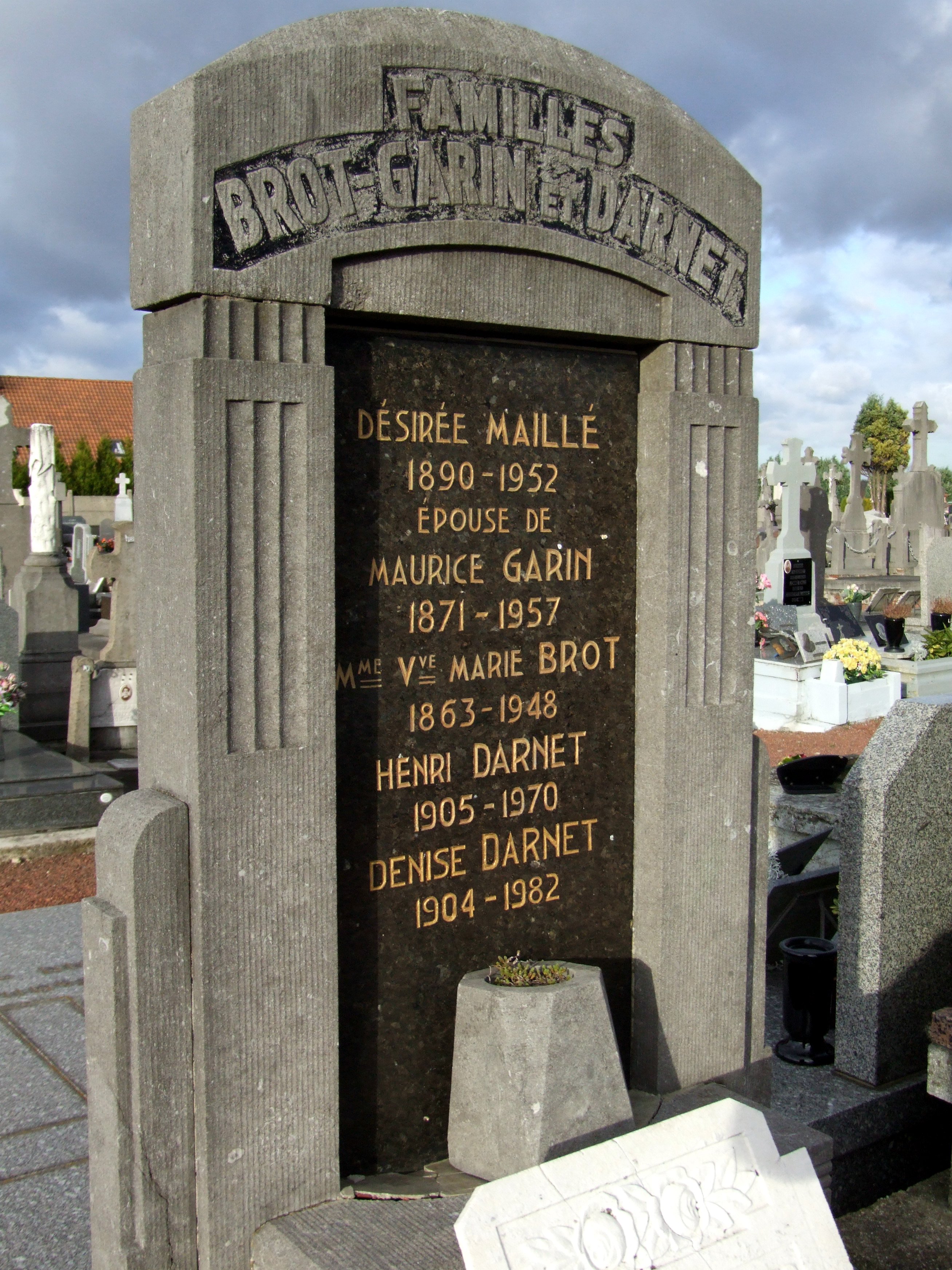
Maurice Garin died on February 19, 1957. He is buried in a family grave alongside his wife, Desirée Maille (1890-1952), in Sallaumines, a commune near Lens. The inscription on their headstone reads: "Familles Brot, Garin et Darnet. Desirée Maille (1890-1952), - Épouse de Maurice Garin (1871-1957) Mme Vve Marie Brot, (1863-1948) Henri Darnet (1905-1970) Denise Darnet (1904-1982)."
4.2. Commemorations and Tributes
Maurice Garin has been honored in various ways since his death, solidifying his place in cycling history. In 1933, the Stade Vélodrome Maurice Garin was constructed in Lens and named in his honor. Although it was later razed and rebuilt in 1990, and reopened by the then-Minister of Youths and Sports, Roger Bambuck, it faced potential demolition again in 2007 as part of a reconstruction project in Lens. In 1938, Garin received the gold medal of Physical Education from Leo Lagrange, the French Minister of Sport.
On the 100th anniversary of his 1903 Tour de France victory in 2003, a street in Maubeuge was named after him. The following year, in 2004, a cycling association known as Les Amis de Paris-Roubaix placed a cobblestone on his grave, a symbolic gesture as cobblestones are the traditional trophy for winners of the Paris-Roubaix race, which Garin won twice. In Arvier, his birthplace in Italy, a monument stands in his honor. His biographer, Franco Cuaz, noted the enduring reverence for Garin in his hometown, stating that "Every year, the municipality sends me French people who want to see the house where he was born. It's like a pilgrimage."
4.3. Historical Evaluation
Maurice Garin is remembered as a determined, and at times authoritarian, individual. He was widely considered the strongest rider of his era, a "little and stubborn rider of formidable consistency" who achieved victories in "all the races that mattered." His historic win in the inaugural 1903 Tour de France cemented his legendary status and established him as a foundational figure in the sport's most iconic event. This victory showcased his immense endurance and strategic prowess, setting the standard for future champions.
However, his legacy is also inextricably linked to the controversies of the 1904 Tour de France, particularly his disqualification for cheating. While the exact details of the allegations remain debated due to lost archives, the incident profoundly impacted his career and highlighted the nascent struggles with integrity in professional cycling's early days. Despite the tarnishing effect of the disqualification, Garin's pioneering spirit, his dominance in grueling endurance races like Paris-Roubaix and Paris-Brest-Paris, and his role as the first Tour de France champion ensure his enduring significance in cycling history. He is remembered as an intelligent, crafty, instinctive, and calculating rider whose achievements laid the groundwork for modern professional cycling.
5. Career Statistics
Maurice Garin's career as a professional cyclist spanned over a decade, marked by numerous victories in prestigious road races and his foundational role in the Tour de France.
5.1. Major Results
- 1893
- Dinant-Namur-Dinant
- Paris 50 mile (80 km) (velodrome)
- 1894
- Liège 24hr (velodrome)
- Paris-Saint-Malo
- 1895
- 24hr Arts libéraux de Paris (velodrome)
- Guingamp-Morlaix-Guingamp
- World record 311 mile (500 km) behind human pacer on the road 15h 2m 32s
- 1896
- Paris-Le Mans
- Paris-Mons
- Liège-Thuin
- 3rd Paris-Roubaix
- 1897
- Paris-Roubaix
- Paris-Royan
- Paris-Cabourg
- Tourcoing-Béthune-Tourcoing
- 1898
- Paris-Roubaix
- Tourcoing-Béthune-Tourcoing
- Valenciennes-Nouvion-Valenciennes
- Douai-Doullens-Douai
- 31 mile (50 km) Ostend (velodrome)
- 2nd Bordeaux-Paris
- 1899
- 3rd Bordeaux-Paris
- 3rd Bol d'Or (velodrome)
- 1900
- 2nd Bordeaux-Paris
- 2nd Bol d'Or
- 3rd Paris-Roubaix
- 1901
- Paris-Brest-Paris
- 1902
- Bordeaux-Paris
- 1903
- Tour de France
- Winner overall classification
- Winner 3 stages
- Tour de France
5.2. Grand Tour General Classification Results Timeline
| Grand Tour | 1903 | 1904 |
|---|---|---|
| Tour de France | 1 | DSQ |
| Giro d'Italia | N/A | N/A |
| Vuelta a España | N/A | N/A |