1. Playing Career
John Mitchell had a notable career as a rugby player, primarily known for his time with the Waikato provincial team and his uncapped appearances for the All Blacks.
1.1. Early Life and Provincial Career
Born on 23 March 1964 in Hāwera, New Zealand, John Mitchell attended Francis Douglas Memorial College in New Plymouth, where he was part of the first XV rugby team. During his high school years, he also excelled in basketball, being a member of the New Zealand secondary schools basketball team from 1981 to 1983 and the New Zealand Juniors basketball team in 1982-83. Despite his success in basketball, he decided to focus on rugby.
At 19, he earned a place at King Country RFU before joining Fraser-Tech in 1984. He was quickly selected for the Waikato Colts and made his senior debut for Waikato in 1985. Throughout his provincial career, he played at number eight, blindside flanker, and lock, eventually becoming firmly established as a number eight. Mitchell was an equal top scorer in first division rugby during the 1989-90 seasons, scoring more tries than any other New Zealand first division player.
He was appointed Waikato captain in 1989. Although a broken leg limited him to playing only half of the games in the 1990 season, he was reappointed captain in 1991 and continued in the role until his retirement just before the 1995 season. In total, he played 134 games for Waikato, serving as captain a record 86 times, and scored 335 points from 67 tries. During the off-season, Mitchell played club rugby in France and Ireland, including a period with Garryowen in the All-Ireland League, where his team finished second in the 1990-91 season to Cork Constitution.
1.2. All Blacks Career
In 1993, at the age of 29, Mitchell was selected for the All Blacks squad for their tour of Britain. Despite this significant achievement, he never played for the All Blacks at test level, meaning he did not earn an official "cap". His selection came relatively late in his playing career, and he did not manage to secure a regular starting position.
During the 1993 tour, he featured in six uncapped matches. His first appearance was on 26 October 1993 against a Midland Division side, which the All Blacks won 12-6. He later captained the team on three occasions, all of which resulted in victories: 31-12 against a Scottish Development XV, 30-19 against England Emerging Players, and 13-3 against Combined Services.
1.3. Playing Honours
- National Provincial Championship
- Winners: 1986 (Second Division), 1992 (First Division)
2. Coaching Career
John Mitchell transitioned from a successful playing career to an extensive and varied coaching career that has spanned multiple clubs and national teams across different continents.
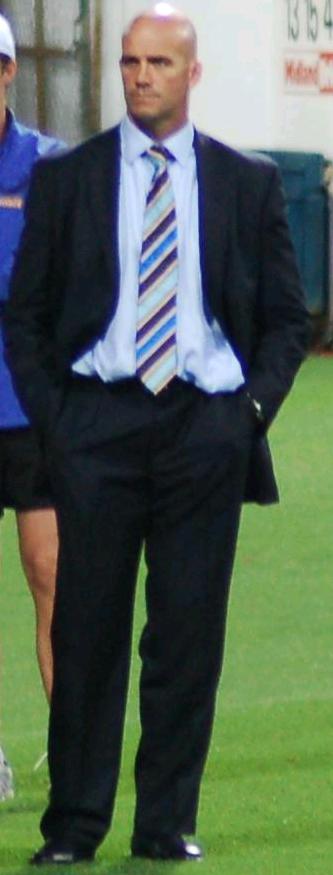
2.1. Early Coaching Roles (Fraser Tech, Ireland, Sale Sharks)
Even before his official retirement as a player in 1995, Mitchell began his coaching journey as a player/coach at Fraser Tech. In January 1996, he took on a more formal coaching role when Murray Kidd, the newly appointed coach of the Ireland national team, hired Mitchell as a technical advisor and forwards coach.
In May 1996, Mitchell joined Sale Sharks in England, brought in by then-coach Paul Turner. When Turner stepped down at the end of the 1995-96 season, Mitchell took charge of Sale, leading the team until 1999. Following internal issues at Sale, his contract was bought out, leading to his departure.
In 1997, Mitchell was approached by Clive Woodward, the new head coach of England, to serve as the national team's forwards coach, a position he held until 2000.
2.2. New Zealand (Chiefs and All Blacks)
In late 2000, Mitchell returned to New Zealand to become the new head coach of the Chiefs in the Super 12 competition. Under his leadership, the Chiefs finished sixth in the table.
In October 2001, Mitchell was appointed head coach of the New Zealand national side, commonly known as the All Blacks, taking over from Wayne Smith. His contract was set to run until the conclusion of the 2003 Rugby World Cup. Mitchell focused on rejuvenating the All Blacks squad by introducing younger players. Under his guidance, the team achieved an impressive record of 23 wins, 4 losses, and 1 draw from 28 matches, resulting in an 82% win rate.
Mitchell's first match in charge of the All Blacks was a 40-29 victory over Ireland in Dublin in November 2001. This was followed by wins against Scotland (37-6) and Argentina (24-20). In 2002, the All Blacks were unable to reclaim the Bledisloe Cup, a trophy they had not won since 1997. However, they successfully reclaimed the trophy a year later in 2003 by winning both matches against Australia.
At the 2003 Rugby World Cup, Mitchell led the All Blacks to a third-place finish. They dominated their group stage, securing victories over Italy, Canada, Tonga, and Wales to top Pool D. In the quarterfinals, the All Blacks defeated the Springboks 29-9. However, their campaign ended in the semifinal with a 22-10 loss to the host nation, Australia. Following this loss, Mitchell's tenure as All Blacks coach concluded. The NZRU cited Mitchell's challenging relationships with the media and sponsors, rather than the team's performance, as the primary reasons for seeking new head coaching candidates.
2.3. Waikato (Second Stint)
After departing from the All Blacks, Mitchell returned to coach his former provincial team, Waikato, ahead of the 2004 National Provincial Championship. In his first season back, Waikato reached the semi-finals but lost 28-16 to Wellington. In the 2005 season, the team finished seventh after the regular season and failed to qualify for the play-offs.
2.4. Australia (Western Force)
In 2006, Mitchell made history by becoming the first New Zealander to coach an Australian Super Rugby franchise, taking the helm of the Western Force in their inaugural season in the expanded Super 14 competition. The Western Force finished last in their debut season, securing only one victory in Round 13 against the Cheetahs, winning 16-14. In their second season, they improved significantly, climbing to seventh on the table with six victories. However, the team's performance declined in the 2008, 2009, and 2010 seasons, and Mitchell was released as coach in 2010.
2.5. South Africa (Golden Lions/Lions and Bulls)
Mitchell then took up a coaching role in South Africa, initially as the head coach of Golden Lions, before returning to the Super Rugby competition in 2011 with the Lions. On 29 October 2011, he led the Golden Lions to victory in the 2011 Currie Cup final against a strong Sharks team led by fellow Kiwi John Plumtree in Johannesburg. Despite the Sharks featuring a full Springbok front row and seven other Springboks, the Golden Lions triumphed 42-16, securing their first Currie Cup Championship in 12 years and their first Currie Cup title on their home field in 61 years.
On 22 June 2012, Mitchell was suspended following complaints from Lions players regarding his treatment of them. In November, he was found not guilty of all charges and reinstated as the Lions head coach. However, on 23 November 2012, he resigned as coach to become a technical advisor at the Lions. On 28 November 2012, after two seasons with the Lions, Mitchell accepted a position at Sale Sharks in the United Kingdom. However, on 29 December 2012, Sale announced that Mitchell had returned to South Africa, citing "personal reasons."
Following the 2015 Rugby World Cup, Mitchell applied for the vacant head coach position of the England national team but the role was ultimately given to Eddie Jones. On 25 May 2017, it was announced that Mitchell would return to South Africa to become the Executive of Rugby at the Blue Bulls, and subsequently replaced Nollis Marais as the head coach of the Bulls Super Rugby franchise. In August 2017, he also took over from Marais as the head coach of the Blue Bulls Currie Cup side. In what would be his only season with the Blue Bulls and Bulls, he led the Currie Cup side to fourth place on the table.
2.6. United States National Team (Eagles)
On 4 January 2016, USA Rugby announced John Mitchell as the new head coach of the USA Eagles, succeeding Mike Tolkin on a four-year contract.
Mitchell's first match in charge was an uncapped game against Argentina XV in the inaugural Americas Rugby Championship, which ended in a 35-35 draw. The USA team in this match included 11 uncapped players. A week later, Mitchell led the USA to a 30-22 victory over Canada, marking the American's fourth consecutive win against their rivals. On 20 February, the USA temporarily topped the table with a dominant 64-0 victory over Chile. However, they lost that position a week later after a surprising 24-23 defeat to Brazil in Barueri, where Brazil secured a last-minute penalty to earn their first-ever victory over a Tier 2 nation. On 5 March, Uruguay defeated the Eagles 29-25 in Montevideo, marking their first victory over the Americans since 2002. The USA concluded the championship in second place with 15 points, 7 points behind champions Argentina XV.
In June 2016, the United States put up a strong performance against Italy, losing narrowly 24-20. A week later, they defeated rivals Russia 25-0. During the 2016 November internationals, Mitchell gave six players their international debut across two test matches. The United States lost both matches, 23-10 to Romania and 20-17 to Tonga. They were also defeated 54-7 by the Māori All Blacks at Toyota Park.
In March 2017, Mitchell guided the United States to their first-ever Americas Rugby Championship title. They secured victories over Brazil (51-3), Canada (51-34), Chile (57-9), and Uruguay (29-23) leading into the final week. Both the United States and Argentina XV were level on points before the championship decider, which ended in a draw for the second consecutive year. A bonus-point try in overtime helped the United States level the score, allowing them to finish with 22 points to Argentina's 21 and claim the title. This marked the US's first major tournament victory since the 1924 Olympics.
Mitchell also played a key role in the United States' qualification for the 2019 Rugby World Cup as Americas 1. This was the first time the States had qualified directly as Americas 1, having previously qualified as Americas 2 or 3. Their qualification came after drawing the first leg against Canada at home 28-28, followed by a decisive 52-16 victory in the return fixture in San Diego.
2.7. International Assistant Coach Roles (England Men's Team and Japan Team)
In September 2018, Mitchell left his position with the South African franchise, and became defense coach for the England national team. He was widely credited for his contributions to England's strong performance at the 2019 Rugby World Cup, where they reached the final. Mitchell was recognized as a rare and versatile coach capable of coaching both attack and defense at an elite level.
In February 2022, Mitchell joined the Japan national team as their defense coach, contributing to their preparations for the Rugby World Cup.
2.8. England Women's National Team (Head Coach)
Mitchell was appointed the head coach of the England women's team, known as the Red Roses, after the 2023 Rugby World Cup. He began his involvement with the team during the 2023 WXV tournament, although he officially took over as head coach after the tournament concluded.
2.9. Coaching Honours
New Zealand National Team
- Rugby World Cup / Webb Ellis Cup
- Third Place: 2003 Rugby World Cup
- Tri Nations Series
- Winners: 2002, 2003
- Bledisloe Cup
- Winners: 2003
- Dave Gallaher Trophy
- Winners: 2002, 2003
Golden Lions
- Currie Cup
- Winners: 2011
United States National Team
- Americas Rugby Championship
- Winners: 2017
- Runners-up: 2016
3. Personal Life
John Mitchell's son, Daryl, has played international cricket for New Zealand.
In October 2010, while staying at an apartment in Johannesburg, South Africa, Mitchell was involved in a robbery incident. He was attacked and sustained stab wounds to his thigh and arm but was able to return to his duties after receiving stitches at a hospital.