1. Early Life and Background
Saint Philomena's traditional narrative, primarily derived from the private revelations of Maria Luisa di Gesù, describes her as the daughter of a king from a small state in Greece. Her parents, who were of noble lineage, had long been unable to conceive children. According to the account, a Roman physician named Publius, who was a Christian, took pity on their plight. He encouraged them to convert to Christianity and be baptized, promising them a child if they embraced the faith of Jesus Christ. Grace accompanied his words, leading to their conversion and baptism along with several members of their court.
Philomena was born on January 10, 289. She was named 'Lumina' because she was conceived and born into the light of faith, but her parents affectionately called her 'Philomena', meaning "Daughter of Light," in reference to the light of Christ within her soul through baptism. Her birth and her parents' conversion led many families in their kingdom to embrace Christianity. Philomena grew up immersed in the teachings of the Gospel, which profoundly influenced her heart. At the tender age of five, she received the Eucharist for the first time, and from that day forward, a deep desire to be eternally united with Christ, the "Spouse of virgins," was instilled within her. By the age of eleven, she made a solemn vow of virginity to Him.
Her peaceful life and her father's kingdom were disrupted when she was thirteen years old. The powerful Emperor Diocletian, who was known for his severe persecution of Christians, unjustly declared war on her father's territory. Recognizing his inability to confront Diocletian's might, Philomena's father decided to travel to Rome to seek a peace treaty. Due to his profound affection for his daughter, he could not bear to be without her and brought Philomena and her mother along to Rome.
2. Discovery of Remains
The remains attributed to Saint Philomena were discovered on May 24, 1802, in the Catacombs of Priscilla on the Via Salaria Nova in Rome. An inscribed loculus (a hollowed-out space in the rock) was found, sealed with three terracotta tiles. The inscription on these tiles read: "lumena paxte cumfi." It was widely accepted that the tiles had been misplaced, and when reordered, the inscription correctly read: "Pax tecum FilumenaLatin", meaning "Peace with you, Philomena."
Inside the loculus, archaeologists found the skeleton of a female, estimated to be between thirteen and fifteen years old. Near her head, a small glass vial containing vestiges of what was believed to be blood was found embedded in the cement. At the time, such vials were commonly interpreted as a sign of a martyr's grave, a belief that was later questioned by scholars like Giovanni Battista De Rossi but has found advocates more recently, such as theologian Mark Miravalle. The presence of a palm branch and three arrows on the tiles were also interpreted as symbols of her martyrdom and virginity.
In 1805, Canon Francesco De Lucia of Mugnano del Cardinale requested the relics for his oratory. On June 8, he obtained the remains, which by then had been reduced to dust and fragments. The relics arrived in Mugnano del Cardinale on August 10, 1805, a date which later became associated with her feast day. They were initially placed in the Church of Our Lady of Grace. A new Church of Our Lady of Grace was subsequently built, and the sacred relics were moved to a dedicated chapel within it on September 29, 1805. In 1827, Pope Leo XII further honored the church in Mugnano del Cardinale by giving it the three inscribed terracotta slabs taken from the tomb.
3. Life and Tradition (Legend)
This section details the hagiographical account of Saint Philomena's life, including her family background, her vow of virginity, and the persecutions and martyrdom she endured under Emperor Diocletian, as revealed through private revelations.
The detailed narrative of Saint Philomena's life and martyrdom is primarily derived from the private revelations received by Maria Luisa di Gesù, a Dominican tertiary from Naples. On December 21, 1833, the Holy Office declared that these revelations contained nothing contrary to Catholic faith, thus allowing their dissemination. According to Maria Luisa di Gesù, Philomena herself recounted her story.
3.1. Family Background and Faith
Philomena stated that she was the daughter of a king ruling a small state in Greece. Her mother also came from a noble family. For many years, her parents were unable to have children, and they continuously offered sacrifices and prayers to their pagan gods. A Roman physician named Publius, who was a Christian, took pity on their childlessness and their spiritual blindness. Inspired by the Holy Spirit, he spoke to them about the Christian faith, promising them a child if they were baptized and embraced Jesus Christ. His words were accompanied by grace, enlightening their minds and softening their hearts. They accepted his counsel, underwent instruction, and were baptized along with several members of their court.
On January 10, Philomena was born, exactly one year after her parents' conversion. She was named 'Lumina', signifying that she was conceived and born into the light of faith, which had transformed her parents into true worshippers of God. They lovingly called her 'Philomena', meaning "Daughter of Light," in reference to the light of Christ that resided in her soul through the grace of her baptism. Her birth inspired many families in her kingdom to convert to Christianity. Philomena was raised in the teachings of the Gospel, which deeply imprinted upon her heart. At the age of five, she received her First Eucharist, and from that day, a profound desire to be forever united with her Redeemer, the Spouse of virgins, took root in her heart. By the age of eleven, she consecrated herself to Him with a solemn vow of virginity.
3.2. Vow of Virginity and Rejection of Emperor's Proposal
When Philomena reached her thirteenth year, the peace that had reigned in her father's house and kingdom was disrupted by the arrogant and powerful Emperor Diocletian, who unjustly declared war on them. Her father, realizing he could not oppose Diocletian, decided to go to Rome to negotiate a peace treaty. Such was his tender affection for Philomena that he could not bear to be without her, so he brought her and her mother with him to Rome.
Upon their arrival, Philomena's father sought an audience with the Emperor. On the appointed day, he brought his wife and daughter to the imperial palace. As her father pleaded his case and denounced the injustice of the threatened war, the Emperor's gaze remained fixed on Philomena. Eventually, Diocletian interrupted her father, saying with apparent compassion, "Do not grieve any longer. Your anxieties will soon end... be at peace. You shall have the full power of the Empire to protect you and your country, if you accept only one condition: give me your daughter Philomena as your wife." Her parents immediately accepted the proposal. Philomena remained silent, as it was inappropriate to contradict her father before the Emperor, but deep in her heart, she resolved to remain faithful to her Spouse, Jesus, regardless of the risk.
Her parents, overjoyed, believed everything was settled. However, upon leaving the Emperor's palace, Philomena respectfully informed them that she would not accept Diocletian's proposal, no matter how grand her future might be. They tried countless ways to persuade her, emphasizing the immense fortune of becoming Empress of Rome. Without hesitation, she rejected the enticing offer, stating that she was committed to Jesus Christ and had married Him by taking a solemn vow of virginity at the age of eleven. Her father attempted to coerce her, arguing that as a young girl, she had no right to govern herself, and he used all his authority to make her accept. Yet, her Divine Spouse granted her the strength to persevere in her resolve. When her mother saw that she would not yield, she pleaded with tears, begging Philomena to have pity on her father, herself, and their country. Philomena replied with a firmness that surprised her: "God is my father and Heaven is my mother."
Her parents were unable to sway her. Faced with her unwavering will, they were disarmed. Their greatest concern was that her refusal might be interpreted by the Emperor as a pretext of bad faith. Philomena wept, telling them, "Do you wish me, for the love of a man, to break the promise I have made to Jesus Christ? My virginity belongs to Him, and I can no longer dispose of it." They argued that she was too young for such a commitment and resorted to terrible threats to make her accept the marriage. When her father finally had to inform the Emperor of her decision, Diocletian ordered her to be brought before him. Philomena initially refused to go. Seeing her so resolute, her parents fell to her feet, imploring her to accept, saying, "Daughter, have pity on us! Have pity on your country and your kingdom!" She replied, "God and the Virgin first. My kingdom and my country is Heaven."
Finally, under immense pressure, she decided to present herself before the tyrant, believing it necessary to bear witness to Jesus. Diocletian first received her with great kindness and honor, hoping to make her accede to his demands and renounce her decision, but he gained nothing from her. Seeing her absolutely firm and fearless before his imperial power, he lost his patience and all hope of achieving his desire, beginning to threaten her. But he could not overcome her, as the Spirit of Jesus gave her strength. Then, in a fit of rage, roaring like a demon, he declared, "If you will not have me as a lover, you shall have me as a tyrant." Philomena replied, "I am not concerned as a lover, nor do I fear him as a tyrant."
3.3. Persecution and Martyrdom
The Emperor, visibly enraged, ordered Philomena to be confined in a cold, dark dungeon under the guard of the Imperial Palace. She was chained hand and foot and given only bread and water once a day. Believing that this severe regimen would change her mind, Diocletian visited her daily to renew his offer, momentarily releasing her shackles so she could eat, before renewing his assaults, which she could not have resisted without the grace of God. She was not alone, for her heavenly Spouse watched over her, and she never ceased commending herself to Him and His Most Pure Mother.
After thirty-six days under this harsh regimen, the Blessed Virgin Mary appeared to Philomena, surrounded by the light of Paradise, with the Child Jesus in her arms. She spoke to Philomena, saying, "Courage, daughter, you will remain three more days in this dungeon, and on the morning of the 40th day of your captivity, you will leave this place of sorrows." Philomena was filled with joy, but then the Virgin continued, "When you leave this cell, you will be exposed to a great struggle of atrocious torments for the love of my Son." Philomena trembled, seeing herself in mortal anguish, but the heavenly Queen encouraged her, saying, "My daughter, I love you very much, for you bear the name of my Son. You are called Lumina, and my Son is called Light, Sun, Star; and I am called Aurora, Star, Moon. I will be your Helper. Now is the hour of human weakness that humbles you, that frightens you, but the grace of strength will come from above, which will assist you, and you will have an Angel by your side to care for you, the protection of Archangel Gabriel, whose name means 'Strength of God'. This Archangel was my protection on earth, and I will send him to help you, because you are my daughter, the dearest daughter among all my daughters. Gabriel will assist you and with him you will emerge victorious." These words revived her spirit and courage. The vision vanished, leaving her prison filled with fragrance and consolation.
After this period, Diocletian grew impatient awaiting her decision. When the forty days had passed, just as the Blessed Virgin had announced, the tyrant ordered her removed from prison. He resolved to torture and threaten her to retract the vow of virginity she had made to her Spouse. Then, in the presence of many of his armed men and other palace officials, he ordered her tied to a column to be cruelly scourged, declaring, "Since this girl obstinately refused an Emperor for the love of a criminal who, as everyone knows, was condemned to death on the cross by his own countrymen, she deserves to be treated like Him by my justice." Seeing her body bloody and covered with wounds, and her life ebbing away, he ordered her taken back to the dungeon to die. Thrown to the ground, her body burning with fever, she awaited death. Then, two angels appeared to her, anointed her severely wounded body with a precious oil, and healed her.
The next day, the Emperor ordered the maiden to appear before him. Philomena, heroic and smiling, appeared calmly before the tyrant. When the Emperor saw that the marks of the scourging had vanished, he was astonished. Seeing her in perfect health and with the same beauty that had obsessed him, he tried to make her believe that she owed this favor to Jupiter, his false god, who had healed her because her destiny was to be the Emperor's wife. He spoke to her, "Your youth and beauty inspire pity in me; Jupiter is merciful to you; renounce your past errors and come with me to share the royal throne." Philomena replied, "Never, never. My God wants me to belong only to Him." "You will regret it," he threatened. "I will conquer the blessings of Heaven with the torments of Earth," she answered. "You will die today," he stated. "I will revive to eternal life, in the bosom of God," she countered. "But, do you forget your parents, wretched girl?" the tyrant finally burst out, not knowing how to overcome such firm resistance. The young woman hesitated for a moment, thinking of her aged parents burdened with years and sorrows. The memory of happy days lived with her parents overwhelmed her for an instant, but only an instant. By the grace of God, she regained her serenity and answered calmly, "God will give them comfort and resignation; I die content, faithful to the heavenly Spouse whom my heart has chosen." "Silence, silence, do not blaspheme! Sacrifice to the gods and you are forgiven," he commanded. Then the Emperor took the Christian's hand and led her before the statue of Jupiter, but she covered her face to avoid seeing the idol, saying, "It is useless, I only worship my God; your false gods will soon fall from their altars." These words provoked a tumult among those present. The Emperor, livid with rage, unable to comprehend how she could endure so many trials and sufferings, released her hand and, turning to his servants, ordered in a brief and severe voice that she be tied to an iron anchor around her neck and thrown into the Tiber River.
Dragged by the current and believing she was dying, Philomena embraced her anchor as Jesus embraced His Cross. However, Jesus, demonstrating His omnipotence and confusing the tyrants and pagans, again sent His angels to cut the rope tied around her neck. The anchor fell into the depths of the Tiber River, which remains covered in mud. Supported by the angels' wings, she was carried to the riverbank, without a single drop of water wetting her. When the people saw her, safe and perfectly dry, they spread the news, and many converted.
The tyrant, enraged and desperate, cried that it was all magic and sorcery, and more stubborn than Pharaoh with Moses, he ordered her to be pierced with arrows and dragged through the streets of Rome. But when he saw her pierced with arrows, fainting and dying, he cruelly threw her into prison, so that she would die helpless without any aid. The next morning, hoping to find her lifeless, having seen her in such a terrible state, he was surprised to find her radiant and praising God with psalms and hymns, as if nothing had happened. During the night, the Almighty God gave her a beautiful dream and sent angels to heal her body, anointing it with fragrant oil, leaving no scars. Because of her great love for Jesus, she wished to have a thousand lives to offer Him; one life felt too small, and she was happy to suffer in union with Him. That is why she was saved from death many times and endured several tortures. This time, the Emperor, feeling mocked and helpless, became so furious that he ordered her to be shot with arrows until she died. The archers bent their bows, but the arrows could not move. The tyrant cursed her, accusing her of being a sorceress. Thinking that fire would neutralize the sorcery, he ordered the arrows to be heated until they glowed in a cauldron. Again, her Spouse saved her from this torment. She felt immense joy. The arrows aimed at her body returned towards the archers, and six of them were pierced and died.
Given this new miracle, many people repented, and began to change their lives and embrace the path of faith in Jesus Christ. Fearing serious consequences, the tyrant ordered her to be decapitated without further delay. Thus, Philomena's soul flew triumphantly and gloriously to Heaven, to receive from her Spouse Jesus the crown of virginity, for which she had endured several martyrdoms to defend. This occurred on August 10, a Friday, at three thirty in the afternoon. Therefore, as she conveyed, the Almighty wished her translation to Mugnano to occur on this day, with so many signs of heavenly assistance, which He wished to make known from that moment on. The two anchors, three arrows, the palm, and the ivy leaf found on the tiles in her tomb were interpreted as symbols of her martyrdom.
4. Veneration and Miracles
This section explores the growth of devotion to Saint Philomena, highlighting key figures who promoted her cult, the numerous miracles attributed to her intercession, and the various devotional practices associated with her veneration.
Devotion to Saint Philomena grew significantly, particularly in the 19th century, fueled by numerous alleged miracles and the efforts of prominent Catholic figures.
4.1. Spread of Devotion and Key Figures
The spread of devotion to Saint Philomena in France and Italy was greatly aided by John Vianney, the Curé of Ars. He built a shrine in her honor and frequently referred to her, attributing to her intercession the extraordinary cures that others attributed to him. He often stated, "My children, Saint Philomena has obtained for me the graces that I have received."
Another significant impetus to her veneration was the miraculous healing of Pauline Jaricot, the founder of the Society for the Propagation of the Faith, who was near death. This cure occurred at Philomena's shrine on August 10, 1835, and received wide publicity. Following her healing, Jaricot founded three Catholic associations: the Association of the Living Rosary, the Society for the Propagation of the Faith, and the Holy Childhood Association, all in honor of the saint. On July 6, 1835, the Miracle of Giovanna Cescutti also took place in Venice, further bolstering her reputation.
Many other saints were devoted to Philomena, including Damien of Molokai, who had an intense devotion to her and named his church at Kalawao in her honor. Other notable figures who held a strong devotion to Saint Philomena included Peter Julian Eymard, Peter Chanel, Anthony Mary Claret, Madeleine Sophie Barat, Euphrasier Pelletier, John Neumann, and Anna Maria Taigi.
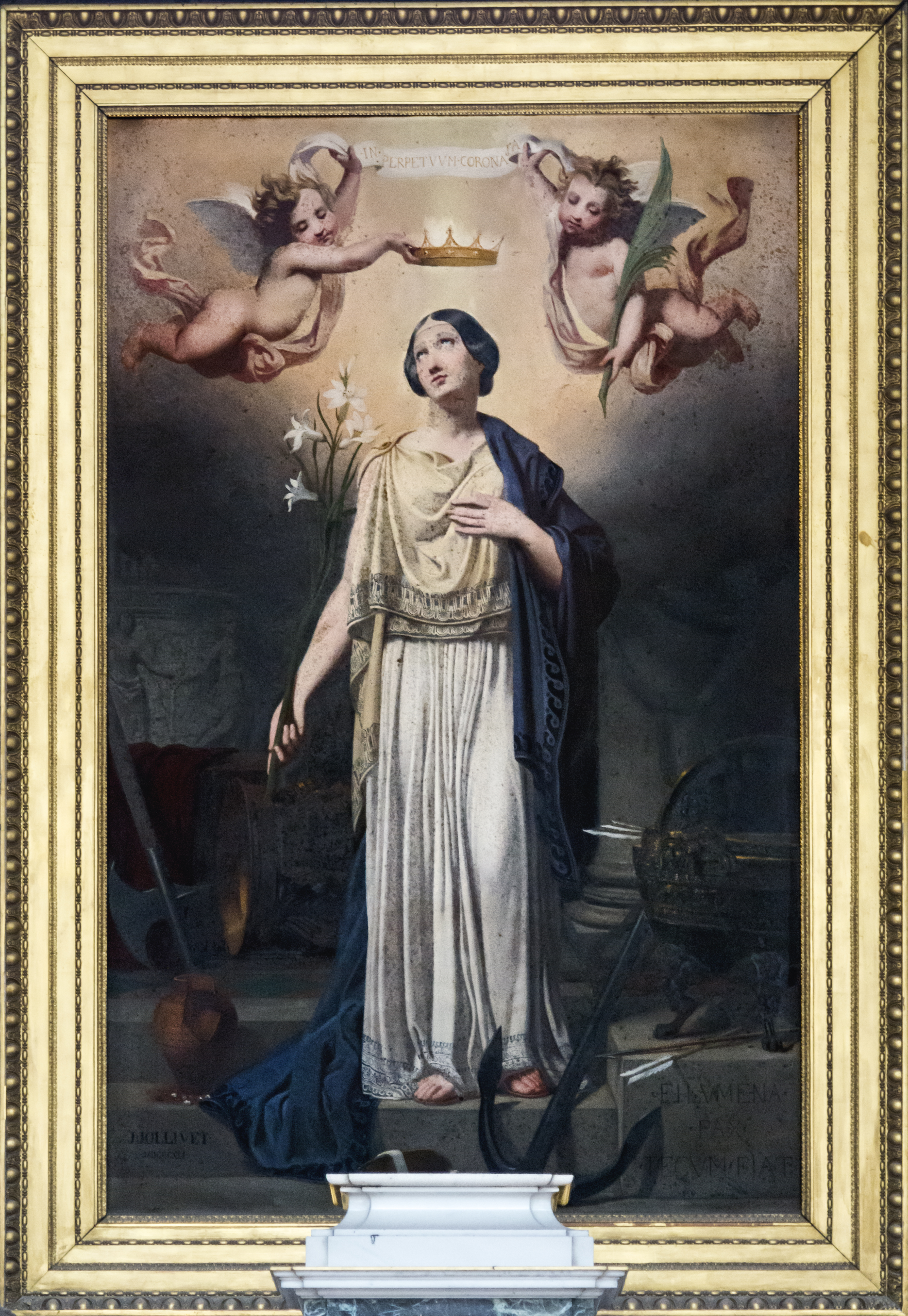
4.2. Miracles Attributed to Saint Philomena
Numerous miraculous events and healings have been attributed to Saint Philomena's intercession, contributing significantly to her widespread popularity. Upon the arrival of her relics in Mugnano del Cardinale, wonders were reported, including a statue of the saint that continuously sweated a liquid for three days. Another miracle, accepted as proven in the same year, was the multiplication of the saint's bone dust, which provided for hundreds of reliquaries without any decrease in the original quantity. The healing of Pauline Jaricot from a severe heart condition in 1835, and the miracle of Giovanna Cescutti in Venice, are among the most celebrated.
4.3. Devotional Practices
Several devotional practices are associated with Saint Philomena's cult:
- Cord of Philomena: Devotees wear a red and white cord, which historically had a number of indulgences attached to it, including a plenary indulgence on the day it was first worn. However, these indulgences were not renewed in Indulgentiarum doctrina, the 1967 general revision of the discipline concerning them.
- Chaplet of Saint Philomena: This chaplet consists of three white beads in honor of the Christian Trinity and thirteen red beads, symbolizing the thirteen years of Philomena's life before her martyrdom.
- Oil of Saint Philomena: This sacramental is used by devotees for the putative healing of the body and soul, believed to convey the saint's intercessory power.
In August 1876, the first issue of Messenger of Saint Philomena was published in Paris, France, further promoting her devotion. On October 6, 1876, Father Louis Petit founded the Confraternity of Saint Philomena in Paris. This Confraternity was elevated to the rank of Archconfraternity by Pope Leo XIII in November 1886. On May 21, 1912, Pope Pius X further raised it to the rank of Universal Archconfraternity with the Apostolic brief Pias Fidelium Societates. This brief notably stated, regarding the historical authenticity of Philomena, that: "The current statements (regarding St. Philomena) are and remain always fixed, valid and effective; in this way it has to be judged as normative; and if it is proceeded in another way, it will be null and void, whatever its authority."
5. Church Recognition and Liturgy
This section traces the official recognition and liturgical status of Saint Philomena within the Catholic Church, from initial papal approvals for regional feast days to her eventual removal from universal liturgical calendars.
The official recognition and liturgical status of Saint Philomena within the Catholic Church underwent significant changes over time, moving from initial approvals to eventual removal from liturgical calendars.
5.1. Papal Approvals and Feast Day
In 1834, due to the numerous purported miracles attributed to her intercession, Pope Gregory XVI formally allowed the veneration of Saint Philomena. Three years later, in 1837, he authorized the celebration of her feast day. This authorization was initially granted for August 11 (though some sources indicate September 9) in the Diocese of Nola, to which Mugnano del Cardinale belongs, and soon extended to several other dioceses in Italy.
Despite these regional approvals, the name "Philomena" was never included in the Roman Martyrology, which is the official catalog of saints recognized by the Catholic Church. Saints are typically listed in the Martyrology immediately upon their beatification or canonization. The 1920 typical edition of the Roman Missal did include a mention of her under August 11, in the section titled Missae pro aliquibus locisLatin ("Masses for some places"). This indicated that the Mass to be used in those places was one from the common of a virgin martyr, without any proper prayers specific to her.
5.2. Removal from Liturgical Calendars
On February 14, 1961, the Holy See issued an instruction ordering the removal of Philomena's name from all liturgical calendars. This directive was part of a broader instruction concerning the application of principles from the 1960 Code of Rubrics to local calendars, principles that had already been applied to the General Roman Calendar. Section 33 of this document specifically mandated: "Festum autem S. Philumenae V. et M. (11 augusti) e quolibet calendario expungatur.Latin" ("However, the feast of Saint Philomena, virgin and martyr (11 August), is to be removed from all calendars.").
The primary reason cited for this removal was the lack of historical evidence supporting her existence and the traditional narrative of her life. The decision followed a period of scholarly scrutiny and debate regarding the authenticity of her relics and the hagiographical account of her martyrdom. Consequently, the 1962 edition of the Roman Missal, which is still used in the extraordinary form of the Roman Rite, does not include any mention of Saint Philomena.
6. Historical Criticism and Controversy
This section delves into the scholarly debate surrounding Saint Philomena's historical existence and the authenticity of her traditional narrative, examining both the criticisms and the arguments in defense of her cult.
The historical existence and authenticity of Saint Philomena have been subjects of considerable scholarly debate, often referred to as the "Philomena Question." This controversy examines the archaeological evidence and the traditional hagiographical narrative.
6.1. The "Philomena Question"
The "Philomena Question" encompasses the historical and archaeological doubts raised by scholars concerning the identification of the remains found in the Catacombs of Priscilla and the historicity of the traditional narrative attributed to her. These questions intensified particularly in connection with the revelations of Sister Maria Luisa di Gesù, which provided the detailed biography of the saint.
6.2. Archaeological and Hagiographical Analysis
Scholars, notably Orazio Marucchi in the late 19th century, whose work was supported by Johann Peter Kirsch (author of the 1911 article on Philomena in the Catholic Encyclopedia), raised significant objections. Marucchi argued that the inscription on the three tiles, which provided the name "Filumena," belonged to the middle or second half of the second century. However, the body found within the loculus was determined to be from the fourth century, a period when the intense persecutions of Christians had largely ceased. Based on this theory, not only the name but also the symbols (the leaf, the two anchors, and the palm) decorating the three tiles, which had been believed to indicate that Filumena was a martyr, had no direct relation to the person whose remains were found. The alleged disarrangement of the tiles could be explained by a fourth-century practice of reusing materials that had already been engraved, with the aim of indicating that a different person was now buried in that spot.
Furthermore, critics of the traditional legend, particularly from the Indonesian source, point out several historical and hagiographical errors and anachronisms:
- The legend describes Philomena as a Greek princess born on the island of Corfu. However, at the time the legend places Philomena, there were no longer Greek kingdoms or city-states; the Polis Corcyra (Corfu) had been dissolved in 148 BC by the Roman Empire, which had already conquered all of Greece unified by Alexander the Great.
- The motif of childless parents conceiving after converting to Christianity is a recurring trope in medieval legends of martyrs.
- The name "Philomena" is derived from the Greek word ΦιλουμένηGreek, Ancient (philouménē), meaning "beloved" or "who loves to sing," and is an ancient name given to the Nightingale. It has no etymological connection to "filia luminis" ("daughter of light"), as claimed in the legend, suggesting this interpretation was created by those who reconstructed the broken tomb inscription.
- It is considered highly improbable that Emperor Diocletian would declare war on his own territory. Additionally, Diocletian was never widowed; his wife, Prisca, survived him for several years after his death.
- Diocletian did not rule the empire from Rome but from Ravenna.
- The Roman imperial palace did not have dungeons as described in the narrative.
- The story, supposedly dictated by the saint herself, inconsistently shifts between first and third-person narration.
- An anchor was a valuable and expensive instrument, not typically used for torturing Roman lawbreakers.
These inconsistencies lead critics to conclude that the "Passio Philomenic" is a legend created to promote piety and devotion to the saint, based solely on the instruments drawn on the tombstone found in the catacomb where her body was discovered. The imprimatur granted by the Church to this legend only signifies that it contains no doctrine contrary to the faith, not that it compels the faithful to believe its historical accuracy.
6.3. Defense of Authenticity
Despite the historical criticisms, arguments supporting the authenticity of Saint Philomena's cult persist. Proponents, such as Mark Miravalle, argue that Marucchi's conclusions should not be considered the definitive word on the historicity of Saint Philomena. Miravalle's book, It Is Time to Meet St. Philomena, cites several specialists who disagree with Marucchi's findings. Historian Michael S. Carter has also written about devotion to Saint Philomena within the broader context of the veneration of "catacomb martyrs" and their relics in 19th-century American Catholicism.
Further support for the integrity of the relics emerged in April 2005, at the Conference of Philomenian Studies - 1805-2005. Findings from a study conducted on the tiles by the Opificio delle Pietre Dure e Laboratori di Restauro (Factory of Hard Stones and Restoration Laboratories) of Florence were made public. The analysis confirmed that only one type of mortal lime could be found on the tiles, providing strong support for the theory that the tiles had not been rearranged, thus challenging Marucchi's hypothesis of reuse.
Defenders also emphasize that the authenticity of her cult can be grounded in the numerous miracles attributed to her intercession, its long-standing papal approbation (even if later withdrawn from the universal calendar), and the saint's continued popularity. This position is upheld by the rector of the shrine in Mugnano del Cardinale and is presented in the Italian-language Enciclopedia Dei Santi. Pilgrims from all over the world continue to arrive at Philomena's shrine in the Diocese of Nola, Italy, demonstrating an intense degree of popular devotion. Some traditionalist groups, such as the Society of Saint Pius X (SSPX), view the Holy See's action in 1961 as a "work of the devil" intended to deprive the faithful of a powerful intercessor, especially in matters of purity and faith.
7. Places Dedicated to Saint Philomena
Numerous churches, shrines, and institutions around the world are dedicated to Saint Philomena, reflecting the global reach of her veneration.
- Sanctuary of St. Philomena, Mugnano del Cardinale, Avellino, Italy, which houses her remains within a life-size, richly robed effigy.
- St. Philomena's Cathedral, Mysore, India.
- St. Philomena's Church (Cincinnati, Ohio), Cincinnati, Ohio, United States.
- St. Philomena's Church (Pittsburgh, PA), Pittsburgh, Pennsylvania, United States.
- St Philomena's Catholic High School for Girls, Carshalton, London, England.
- St. Philomena's Roman Catholic Church, Franklinville, New York, United States.
- Sanctuary of St. Philomena, Sorocaba, Brazil.
- St. Philomena's Catholic Church and School, Peoria, Illinois, United States.
- St. Philomena's Catholic Church, Monticello, Illinois, United States.
- St. Philomena Coptic Orthodox Children's Home, Suva, Fiji.
- St. Philomena Catholic Church in Kalawao, Kalaupapa National Historical Park, Hawaii, United States, named by Damien of Molokai.
8. Legacy and Influence
Despite the controversies and the official removal of her feast day from liturgical calendars, Saint Philomena's veneration has left a lasting impact on popular piety and religious devotion. Her story, whether historical or legendary, has inspired countless individuals to live lives of faith, purity, and perseverance in the face of adversity. She continues to be regarded by many as a powerful intercessor, particularly for infants, babies, and youth, and is widely known as "The Wonderworker" due to the numerous miracles attributed to her. The ongoing pilgrimages to her shrine in Mugnano del Cardinale and the dedication of churches and institutions worldwide underscore her enduring significance as a patron saint and a figure of profound spiritual influence for many Catholic faithful.