1. Early Life
Maud Gonne's early life was shaped by her family background and personal experiences, which eventually steered her towards a path of political and social activism.
1.1. Birth and Childhood
Edith Maud Gonne was born on December 21, 1866, in Tongham, near Aldershot, Hampshire, England. Her father was Captain Thomas Gonne (1835-1886) of the 17th Lancers, and her mother was Edith Frith Gonne (née Cook, 1844-1871). Her mother died in 1871 in London during childbirth when Maud was still a child. Following this, Maud was briefly placed with relatives in London before being sent to a boarding school in France for her education, which made her fluent in French in addition to English.
The Gonne family had roots in County Mayo, Ireland. Maud Gonne recounted that her great-great-grandfather was disinherited and sought his fortune abroad by trading in Portuguese wine. Her grandfather later became the head of a prosperous firm with offices in London and Porto. He intended for Maud's father to manage the foreign business, leading him to be educated abroad. Although her father spoke six languages, he had little interest in business, opting instead for a commission in the English army. His linguistic skills secured him diplomatic appointments in countries such as Austria, the Balkans, and Russia, making him equally at home in Paris as in Dublin.
1.2. Early Relationships and Personal Events
In 1882, Maud Gonne's father, an army officer, was posted to Dublin, and she accompanied him, remaining with him until his death in 1886. After her father's passing, she spent an unhappy period in London under the guardianship of her uncle, William Gonne. Unaware at the time that she would inherit a significant fortune upon reaching her majority, she attempted to pursue an acting career. However, she became ill with tuberculosis, an ailment that would affect her throughout her life. In the summer of 1887, she traveled to the French spa town of Royat in Auvergne to recover.
While in France, Gonne met Lucien Millevoye (1850-1918), a married journalist with ardent right-wing political views, known for supporting the revanchist General Boulanger. Millevoye was sixteen years her senior, and their relationship was driven by both sexual and political motivations. Millevoye envisioned redeeming France by reclaiming Alsace-Lorraine alongside Boulanger, while Gonne saw her mission as Ireland's liberation. Together, they sought to form an alliance against the British Empire.
In December 1887, Maud Gonne inherited trust funds exceeding 13.00 K GBP and an unentailed sum from her mother's estate, making her a wealthy woman capable of living as she pleased. In early 1888, she embarked on a clandestine Boulangist mission to Russia, where she met the prominent Pall Mall Gazette editor, W. T. Stead, who described her as "one of the most beautiful women of the world." Upon returning to Ireland, she dedicated herself to campaigning for the release of Irish political prisoners.
In 1889, Gonne first met the poet W. B. Yeats, who became deeply enamored with her. Gonne was drawn to the occultism and spiritualism that were central to Yeats's interests, frequently inquiring of his friends about the reality of reincarnation. In 1891, she briefly joined the Hermetic Order of the Golden Dawn, an occultist organization in which Yeats was also involved.
In 1890, while in France, she reunited with Millevoye. They had a son, Georges Silver, who tragically died within the year, possibly from meningitis. Gonne was profoundly distraught by this loss, burying him in a large memorial chapel. Her grief remained with her; in her will, she requested that Georges's baby shoes be interred with her. Following the child's death, she separated from Millevoye. However, in late 1893, influenced by mysticism and a belief in metempsychosis, she arranged to meet him at Georges's mausoleum in Samois-sur-Seine. There, next to their child's sarcophagus, they engaged in sexual intercourse, with Gonne hoping to conceive a baby by the same father into whom Georges's soul would transmigrate. Her daughter with Millevoye, Iseult Gonne, was born in August 1894. Iseult was educated at a Carmelite convent in Laval, France. In Ireland, she was often introduced as Maud's niece or cousin, though it was widely known in Dublin that she was Gonne's daughter born out of wedlock.
2. Irish Nationalist and Republican Activism
Maud Gonne's involvement in the Irish nationalist and republican movements was central to her public life, defining her as a pivotal figure in the struggle for Irish independence.
2.1. Early Political Engagement
During the 1890s, Maud Gonne traveled extensively throughout England, Wales, Scotland, and the United States, actively campaigning for the Irish nationalist cause. In 1896, she established an organization called the "Irish League" (L'association irlandaiseThe Irish AssociationFrench). She ardently supported Irish Catholic tenant farmers in their resistance against the Protestant Ascendancy and the Royal Irish Constabulary (RIC) during the Land War. Gonne also chaired several international meetings to garner sympathy for her causes among the American, British, and French publics.
During the Second Boer War, Gonne, alongside a small group of Irish republicans, publicly supported the Boer republics, delivering speeches and publishing newspaper articles that vehemently opposed Irish involvement in the war. She became renowned for her eloquence in political speeches, which were credited with inspiring the establishment of new Irish nationalist organizations. In April 1900, on the occasion of a planned visit by Queen Victoria to Ireland, Gonne wrote a scathing article titled "The Famine Queen" for the United Irishman newspaper. The article, which criticized Queen Victoria's perceived indifference to the Great Famine, led to the suppression of the newspaper by the RIC. However, Gonne's article was subsequently republished in American newspapers, amplifying its reach and impact.
2.2. Women's Movement and Cultural Activities
In 1900, Maud Gonne was instrumental in founding Inghinidhe na hÉireann (Inghinidhe na hÉireannDaughters of IrelandIrish). The inaugural meeting was attended by twenty-nine women, who resolved to "combat in every way English influence doing so much injury to the artistic taste and refinement of the Irish people." Gonne conceived of Inghinidhe na hÉireann as a distinct and powerful voice for women in Irish affairs. An early editorial in Bean na hÉireannWoman of IrelandIrish, the organization's journal, declared, "Our desire to have a voice in directing the affairs of Ireland is not based on the failure of men to do so properly, but is the inherent right of women as loyal citizens and intelligent human souls." The organization was decidedly feminist, advocating for issues such as women's suffrage.
Gonne's activism extended to the cultural sphere. In April 1902, she took on the leading role in W. B. Yeats's play Cathleen Ní Houlihan (Cathleen Ní HoulihanKathleen Ni HoolihanIrish). She portrayed Cathleen, the "old woman of Ireland," who symbolizes Ireland itself, mourning for her four provinces that had been "lost" to the British. The play, set against the backdrop of the 1798 uprising, tells the story of an old woman who appears to a young man about to be married, asking for his help to reclaim her stolen land. This performance was a major success and significantly fueled the rising tide of Irish nationalism. The play was considered the "climax" of Yeats's revolutionary fervor, and Gonne, already a recognized nationalist, embodied Ireland's spirit, demanding the blood of her sons for freedom. By this time, she was spending much of her time in Paris.
In 1903, Gonne converted to the Catholic Church. She consistently refused numerous marriage proposals from W. B. Yeats, rejecting at least four between 1891 and 1901. Her reasons included his unwillingness to convert to Catholicism and her perception that his nationalism was insufficiently radical. Furthermore, she believed that Yeats's unrequited love for her had been a boon for his poetry, famously telling him: "Oh yes, you are, because you make beautiful poetry out of what you call your unhappiness and are happy in that. Marriage would be such a dull affair. Poets should never marry. The world should thank me for not marrying you."
2.3. Founding of Sinn Féin
In 1903, Gonne, alongside Arthur Griffith and others, formed a second organization, the National Council. This group was established to protest the visit of Edward VII to Dublin, specifically lobbying the Dublin Corporation to refrain from presenting an address to the King. Although the motion to present an address was defeated, the National Council persisted as a pressure group, aiming to increase nationalist representation in local councils.
The first annual convention of the National Council, held on November 28, 1905, marked two significant developments: a majority vote (with Griffith dissenting) to establish branches and organize on a national basis, and Griffith's presentation of his 'Hungarian' policy, which was subsequently named the Sinn Féin (Sinn FéinShin FeynIrish) policy. This meeting is generally recognized as the foundational date of the Sinn Féin party.
2.4. Marriage to John MacBride and its Impact

In 1903, in Paris, after declining multiple marriage proposals from W. B. Yeats, Maud Gonne married Major John MacBride, a prominent nationalist who had led the Irish Transvaal Brigade against the British during the Second Boer War. Their son, Seán MacBride, was born in January 1904.
By late 1904, the marriage between Gonne and MacBride had severely deteriorated, leading to a divorce case initiated in Paris on February 28, 1905. Gonne sought sole custody of their son, which MacBride refused to concede. During the proceedings, the only charge against MacBride that was legally substantiated in court was that he had been drunk on one occasion during the marriage. A formal divorce was not granted, but MacBride was given the right to visit his son twice weekly.
Following the breakdown of the marriage, Gonne made allegations of domestic violence. According to W. B. Yeats, she also claimed that MacBride had sexually molested Iseult, her daughter from her previous relationship with Lucien Millevoye, who was then around eleven years old. Critics have suggested that Yeats, harboring animosity towards MacBride due to Gonne's rejection of him, might have fabricated or exaggerated these specific allegations. While neither the divorce papers submitted by Gonne nor Iseult's own writings explicitly mention such an incident-which is not surprising given the social reticence surrounding such matters at the time-Francis Stuart, Iseult's later husband, attested that Iseult had confided in him about it. The allegation concerning Iseult was initially made by Maud to John's brother, Anthony MacBride. Although Maud chose not to pursue this particular claim in court, John MacBride himself raised it in court to clear his name. Yeats and some of his biographers have maintained that Iseult was indeed a victim, often omitting the court incident from their accounts.
The highly publicized divorce scandal in Dublin prompted Gonne to primarily conduct her activities from France to avoid public scrutiny. John MacBride exercised his right to visit his son for a short period but subsequently returned to Ireland and never saw Seán again. Gonne raised their son in Paris.
John MacBride was executed in May 1916 alongside James Connolly and other leaders of the Easter Rising. Following MacBride's death, Gonne felt it was safe to return to Ireland permanently. In 1916, Yeats, then in his fifties, again proposed to Maud Gonne, who again declined. He then proposed to her 23-year-old daughter, Iseult. Yeats had known Iseult since she was four years old, often referring to her as his "darling child" and taking a paternal interest in her writings. Due to this close relationship, many Dubliners wrongly suspected that Yeats was Iseult's father. Iseult seriously considered the proposal but ultimately refused, believing that Yeats did not truly love her and that accepting would deeply upset her mother.
2.5. Activism During the Irish War of Independence and Civil War
Maud Gonne returned to Ireland in 1917 and remained highly active in republican movements. In 1913, she had established L'Irlande libreFree IrelandFrench, a French newspaper, underscoring her commitment to the cause even while abroad. She sought to gain international recognition for Cumann na mBan (Cumann na mBanKooman na MonIrish), the Irishwomen's Council, by exploring affiliation with the English Red Cross and corresponding with the Red Cross in Geneva.
In 1918, Gonne was arrested in Dublin and imprisoned in England for six months on suspicion of involvement in a pro-German conspiracy. After significant campaigning by her friends and a recurrence of her tuberculosis, she was released and returned to Dublin. She dedicated herself to humanitarian efforts, working with the Irish White Cross to provide relief to victims of violence. Gonne moved within upper-class circles, often accompanied by Mrs. Charlotte Despard, Lord French's sister, a renowned suffragist and an ardent Sinn Féiner who arrived in Dublin in 1920. Together, they toured County Cork, a hotbed of revolutionary activity, even though Cork was under a Martial Law Area prohibiting access to most Irishmen and women, a restriction that Despard's status as the Viceroy's sister allowed her to bypass.
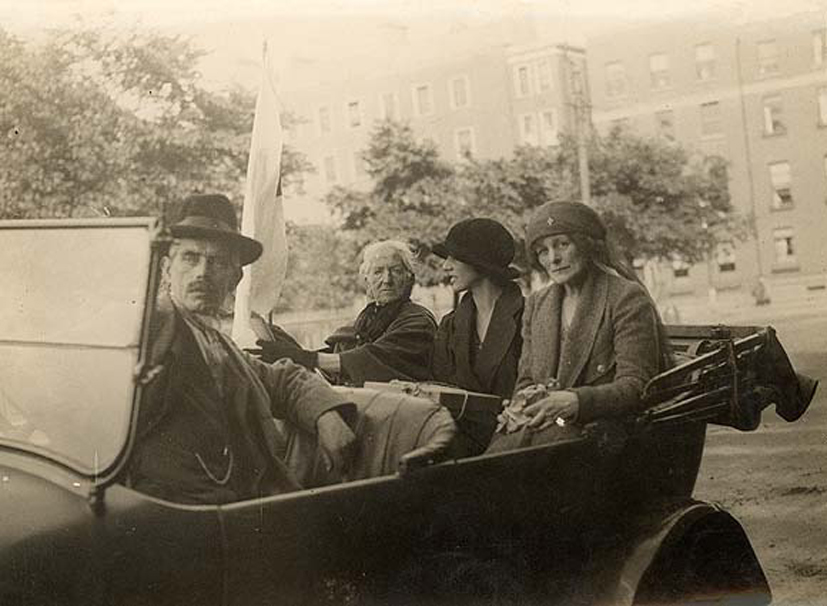
In 1921, Gonne initially showed openness to the Anglo-Irish Treaty in alignment with Arthur Griffith's position. However, following Griffith's death, she vehemently opposed the Treaty and sided with the Republican faction. In January 1921, the committee that established the White Cross in Ireland invited Gonne to join their efforts to distribute funds to victims, a task administered through Cumann na mBan (Cumann na mBanKooman na MonIrish). She settled in Dublin in 1922.
During the intense street battles of the Irish Civil War, Gonne led a delegation called the Women's Peace Committee, which appealed to the Dáil leadership and her old friend Arthur Griffith in an attempt to halt the indiscriminate shooting of civilians. Their efforts, however, were largely unsuccessful as the authorities prioritized maintaining law and order. In August of the same year, she established another organization, the Women's Prisoner's Defence League. This League addressed the dire conditions in Irish prisons, where many women were unjustly held, often in men's facilities. The League supported families seeking information about inmates, advocated for prisoners' rights, organized vigils, and published accounts of tragic deaths in custody. Due to her close friendship with Despard and their shared opposition to the government, they were collectively labeled "Mad and Madame Desperate."
Historians have documented the extensive damage inflicted upon Gonne's home at 75 St Stephen's Green, which was ransacked by soldiers from the National Army. Gonne was subsequently arrested and taken to Mountjoy Jail. On November 9, 1922, the Sinn Féin Office on Suffolk Street was raided as the Irish Free State systematically rounded up and interned opposition members across the capital. This account is corroborated by Margaret Buckley, who, as Secretary of Sinn Féin, served as a legal representative for the women detained, consistently opposing civil rights abuses.
On April 10, 1923, Gonne was again arrested. The charges against her included painting banners for seditious demonstrations and preparing anti-government literature. According to the diary of her colleague Hannah Moynihan, Gonne was arrested along with her daughter Iseult Stuart and two other women. Moynihan recounted that Gonne arrived at the prison "walking majestically past our cell door leading on a leash a funny little lap dog which answered to the name that sounded like Wuzzo - Wuzzo." Gonne was released on April 28, after twenty days in custody. Months later, the women spread a rumor that Nell Ryan had died in custody in an attempt to achieve a propaganda victory. Women continued to face arrests. On June 1, Gonne, accompanied by writer and activist Dorothy Macardle and Iseult Stuart, stood in protest outside Kilmainham Gaol, demonstrating support for hunger striker Máire Comerford.
3. Other Social and Economic Activism
Beyond her direct involvement in Irish nationalism, Maud Gonne also engaged in broader social and economic movements, demonstrating her diverse commitment to reform and justice.
3.1. Social Credit Movement
Maud Gonne was a prominent figure in the Catholic monetary reform movement in Ireland during the 1930s. Initially established in 1932 as the Financial Freedom Federation, this organization evolved into the Irish Social Credit Party by late 1935. Gonne MacBride remained a central member of the group throughout the 1930s. The party aimed to reform Ireland's financial and economic systems by implementing the distributive program advocated by social credit economics originator, Major C.H. Douglas, which had gained traction in the inter-war period.
In 1936, Gonne publicly criticized Ernest Blythe's denunciation of social credit economics in the Irish Independent. She wrote, "I read with amazement the report of Mr. Blythe's broadcast attack on Social Credit. Major Douglas's contention that production has outstripped distribution with disastrous results of unemployment and starvation, tending to war and anarchy is incontrovertible, and is apparent to all in the desperate scramble for markets, the restriction of output and destruction in almost every country of consumable goods, while millions of people who need these goods are allowed to starve."
3.2. International Solidarity
In the 1930s, Gonne also became involved with the Friends of Soviet Russia organization. Her engagement with international anti-imperialist and social justice causes was further highlighted when she met and was photographed with the Indian independence leader Subhas Chandra Bose during his visit to Ireland in 1936.
4. Ideology and Beliefs
Maud Gonne's ideology was complex, characterized by deep-seated nationalism and a commitment to women's rights, alongside controversial and problematic views.
4.1. Core Principles
Maud Gonne was first and foremost a staunch Irish nationalist, a principle that underpinned all her social and political activities. While her political leanings sometimes wavered between socialism and more right-wing thought, her dedication to Irish self-determination remained unwavering.
Gonne was also a committed feminist, advocating for women's voices and roles in public life, notably through her work with Inghinidhe na hÉireann, which championed women's rights and suffrage. In her autobiography, she articulated a nuanced stance on pacifism, stating, "I have always hated war and am by nature and philosophy a pacifist, but it is the English who are forcing war on us, and the first principle of war is to kill the enemy." This reflects her belief that while peace was desirable, it could not come at the expense of national freedom and resistance against oppression.
4.2. Controversial Views
Despite her progressive stances on nationalism and feminism, Maud Gonne held problematic and debated viewpoints, particularly regarding her anti-Semitism. She was known for her anti-Semitic remarks, with historian D. G. Boyce describing her as "noisily anti-Semitic." The Dictionary of Irish Biography further notes that she adhered to anti-Semitic and anti-Masonic theories, views believed to have been influenced by Lucien Millevoye.
Gonne also held complex, at times ambivalent, attitudes towards fascism and communism. While she engaged with groups like the Friends of Soviet Russia, she also considered that both fascism and communism contained aspects that Ireland could learn from. During World War II, her intense anti-British sentiment led her to express sympathies towards Germany. These views reflect a complicated ideological landscape, shaped by her fervent nationalism and a search for alternative political and economic models outside the British sphere of influence, though they remain subjects of historical scrutiny and criticism.
5. Relationship with W. B. Yeats
The relationship between Maud Gonne and W. B. Yeats was one of the most significant and enduring connections in Irish literary history, deeply influencing the poet's life and work.
5.1. Muse and Inspiration
Maud Gonne served as a profound muse for W. B. Yeats. Her beauty, intelligence, and fervent nationalism inspired a vast body of his poetry and plays. Many of Yeats's poems are either directly inspired by her or mention her, such as "This, This Rude Knocking." He specifically wrote the plays The Countess Cathleen and Cathleen Ní Houlihan for her.
Few poets have celebrated a woman's beauty with the intensity and consistency that Yeats did in his lyric verse about Gonne. From his second published book of poetry through his Last Poems, she appeared under various symbolic guises. She was depicted as the Rose, Helen of Troy (in No second Troy), the Ledaean Body (in "Leda and the Swan" and "Among School Children"), Cathleen Ní Houlihan, Pallas Athene, and Deirdre. In his 1916 poem "No second Troy," he famously questioned:
Why should I blame her that she filled my days
With misery, or that she would of late
Have taught to ignorant men most violent ways
Or hurled the little streets upon the great.
Yeats's 1893 poem "On a Child's Death" is widely believed to have been inspired by the death of Gonne's son, Georges, whom Yeats mistakenly believed Gonne had adopted. The poem was not published during Yeats's lifetime; scholars suggest that its uneven quality may have led him to exclude it from his official canon.
5.2. Unrequited Love and Its Influence
Yeats's love for Maud Gonne was largely unrequited, a theme that became central to his literary output. He proposed marriage to her at least four times between 1891 and 1901, but she consistently refused. Gonne's reasons for her rejections were varied: she noted his unwillingness to convert to Catholicism and her view that his nationalism was not sufficiently radical. Crucially, she also believed that his unfulfilled love for her was a creative force, enriching his poetry. She famously stated that if she were to marry him, his poetry would suffer, and that the world should thank her for never accepting his proposals. This dynamic of profound admiration coupled with romantic rejection profoundly shaped Yeats's exploration of beauty, nationalism, and spiritual longing throughout his work.
6. Publications
Maud Gonne's literary contributions primarily include her significant autobiography, offering unique insights into her life and motivations.
6.1. Autobiography
In 1938, Maud Gonne MacBride published her autobiography, titled A Servant of the Queen. The title holds a dual meaning: it is both a reference to a vision she had of the ancient Irish queen, Kathleen Ni Houlihan, embodying the spirit of Ireland, and an ironic comment given Gonne's fervent Irish nationalism and her staunch rejection of the British monarchy. The book provides a detailed account of her life and motivations, particularly her deep-seated Irish nationalist convictions.
7. Later Life and Family
Maud Gonne's later years were marked by continued activism and the notable lives of her children, who also left their own legacies.
7.1. Children's Lives and Legacies
Iseult Gonne (1894-1954), Maud Gonne's daughter with Lucien Millevoye, attracted the admiration of several literary figures, including Ezra Pound, Lennox Robinson, and Liam O'Flaherty. In 1920, Iseult eloped to London with the 17-year-old Irish-Australian Francis Stuart, who would later become a renowned writer, and the couple subsequently married. Tragically, Iseult died less than a year after her mother, in 1954, from heart disease. In Maud Gonne's will, Iseult was not formally acknowledged as her daughter, a decision believed by some to be due to pressure from Iseult's half-brother, Seán MacBride, who wished to keep Maud's relationship with Millevoye private.
Maud Gonne's son, Seán MacBride (1904-1988), became a highly influential figure in Irish and international politics. He was actively involved in the IRA and in Irish republican political movements. As the Irish Foreign Minister from 1948 to 1951, he played a significant role in the United Nations and was instrumental in securing the ratification of the European Convention on Human Rights. Later, Seán MacBride became a founding member and Chairman of Amnesty International, an organization dedicated to human rights advocacy worldwide. His distinguished career was recognized in 1974 when he was awarded the Nobel Peace Prize for his efforts in promoting human rights and international peace.
7.2. Final Years and Death
In her later life, Maud Gonne resided in Clonskeagh, a suburb of Dublin. In 1922, she and her friend Charlotte Despard purchased a house in Clonskeagh and established a jam factory there, providing employment to struggling republicans. She continued her activism, despite her age and declining health, and was briefly imprisoned in 1923 for her anti-government activities.
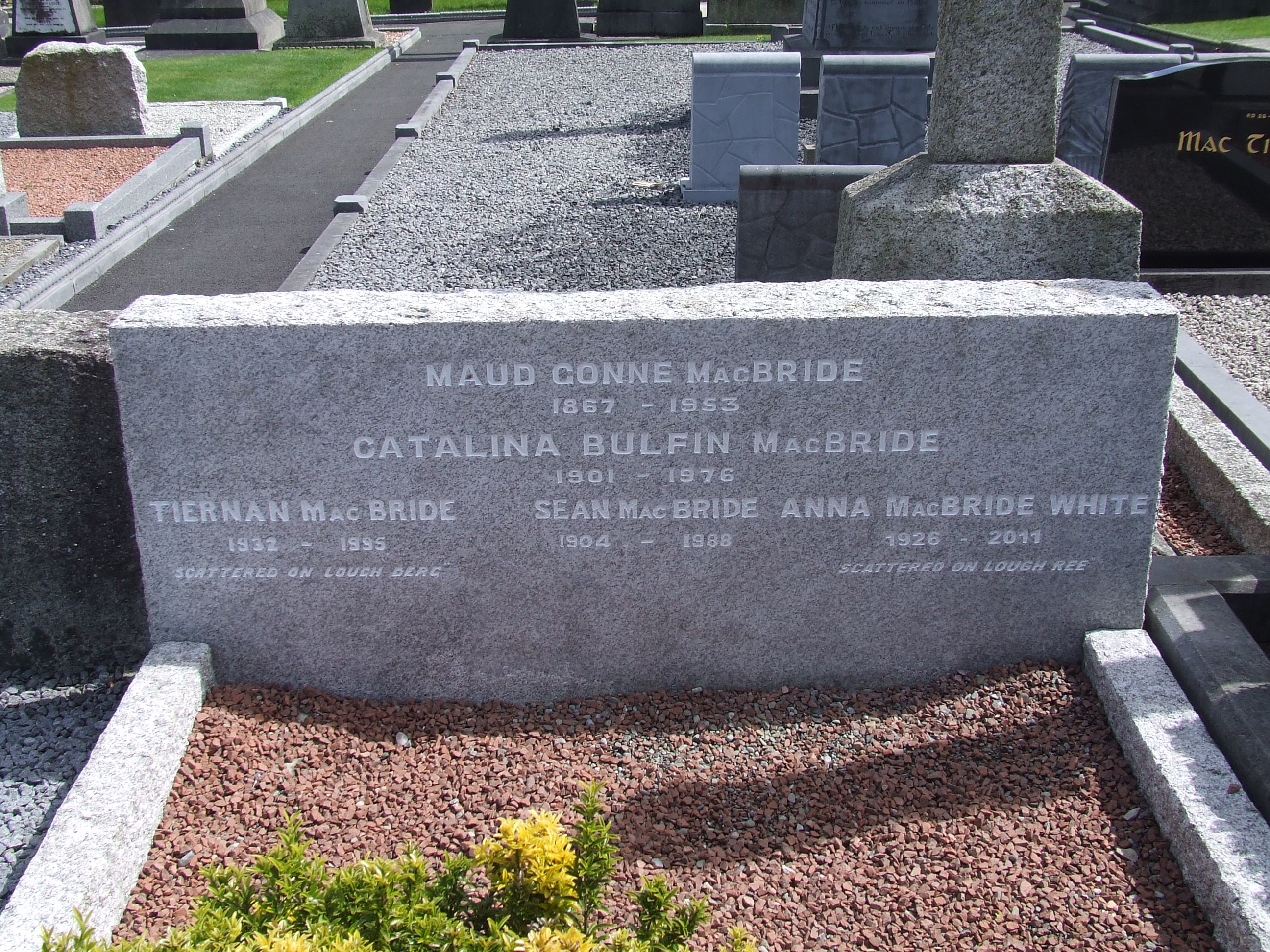
Maud Gonne MacBride died in Clonskeagh on April 27, 1953, at the age of 86. She was buried in Glasnevin Cemetery in Dublin, a site where many prominent Irish nationalists and historical figures are interred.
8. Legacy and Assessment
Maud Gonne's legacy is a multifaceted one, marked by her profound influence on Irish history and society, as well as by aspects of her character and beliefs that have drawn criticism.
8.1. Contributions and Positive Impact
Maud Gonne MacBride left an indelible mark on Irish history, primarily through her unwavering dedication to the Irish independence movement. Her active agitation for home rule and a full Irish Republic, coupled with her powerful rhetoric, earned her the moniker "Irish Joan of Arc." She galvanized public sentiment against British rule, particularly through her support for tenant farmers during the Land Wars and her vocal opposition to British involvement in the Second Boer War.
Her contributions to women's rights were significant. As a co-founder of Inghinidhe na hÉireann (Daughters of Ireland), she played a crucial role in establishing a distinct platform for women's voices in Irish affairs, advocating for feminist principles and greater female participation in nationalist movements. Gonne also actively engaged in humanitarian work, notably with the Irish White Cross and the Women's Prisoner's Defence League, providing relief to victims of violence and advocating for the rights of political prisoners during the tumultuous Irish War of Independence and Civil War.
Beyond politics, Gonne fostered the Irish cultural revival. Her leading role in W. B. Yeats's play Cathleen Ní Houlihan was a seminal moment, transforming theater into a potent tool for nationalist sentiment. Her influence as Yeats's muse inspired some of the most enduring works of Irish poetry, embedding her image deeply within the literary and cultural landscape of Ireland.
8.2. Criticisms and Controversies
Despite her significant contributions, Maud Gonne's life and actions have also been subject to considerable criticism and controversy. A notable aspect of this is her anti-Semitism. Historians like D. G. Boyce have described her as "noisily anti-Semitic," and she was known to believe in anti-Semitic and anti-Masonic theories, views believed to have been influenced by Lucien Millevoye.
Her tumultuous marriage to John MacBride was another source of controversy. The divorce proceedings in 1905 brought serious allegations of domestic violence to light. Furthermore, Maud Gonne made accusations, which W. B. Yeats supported, of sexual molestation against her daughter, Iseult, by John MacBride. While direct legal documentation from the time for the sexual abuse claim is ambiguous, the detailed testimonies and subsequent accounts, including those from Iseult's later husband Francis Stuart, attest to the severity of these allegations and the profound personal distress they caused, although John MacBride himself attempted to clear his name in court. The scandal surrounding the divorce and these accusations significantly impacted Gonne's public and private life, forcing her to relocate much of her activity to France for a period.
Additionally, Gonne's ideological complexities, particularly her ambiguous attitudes towards fascism and communism and her pro-German sympathies during World War II driven by anti-British sentiment, have also drawn scrutiny. While reflective of the diverse and sometimes contradictory political currents of her era, these views complicate her overall assessment. Overall, Maud Gonne's legacy is that of a powerful, complex, and sometimes contradictory figure who played an undeniable role in shaping early 20th-century Irish history and culture.