1. Early Life and Activities
Erich Bauer's early life in Berlin was followed by military service during World War I and a civilian career before his full immersion into the machinery of Nazi persecution.
1.1. Background and Early Career
Erich Bauer was born in Berlin, German Empire, on March 26, 1900. He served as a soldier during World War I, during which he was captured and held as a prisoner of war by the French. Upon his return to Germany after the war, Bauer became active in the Iron Helmet Federation, a right-wing veterans' organization. He subsequently found employment as a tram conductor.
1.2. Joining the Nazi Party and SS
In 1933, following the Nazi Party's rise to power, Bauer joined the Nazi Party (NSDAP) and the SA. He later became a member of the SS. He continued his work as a tram conductor until 1940, at which point he fully transitioned into his roles within the Nazi apparatus.
2. Involvement in Nazi Atrocities
Erich Bauer's involvement in Nazi atrocities escalated from participation in the euthanasia program to becoming a central figure in the mass extermination at Sobibór.
2.1. Action T4 (Euthanasia Program)
In 1940, Erich Bauer was assigned to the infamous Action T4 (Aktion T4German) Euthanasia Program, a Nazi initiative designed to systematically murder physically and mentally disabled individuals in institutions through gassing and lethal injection. Initially, Bauer served as a driver, collecting and transporting victims from hospitals and homes to the killing centers. However, he quickly advanced within the program, becoming directly involved in the gassing operations. He later testified about one of his early acts of mass murder, stating that "A pipe connected the exhaust of a car to a bricked-up laboratory in the asylum. A few patients were shut into the room and I turned on the car engine. This killed the patients in eight minutes." His direct participation in these initial mass killings marked his progression into the systematic extermination of human lives.
2.2. Role in Sobibór Extermination Camp
In early 1942, Bauer was transferred to the office of Odilo Globocnik, the SS and Police Leader of Lublin, Poland. There, he was issued an SS uniform and promoted to the rank of SS-Oberscharführer (Staff Sergeant). In April 1942, he was dispatched to the Sobibór extermination camp, where he remained until the camp's liquidation in December 1943 following a prisoner revolt.
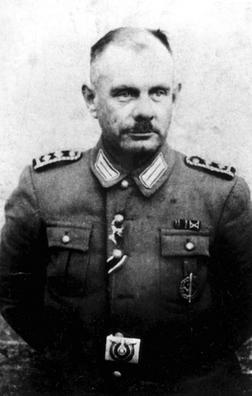
At Sobibór, Erich Bauer was primarily responsible for operating the camp's gas chambers, overseeing the murder of Jewish and Roma victims. He was known to prisoners as the BadmeisterBath MasterGerman because the gas chambers were disguised as shower rooms. After the war, survivors more pointedly referred to him as the GasmeisterGas MasterGerman. Bauer was described as a short, stocky man who was a known drinker and regularly overindulged, often keeping a private bar in his room. In stark contrast to other SS guards who maintained a neat appearance, Bauer was consistently filthy and unkempt, emitting a strong stench of alcohol and chlorine. In his room, he displayed photographs of himself and his entire family alongside the Führer (leader), Adolf Hitler. The gassing process at Sobibór was horrific; it reportedly took victims up to half an hour to die. The SS kept a flock of geese specifically to drown out the agonizing screams of those perishing in the gas chambers, a chilling testament to the calculated cruelty employed at the camp. This systematic approach to mass murder, with Bauer at its core, represents a grave assault on human dignity and life.
2.3. Sobibór Uprising and His Role
On October 14, 1943, the day of the Sobibór uprising, Erich Bauer's unexpected actions inadvertently triggered the premature start of the revolt. He had driven to Chełm for supplies, and his earlier-than-expected return caught the resistance movement off guard. The uprising's leader, Alexander Pechersky, had placed Bauer at the top of his "death list" of SS guards to be assassinated before the escape. Upon his return, Bauer discovered the body of SS-Oberscharführer Rudolf Beckmann, who had been murdered by the prisoners. In a fit of rage, Bauer immediately began shooting at two Jewish prisoners who were unloading his truck. The sound of his gunfire, an unplanned and desperate act, served as the unexpected signal for Pechersky to commence the revolt ahead of schedule, fundamentally altering the course of the uprising.
3. Post-War Arrest and Legal Proceedings
Following the war, Erich Bauer managed to evade justice for a brief period before being recognized by survivors of his atrocities, leading to his re-arrest and the subsequent legal processes that brought his crimes to light.
3.1. Recognition and Re-arrest
At the conclusion of World War II, Bauer was initially apprehended by American forces in Austria and confined to a prisoner of war camp until 1946. After his release, he returned to Berlin, where he found work as a laborer, participating in the cleanup efforts for war-damaged areas. His freedom was short-lived, however, as he was re-arrested in 1949 under dramatic circumstances. Two former Jewish prisoners from Sobibór, Samuel Lerer and Esther Raab, recognized him during a chance encounter at a public fairground in Kreuzberg, Berlin. When Esther Raab confronted him, Bauer reportedly uttered the chilling words, "How is it that you are still alive?" He was arrested shortly thereafter, and his trial commenced the following year.
3.2. Trial and Conviction
During his trial, Bauer attempted to downplay his role at Sobibór, claiming that he only worked as a truck driver, collecting necessary supplies for the camp's inmates and the German and Ukrainian guards. He admitted to being aware of the mass murders at Sobibór but insisted he never took part in them or engaged in any acts of cruelty. Even former Sobibór guards, SS-Oberscharführer Hubert Gomerski and SS-Untersturmführer Johann Klier, testified on his behalf.
However, the court, the Schwurgericht Moabit in Berlin, ultimately convicted Bauer based on the compelling testimonies of four Jewish witnesses who had managed to escape from Sobibór. These survivors unequivocally identified Bauer as the former Sobibór Gasmeister. They testified that he not only operated the gas chambers, directly orchestrating the deaths of thousands, but also engaged in mass executions by shooting. Furthermore, they detailed his involvement in a variety of particularly vicious and random acts of cruelty against camp inmates and victims on their way to the gas chambers, showcasing his profound disregard for human life. On May 8, 1950, the court sentenced Bauer to death for crimes against humanity. However, as capital punishment had been abolished in West Germany by that time, his sentence was commuted to life imprisonment.
4. Imprisonment and Death
After his conviction, Erich Bauer spent the remainder of his life incarcerated, a period during which he eventually acknowledged his immense guilt for mass murder.
Bauer served the initial 21 years of his sentence at Alt-Moabit Prison in Berlin before being transferred to Tegel Prison. During his long incarceration, he eventually admitted to his extensive participation in the mass murder at Sobibór. He also occasionally testified against former SS colleagues, notably at the Sobibor trial, providing insights into the atrocities committed at the camp. Erich Bauer died on February 4, 1980, while still in custody at Tegel Prison, having spent decades imprisoned for his egregious crimes against humanity.
5. Historical Assessment and Media Portrayal
Erich Bauer is historically recognized as a direct and active participant in the Holocaust, with his actions leaving an indelible mark on the lives of countless victims and a profound impact on human rights.
5.1. Role as a Perpetrator
Erich Bauer's role as a perpetrator of the Holocaust was significant due to his direct involvement in both the Action T4 euthanasia program and the systematic extermination at Sobibór. His duties as a driver transporting victims to their deaths, and more critically, his direct operation of the gas chambers as the Gasmeister, place him squarely among those who implemented the Nazi regime's genocidal policies. Testimonies from survivors vividly describe his cruelty, his responsibility for the deaths of thousands, and his active participation in violence, even triggering the Sobibór uprising with his spontaneous shooting. His actions were a direct assault on human rights, contributing to one of the darkest chapters in human history and highlighting the capacity for extreme inhumanity when individuals willingly participate in systems of oppression and extermination.
5.2. Portrayal in Media
Erich Bauer's role in the Holocaust has been depicted in media, reflecting his historical significance as a perpetrator. He was portrayed by Klaus Grünberg in the 1987 British television film Escape from Sobibor, which dramatizes the Sobibór extermination camp uprising. He is also referenced in the 2018 Russian film Sobibor, which similarly recounts the events of the uprising.