1. Biography
Giovanni Battista Pergolesi's life, though short, was marked by early musical talent, significant compositional output, and a battle with illness that ultimately led to his premature death.
1.1. Childhood and Education
Born Giovanni Battista Draghi on January 4, 1710, in Jesi, which was then part of the Papal States (now in the Province of Ancona), he was commonly known by the nickname "Pergolesi." This name is a demonym indicating residents of Pergola, Marche, the birthplace of his ancestors. He displayed a remarkable musical talent from a young age, receiving initial instruction in Jesi from a local musician, Francesco Santi. In 1725, with financial support from a local lord, he moved to Naples to pursue formal music education at the Naples Conservatory. There, he studied under prominent teachers such as Gaetano Greco and Francesco Feo. Pergolesi was particularly skilled on the violin, and his teachers were reportedly impressed by his exceptional improvisation abilities.
1.2. Early Career and Activities
Upon graduating from the conservatory in 1731 at the age of 21, Pergolesi began his professional career. His graduation works, which brought him initial recognition, included the two-part oratorio La fenice sul rogo, o vero La morte di San GiuseppeThe Phoenix on the Pyre, or The Death of Saint JosephItalian and the three-act dramma sacro Li prodigi della divina grazia nella conversione e morte di san Guglielmo duca d'Aquitania (The Miracles of Divine Grace in the Conversion and Death of Saint William, Duke of Aquitaine). His first opera seria, La Salustia, premiered in 1731 but was not well-received. However, he achieved his first significant success in 1732 with the opera buffa Lo frate 'nnamorato (The Brother in Love).
Pergolesi spent the majority of his brief working life under the patronage of aristocratic families, including Ferdinando Colonna, Prince of Stigliano, and Domenico Marzio Carafa, Duke of Maddaloni. In February 1734, at just 24 years old, he was appointed acting chapel master for the city of Naples.
1.3. Major Works and Compositions
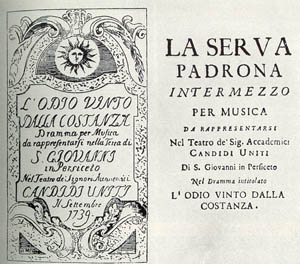
Pergolesi's relatively small output of works includes several compositions of high artistic and historical importance. On August 28, 1733, his opera seria Il prigionier superbo premiered at the Teatro San Bartolomeo in Naples. Though the main opera was not a success, it contained the two-act buffa intermezzo, La serva padrona (The Servant Mistress), which quickly gained immense popularity and became a standalone work. This intermezzo was crucial for the development and widespread dissemination of opera buffa across Europe.
In January 1735, his opera seria L'Olimpiade premiered in Rome, distinguishing it from his other operas which mostly premiered in Naples. This work is considered one of the masterpieces of 18th-century opera seria.
His most famous sacred work is the Stabat Mater, composed in 1736 for soprano, alto, string orchestra, and basso continuo. It was commissioned by the Confraternita dei Cavalieri di San Luigi di Palazzo for their annual Good Friday meditation honoring the Virgin Mary. Pergolesi's Stabat Mater replaced an earlier setting by Alessandro Scarlatti (1724), which was already considered "old-fashioned," reflecting the rapid changes in musical taste. The work's opening section demonstrates Pergolesi's mastery of the Italian Baroque durezze e ligature style, characterized by numerous suspensions over a faster, conjunct bassline. It became the most frequently printed musical work of the 18th century and was even adapted by Johann Sebastian Bach for a non-Marian text in his cantata Tilge, Höchster, meine Sünden (BWV 1083).
Other notable operatic works include Adriano in Siria (1734), which featured the intermezzo Livietta e Tracollo, and Il Flaminio (1735), both of which, like Lo frate 'nnamorato, were set to texts in the Neapolitan language. In addition to his operas, Pergolesi composed other sacred music, including a Mass in F and three settings of the Salve Regina. The Lenten Hymn 'God of Mercy and Compassion' by Redemptorist priest Edmund Vaughan is most commonly set to a tune adapted from Pergolesi.
1.4. Health Decline and Death
Around 1735, Pergolesi's health began to decline significantly due to tuberculosis, a chronic illness he had been battling. In February 1736, following his doctor's advice, he moved to the Franciscan monastery in Pozzuoli, near Naples, seeking a change of air and rest for his recuperation. It was there, while his health was rapidly deteriorating, that he composed his final masterpiece, the Stabat Mater, commissioned by the Confraternita dei Cavalieri di San Luigi di Palazzo. Pergolesi died shortly after completing this work, on March 16 or 17, 1736, at the remarkably young age of 26. He was buried in the Franciscan monastery the day after his death.
1.5. Portraits and Depictions
The visual representations of Giovanni Battista Pergolesi are scarce, with only two caricatures by the artist Pier Leone Ghezzi considered authentic portraits. These sketches provide a unique glimpse into his appearance, contrasting sharply with later idealized depictions.
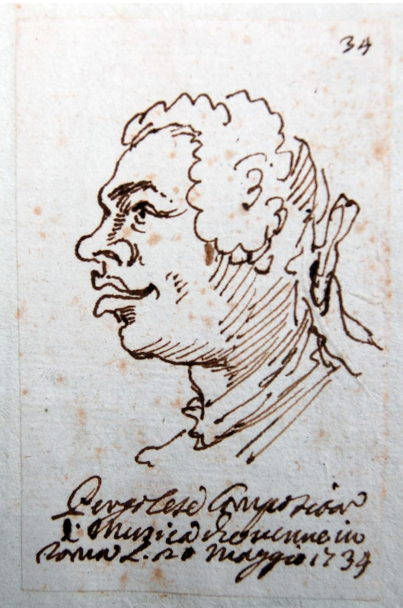
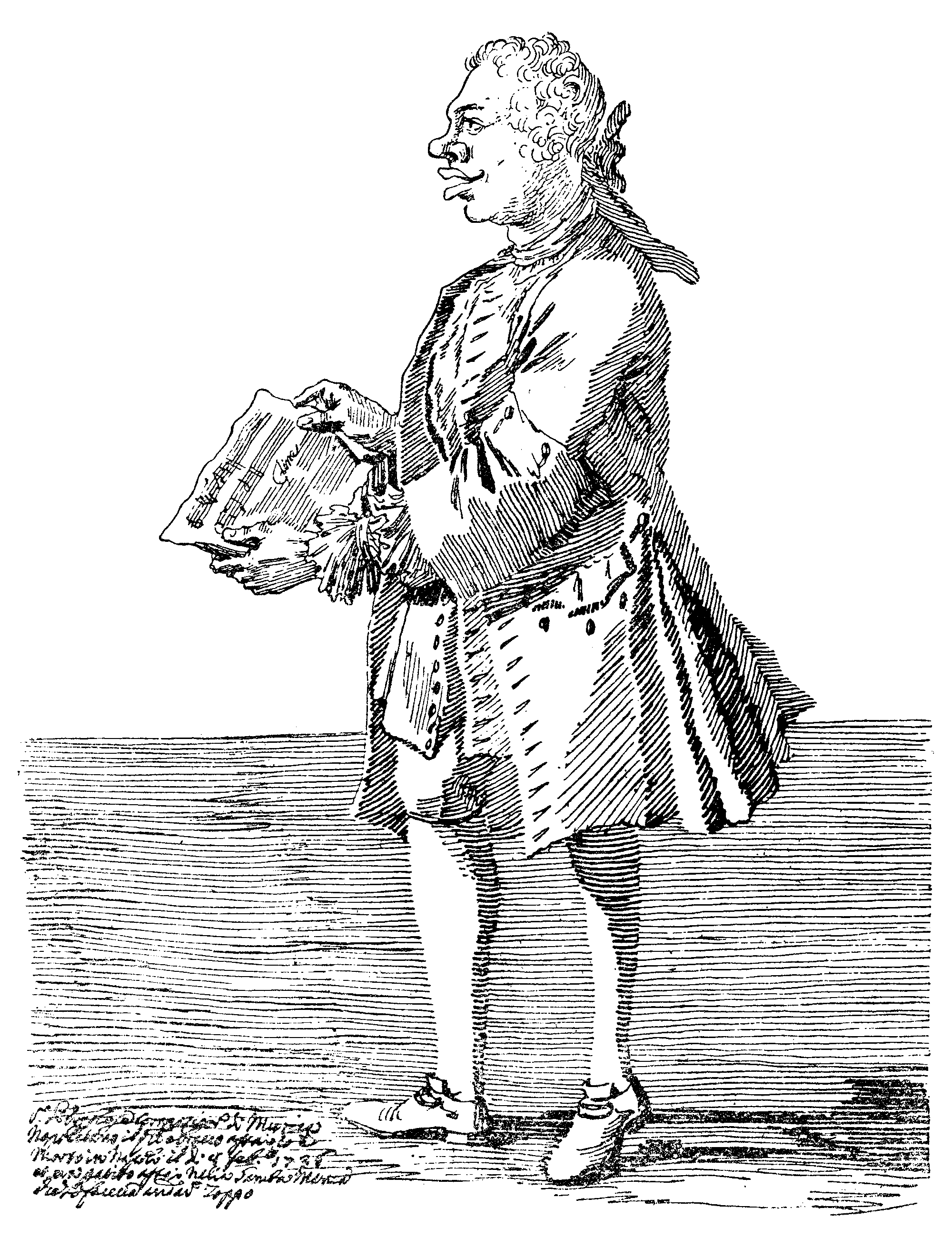
The two caricature sketches by Pier Leone Ghezzi are the only two authentic portraits of the musician that have survived. These depictions show marked features of his face that are very different from subsequent idealizations. Notably, the second caricature explicitly illustrates a "pronounced deformity" of his left leg, indicating a probable previous condition such as poliomyelitis, which caused him to walk with a limp. The first caricature is dated May 20, 1734, noting his arrival in Rome, while the second, evidently derived from the first, includes a note about his death on February 7, 1736, in Naples.
2. Musical World and Style
Pergolesi's musical contributions are significant for their stylistic innovations and his unique position as a transitional figure, bridging the grandeur of the Baroque era with the emerging clarity and expressiveness of the Classical style.
2.1. Neapolitan School and Baroque Tradition
Pergolesi was a prominent figure within the Neapolitan School of music, a highly influential center for opera and sacred music in the 18th century. He inherited and worked within the rich Baroque musical heritage, demonstrating a mastery of its techniques and forms. For instance, the opening section of his Stabat Mater showcases his command of the Italian Baroque durezze e ligature style, characterized by the use of numerous suspensions over a faster, conjunct bassline, creating a poignant and expressive texture.
2.2. Transition to Classical Style
Despite his short life, Pergolesi played a crucial role in pioneering elements that would come to define the Classical era in music. He is recognized as one of the earliest composers to exhibit characteristics of the Classical style, particularly through his contributions to opera buffa. His works, especially La serva padrona, laid important foundations for the development of comic opera, influencing later composers such as Mozart and Gioachino Rossini. He is considered by some to be the first classicist in this genre, marking a shift from the more elaborate and serious Baroque forms towards a lighter, more direct, and emotionally accessible musical language. His activity occurred during a period of transition from the grand, intricate Baroque style to the clear, elegant Classical style.
2.3. Musical Characteristics
Pergolesi's music is noted for several distinct qualities. His compositions are characterized by their smooth and flowing melodies, often possessing a fresh and captivating beauty. He employed a rich harmonic language, creating nuanced textures and delicate expressions. His vocal writing, in particular, is often described as brilliant and radiant, showcasing a deep understanding of the human voice. While some critics note that his works may sometimes lack a grand structural force characteristic of earlier Baroque masters, this is often compensated by his inventive melodic lines, clarity of expression, and an innate simplicity that resonated with audiences. His ability to craft expressive melodies and convey emotions in a direct and unadorned manner contributed significantly to the evolving musical aesthetic of his time.
3. Works
The standard catalogue of Pergolesi's works was established by Marvin Paymer in 1977, assigning a unique "P. number" to each item. For example, his famous Stabat Mater is cataloged as P.77. However, the authentication of his works has been a complex issue due to widespread misattributions after his death. Modern critical studies have significantly reduced the number of works confidently attributed to him, with only about 30 out of over 300 attributed compositions considered authentic.
3.1. Operas
Pergolesi's operatic output includes both serious and comic works, as well as intermezzos that often gained independent popularity.
- La Salustia (January 1732, Teatro San Bartolomeo, Naples): His first opera seria; the text was possibly by Sebastiano Morelli after Alessandro Severo by Apostolo Zeno.
- Lo frate 'nnamorato (September 27, 1732, Teatro dei Fiorentini, Naples): A musical comedy (commedia musicare) set to a Neapolitan language text.
- Il prigionier superbo (August 28, 1733, Teatro San Bartolomeo, Naples): An opera seria that famously contained the intermezzo La serva padrona.
- La serva padrona (1733): The intermezzo from Il prigionier superbo, which became a highly successful and influential work in its own right.
- Adriano in Siria (October 25, 1734, Teatro San Bartolomeo, Naples): An opera seria that included the intermezzo Livietta e Tracollo.
- Livietta e Tracollo (1734): The intermezzo from Adriano in Siria.
- L'Olimpiade (January 1735, Teatro Tordinona, Rome): An opera seria.
- Il Flaminio (Autumn 1735, Teatro Nuovo, Naples): A musical comedy (commedia) set to a Neapolitan language text.
3.2. Sacred Music
Pergolesi composed a variety of sacred works, with his Stabat Mater being the most celebrated.
- Antifona "In caelestibus regnis" (1731)
- Confitebor tibi Domine (Psalm 111) in C for Soprano, Alto, Choir, Strings and Continuo (1732)
- Dixit Dominus (Psalm 110) for Soprano, Bass, 2 Choirs and 2 Orchestras (1732)
- Laudate pueri Dominum (Psalm 113) in D for Soprano, Mezzo, Choir and Orchestra (1734)
- Mass in D (1732)
- Mass in F "San Emidio" (Missa romana) for Soprano, Alto, 2 Choirs, 2 Orchestras and Continuo (1732)
- Oratorio La fenice sul rogo, o vero La morte di San GiuseppeThe Phoenix on the Pyre, or The Death of Saint JosephItalian (1731, atrium of the Chiesa dei Girolamini, Naples)
- Dramma sacro Li prodigi della divina grazia nella conversione e morte di san Guglielmo d'Aquitania (1731, Monastery of Sant'Agnello Maggiore, Naples)
- Salve regina in A for Soprano, Strings and Continuo (1731)
- Salve regina in C for Soprano, Strings and Continuo (1735)
- Salve regina in F for Alto, Strings and Continuo (1736, adapted from the Salve regina in C)
- Stabat Mater in F (written 1735, premiered 1736, Naples)
3.3. Instrumental Music
Pergolesi's instrumental compositions include sinfonias and concertos.
- Sinfonia in B-flat major
- Sinfonia in D major
- Sinfonia in F major
- Sinfonia in G major, P.35
- Sinfonia in G minor, P.24c
- Concerto for Flute and 2 Violins in D major
- Concerto for Flute and 2 Violins in G major
- Concerto for 2 Harpsichords and Orchestra
- Violin Concerto in B-flat major
3.4. Keyboard and Chamber Works
His smaller-scale works include pieces for keyboard instruments and chamber ensembles.
- Harpsichord Sonata in A major, P.1
- Harpsichord Sonata in D major
- Organ Sonata in F major
- Organ Sonata in G major
- Trio Sonata in G major, P.12
- Trio Sonata in G minor
- Unspecified Andantino, for violin and piano
- Violin Sonata in G major
- Sonata No.1 in G major, for 2 violins
- Sinfonia in F major, for cello and continuo
3.5. Spurious and Doubtful Works
A significant challenge in cataloging Pergolesi's oeuvre is the large number of works that have been misattributed to him. This phenomenon arose from his extraordinary posthumous fame, leading to the commercial practice of publishing any score resembling the Neapolitan school style under his name. By the end of the 19th century, over 500 compositions were informally attributed to him. Contemporary studies have drastically reduced this number, with less than 50 works now considered authentic, and only 28 whose paternity is considered certain by some scholars. Even among well-known pieces, doubts persist about attribution, such as the Salve Regina in F minor.
Notable examples of spurious or doubtful works include:
- The 6 Concerti armonici for 4 violins, viola, and continuo, which were long attributed to Pergolesi but are in fact by Unico Wilhelm van Wassenaer.
- The intermezzo Il maestro di musica (The Music Teacher), which is primarily a pasticcio of works by Pietro Auletta.
- The popular aria Nina (Tre giorni son che Nina), now attributed to Vincenzo Legrenzio Ciampi.
- The aria Se tu m'ami (If you love me), which was certainly composed by the 19th-century musicologist Alessandro Parisotti and included in one of his collections of Baroque arias under Pergolesi's name.
- The Magnificat in D major, which was composed by his teacher Francesco Durante.
- The Flute Concerto in G major (P.33) and other flute concertos (No. 1 in G major, No. 2 in D major) are considered very doubtful.
- Other works such as some trio sonatas and harpsichord etudes have also been found to be misattributed.
The extent of this misattribution is famously illustrated by Igor Stravinsky's ballet Pulcinella, composed in 1920 as a tribute to Pergolesi's style. More recent musicological research has revealed that out of the 21 pieces used in Pulcinella, 11 are now attributed to other composers (primarily Domenico Gallo), two are of dubious attribution, and only eight (mostly taken from Pergolesi's authentic operas) can be confidently attributed to him.
4. Posthumous Fame and Influence
Pergolesi's renown during his lifetime was largely confined to the musical circles of Naples and Rome, despite numerous accolades. However, his death sparked an extraordinary phenomenon of posthumous fame across Europe, influencing poets and artists who reinterpreted him in a romantic light during the 19th century.
4.1. Spread of Fame and Myth Creation
As the historian and traveler Charles Burney observed, "from the moment his death became known, all Italy manifested a keen desire to hear and possess his works." This surge in popularity after his death was exceptional in music history, comparable to the phenomenon experienced by Mozart. The demand for his music led to numerous prints of his compositions spreading throughout Europe, even though many works were falsely attributed to him. The scarcity of concrete information about his life and works provided fertile ground for the flourishing of imaginative anecdotes and romantic myths. These included tales of his tragic end being due to poisoning by envious musicians rather than natural causes, and attributions of Apollonian beauty and numerous tragic loves.
4.2. Role in the Querelle des Bouffons
Several years after Pergolesi's death, the performance of La serva padrona in Paris in 1752 by an Italian comic opera troupe ignited the famous Querelle des Bouffons (Quarrel of the Comic Actors). This two-year debate deeply divided Paris's musical community between proponents of serious French opera, championed by figures like Jean-Baptiste Lully and Jean-Philippe Rameau, and supporters of the new Italian comic opera. Pergolesi was held up as the quintessential model of the Italian style during this quarrel. For Jean-Jacques Rousseau, in particular, the freshness and grace of Pergolesi's music in La serva padrona served as a dazzling demonstration of the Italian opera's superiority over French lyric tragedy. The French composer André Grétry famously declared, "Pergolesi was born, and the truth was known!"
4.3. Misattributions and Misuse of Works
Due to Pergolesi's extraordinary posthumous fame, the catalog of his works experienced an unpredictable destiny. Throughout the 18th and 19th centuries, it became a common practice in Europe to publish any score resembling the Neapolitan school style under his name, primarily for speculative and commercial purposes. This led to a massive inflation of his informal catalog, reaching over 500 compositions by the end of the 19th century. This widespread misattribution created significant confusion regarding his genuine oeuvre, a situation that persisted even into the 20th century. Modern scholarly efforts have been crucial in meticulously sifting through these works to establish a more accurate catalog, drastically reducing the number of compositions confidently attributed to him. Music and record editions continue to perpetuate some of these uncertainties, publishing works under his name that were certainly produced by other composers.
4.4. Influence on Later Music
Pergolesi's innovative approach, particularly in opera buffa, had a notable influence on subsequent generations of composers. His melodic inventiveness and clear, expressive style resonated with the emerging Classical aesthetic. His impact can be seen in the works of composers like Mozart, who further developed the comic opera genre. A significant example of his lasting influence is Igor Stravinsky's ballet Pulcinella, composed in 1920. Although later research revealed that many of the pieces Stravinsky used were not actually by Pergolesi, the ballet was conceived as a tribute to Pergolesi's style and is considered a seminal work in the Neoclassical movement, marking the beginning of a new stylistic era in the 20th century.
5. Works in Popular Media
Pergolesi's music has been featured in various films and documentaries, highlighting its enduring appeal and emotional depth.
- His Salve Regina is prominently featured in the 1994 film Farinelli, in which the titular castrato also performs the Stabat Mater Dolorosa in a duet.
- The first and last parts of Pergolesi's Stabat Mater were used in the soundtrack of the 1989 film Jesus of Montreal (Jésus de Montréal).
- The fifth part ("Quis est homo") of his Stabat Mater was featured in the soundtrack of the 1997 film Smilla's Sense of Snow.
- The last part of the Stabat Mater was also used in the acclaimed 1984 film Amadeus and in Andrei Tarkovsky's 1975 film The Mirror.
- The 1986 Australian film Cactus, directed by Paul Cox, also includes Pergolesi's Stabat Mater on its soundtrack.
- The final movement ("Quando Corpus / Amen") of Pergolesi's Stabat Mater was used in Nothing Left Unsaid, a 2016 documentary about Gloria Vanderbilt and Anderson Cooper.
6. Assessment and Legacy
Giovanni Battista Pergolesi's legacy is marked by his exceptional talent, his pivotal role in musical transition, and the unique trajectory of his posthumous fame. Despite his tragically short life and only five years of active composition, he created works of high artistic value and historical importance that continue to resonate. He is widely regarded as one of the greatest Italian musicians of the first half of the 18th century and a key figure in the Neapolitan School.
Pergolesi's compositional style is celebrated for its smooth melodies, fresh beauty, rich harmonic nuances, and delicate expressiveness. His vocal writing, in particular, is noted for its brilliance. While some scholars suggest his works may occasionally lack the grand structural force found in earlier Baroque masters, this is often offset by his melodic ingenuity and clarity.
His most significant contribution lies in his role as a transitional figure, bridging the elaborate and often weighty Baroque style with the more direct, elegant, and emotionally accessible aesthetics of the emerging Classical era. He was a crucial early composer of opera buffa, and his intermezzo La serva padrona not only achieved immense popularity but also profoundly influenced the development of comic opera across Europe, laying foundations for later masters. His Stabat Mater stands as one of the most important sacred works of all time, demonstrating his profound emotional depth and mastery of counterpoint.
The phenomenon of widespread misattribution following his death, though problematic for cataloging his authentic works, paradoxically underscores his immense posthumous popularity and the profound impact his name had on the musical imagination of the 18th and 19th centuries. Pergolesi's enduring influence, from inspiring the Querelle des Bouffons to being honored by 20th-century composers like Stravinsky, firmly establishes his place as a pioneering and influential figure in the history of classical music.