1. Overview
In Norse mythology, Gefjon (GefjonGefjonNorse, Old, GefjunGevyinIcelandic, GjevjonYevyonNorwegian, GefionGepionDanish, GefjonYefionSwedish) is an Áss goddess associated with ploughing, foreknowledge, and virginity. She is prominently linked to the creation of the Danish island of Zealand from the land of the legendary Swedish king Gylfi. Her mythology also connects her to the legendary Danish king Skjöldr and her children, who were transformed into oxen for the monumental task of ploughing.
Gefjon is attested in various Old Norse literary sources, including the Poetic Edda, a compilation from the 13th century of earlier traditional sources; the Prose Edda and Heimskringla, both written in the 13th century by Snorri Sturluson; in the works of skalds; and she appears as a gloss for various Greco-Roman goddesses in some Old Norse translations of Latin works. Scholars have extensively theorized about the etymology of her name, her connections to fertility and ancient ploughing practices, the implications of her virgin status, potential mentions in the Old English poem Beowulf, and her relationship with other goddesses like Freyja and Frigg.
2. Etymology
The etymology of the theonym Gefjon (and its variant Gefjun) has been a subject of scholarly discussion. In modern scholarship, the element Gef- is generally considered to be related to the same element found in the name Gefn, one of the numerous names for the goddess Freyja. This connection suggests that the name likely means 'she who gives (prosperity or happiness)', leading to the etymological interpretation of Gefjun as "the giving one". The names Gefjun and Gefn are also believed to be related to the Matron groups known as the Alagabiae or Ollogabiae.
Scholar Albert Murey Sturtevant noted that the suffix -un is rare in feminine personal names, appearing similarly in Njǫr-un. He proposed that this parallel, with the addition of the n- and un-suffixes, provides an exact linguistic parallel between Gef-n : Gefj-un (similar to Njǫr-n : Njǫr-un). The suffix of the name may also stem from the Old Norse word hjón, which literally means 'the joined'. This term could refer to a household, a loving couple, or even the crew on a ship, particularly a skeið. Furthermore, the Finnish word kapiot, which signifies "bride's outfit" or "trousseau," may also derive from Gefjon's name.
3. Attestations
Gefjon is referenced across several Old Norse literary and historical texts, providing different facets of her mythology and divine roles.
3.1. Poetic Edda
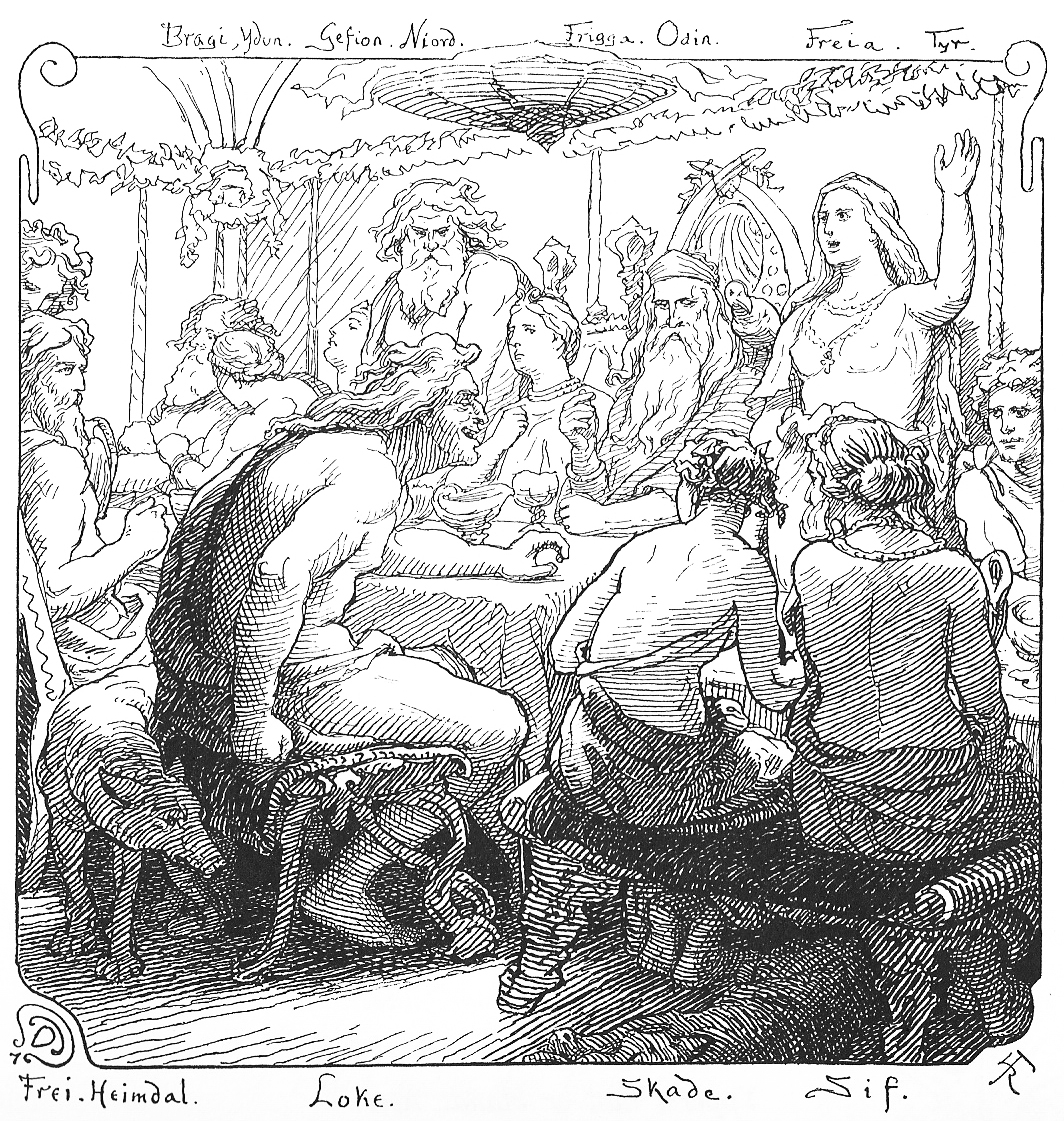
In the Poetic Edda, Gefjon appears in three stanzas within the poem Lokasenna. This section describes a heated exchange between Gefjon and Loki at a dinner feast, during which Odin intervenes to defend her. After an earlier dispute between Loki and the goddess Iðunn, Gefjon questions Loki's intent to sow negativity among the assembled gods:
Benjamin Thorpe's translation:
:Gefion.
:Why will ye, Æsir twain, here within,
:strive with reproachful words?
:Lopt perceives not that he is deluded,
:and is urged on by fate.
Henry Adams Bellows' translation:
:Gefjun spake:
:"Why, ye gods twain, with bitter tongues
:Raise hate among us here?
:Loki is famed for his mockery foul,
:And the dwellers in heaven he hates.
The final two lines of this stanza show considerable variation between translations, with scholar Henry Adams Bellows noting the manuscript text as "puzzling," leading to "freely amended" interpretations. In the subsequent stanza, Loki retaliates against Gefjon by asserting that a youthful male once gave her a necklace, and that Gefjon slept with this youth:
Benjamin Thorpe's translation:
:Loki.
:Be silent, Gefion! I will now just mention,
:how that fair youth thy mind corrupted,
:who thee a necklace gave,
:and around whom thou thy limbs didst twine?
Henry Adams Bellows' translation:
:Loki spake
:Be silent, Gefjun! for now shall I say
:Who led thee to evil life;
:The boy so fair gave a necklace bright,
:And about him thy leg was laid.
Odin then intercedes, stating that Loki must be quite insane to provoke Gefjon's wrath, given that she possesses knowledge of the destinies of mankind as thoroughly as Odin himself:
Benjamin Thorpe's translation:
:Thou art raving mad, Loki! and hast lost thy wits,
:in calling Gefion's anger on thee;
:for all men's destinies,
:I ween, she knows as thoroughly as I do.
Henry Adams Bellows' translation:
:Mad art thou, Loki, and little of wit,
:The wrath of Gefjun to rouse;
:For the fate that is set for all she sees.
:Even as I, methinks.
3.2. Prose Edda
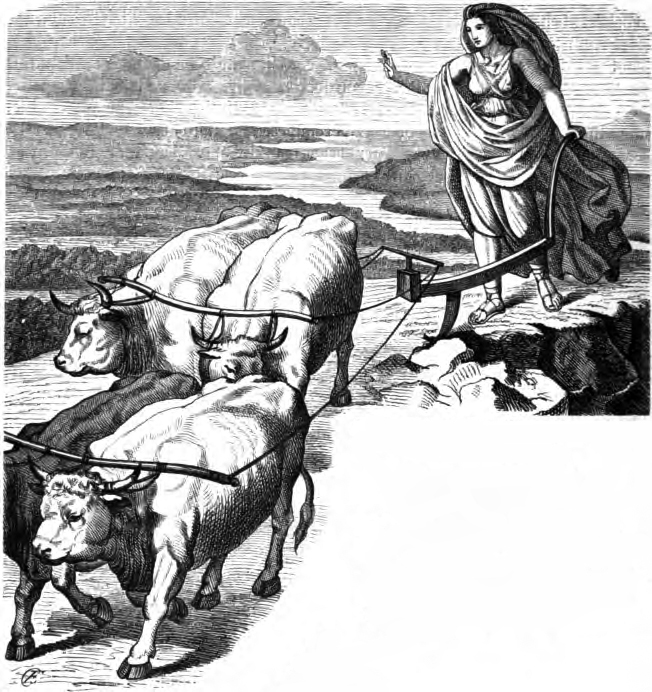
The Prose Edda details Gefjon's role in the creation of Zealand. The book Gylfaginning opens with a prose account describing how King Gylfi, ruler of what is now Sweden, once granted "a certain vagrant woman" a reward for his entertainment: "one plough-land in his kingdom, as much as four oxen could plow up in a day and night." This woman was identified as Gefjun, "of the race of the Æsir." Gefjun obtained four oxen from Jötunheimr in the north, which were her sons from an unnamed jötunn. Her plough "cut so hard and deep that it uprooted the land, and the oxen drew the land out into the sea to the west and halted in a certain sound." Gefjun then placed this land, bestowing upon it the name Zealand. The area from which the land was taken became a lake. According to Snorri Sturluson, this lake is now known as Lake Mälar in Sweden, and its inlets are said to parallel the headlands of Zealand. However, scholars suggest that the myth likely originally referred to Lake Vänern, as its geography matches the description more accurately than Lake Mälar.
As corroboration, the prose account includes a stanza from a work attributed to the 9th-century skald Bragi Boddason:
:Gefjun dragged from Gylfi,
:gladly the land beyond value.
:Denmark's increase,
:steam rising from the swift-footed bulls.
:The oxen bore eight
:moons of the forehead and four heads,
:hauling as they went in front of
:the grassy isle's wide fissure.
In chapter 35 of Gylfaginning, the enthroned figure of High presents a list of goddesses. Gefjun is presented fourth, and High states that Gefjun is a virgin, and all who die as virgins become her attendants. High also notes that, similar to Gefjun, the goddess Fulla is also a virgin. At the beginning of the Prose Edda book Skáldskaparmál, Gefjun is listed among nine goddesses who attend a banquet hosted by Ægir on the island of Hlesey (modern Læsø, Denmark). In chapter 32, Gefjun is again listed among six goddesses present at a party held by Ægir. Chapter 75 includes Gefjun in a list of 27 ásynjur names. Additionally, the name Gefjun appears in a kenning for the völva Gróa ("ale-Gefjun") in the skald Þjóðólfr of Hvinir's composition Haustlöng, which is quoted in chapter 17 of Skáldskaparmál.
3.3. Heimskringla
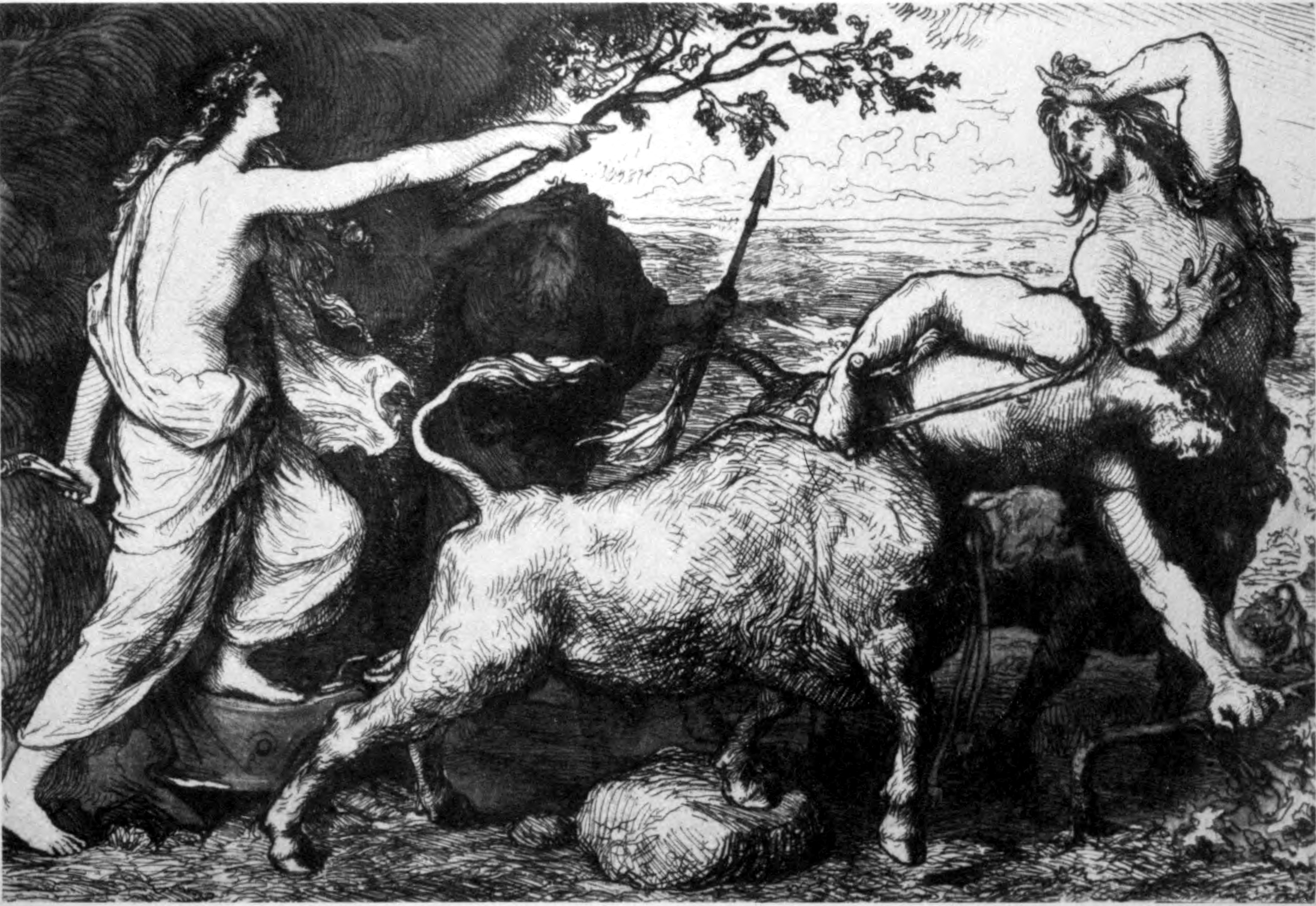
In chapter 5 of Ynglinga saga, a text collected within Heimskringla, a euhemerized prose account of Gefjun is provided. This account relates that Odin dispatched Gefjun from Odense, Funen, instructing her to go "north over the sound to seek for land." There, Gefjun encountered King Gylfi, who granted her ploughland. Gefjun then traveled to the land of Jötunheimr, where she bore four sons to an unnamed jötunn. She transformed these four sons into oxen, harnessed them to a plough, and used them to draw forth the land westward of the sea, directly opposite Odense. The saga specifies that this newly formed land is now known as Zealand. The account further states that Gefjun married Skjöldr, who is described as "a son of Odin," and that the couple subsequently dwelled in Lejre, Denmark. The saga also posits that the area from which Gefjun took the land to form Zealand became a lake known as Lögrinn, and that the bays in Lake Lögrinn correspond to the nesses of Zealand. Following this narrative, the same stanza composed by the skald Bragi Boddason that appears in Gylfaginning is also presented here.
3.4. Völsa þáttr
Gefjun's name is invoked in the þáttr Völsa þáttr (Lay of Völsi). In this narrative, the daughter of a thrall reluctantly engages in worship of a penis severed from a horse, making an oath that includes Gefjun:
Old Norse:
:Þess sver eg við Gefjun
:og við goðin önnur,
:að eg nauðug tek
:við nosa rauðum.
:Þiggi mörnir
:þetta blæti,
:en þræll hjóna,
:þríf þú við Völsa.
Modern English:
:I swear by Gefjun
:and the other gods
:that against my will
:do I touch this red proboscis.
:May giantesses
:accept this holy object,
:but now, slave of my parents,
:grab hold of Völsi.
3.5. Glosses in Classical Mythology Translations
Gefjun's name appears in some Old Norse translations of Latin works as a gloss for goddesses from Greco-Roman mythology, indicating perceived parallels. In several works, including Breta sögur (which is based on Geoffrey of Monmouth's Historia Regum Britanniae), the Roman goddess Diana is glossed as Gefjun. In Stjórn, Gefjun serves as a gloss for the goddess Aphrodite. Furthermore, in other texts, Gefjun is used to gloss the names of the goddesses Athena and Vesta.
4. Deity and Symbolism
Gefjon holds several significant roles and attributes within Norse mythology, primarily associated with the physical transformation of land, the concept of virginity, and prophetic knowledge.
4.1. Creation of Zealand
The most central and distinctive myth associated with Gefjon is her role in the creation of the island of Zealand. The myth recounts that King Gylfi of Sweden offered Gefjon a certain amount of plough-land. Gefjon, with her four sons transformed into powerful oxen, then ploughed the land so vigorously that it was uprooted from the Swedish mainland. These oxen, pulling a plough, dragged the enormous mass of earth westward into the sea, where it came to rest and formed the island now known as Zealand, the largest and most populous island of Denmark, where the capital city Copenhagen is located. The void left behind by this immense ploughing act is said to have formed Lake Mälar (or originally Lake Vänern) in Sweden, with its inlets and headlands mirroring those of Zealand. This act highlights Gefjon's profound connection to the land and its fertility, suggesting a divine power capable of shaping the very geography of the world. The myth imbues Zealand with a sacred origin, linking it directly to a powerful goddess.
4.2. Virginity and Companions
Gefjon is notably depicted as a virgin goddess. According to accounts in the Prose Edda, she is explicitly stated to be a virgin, and it is believed that all women who die as virgins become her devoted attendants in the afterlife. This unique attribute distinguishes her among the Ásynjur, emphasizing a particular aspect of purity or spiritual guardianship. The idea that she receives the souls of deceased virgins suggests a role as a psychopomp or guardian of a specific realm for those who maintain their virginity throughout life, underscoring a symbolic meaning related to innocence, unblemished spirit, or perhaps a distinct form of post-mortem existence.
4.3. Marriage and Family
Despite her portrayal as a virgin, other accounts of Gefjon's life present varying marital statuses. Most notably, Heimskringla records that Gefjon married the legendary Danish king Skjöldr, who is described as a son of Odin. Following their marriage, they are said to have dwelled in Lejre, Denmark, a significant historical and mythological site. In addition to her marital status, Gefjon is a mother; she bore four sons to an unnamed jötunn from Jötunheimr. These four sons were subsequently transformed by Gefjon into the mighty oxen that assisted her in the monumental ploughing act, creating the island of Zealand. This dual portrayal, as both a virgin goddess and a married mother, has led to scholarly discussion and interpretation regarding the consistency of her myths.
4.4. Prophetic and Other Attributes
Beyond her associations with ploughing and virginity, Gefjon is attributed with other significant divine characteristics. In the poem Lokasenna from the Poetic Edda, Odin himself asserts that Gefjon possesses profound knowledge of the destinies of mankind, claiming that she knows them "as thoroughly as I do." This statement elevates her to a prophetic status, indicating her awareness of fate and the future course of human events, a power typically associated with major deities like Odin. Furthermore, the skald Þjóðólfr of Hvinir's composition Haustlöng employs the kenning "ale-Gefjun" for the völva Gróa, suggesting a broader symbolic connection or perhaps a role associated with celebrations or a specific kind of wisdom.
5. Academic Interpretations and Theories
Various scholarly theories and interpretations have been proposed to understand Gefjon's character, her myths, and her potential connections within broader Germanic and Northern European religious traditions.
5.1. Connection to Ploughing, Fertility, and Folk Customs
Scholars have identified a recurring theme in legends and folktales across different cultures, wherein an individual, often a woman, is challenged to acquire as much land as can be traversed within a specified time. This motif is attested in ancient sources like Livy (around 1 CE) and the 5th century BCE Greek historian Herodotus, as well as in numerous folktales from Northern Europe. In particular, six tales from Jutland, Denmark, and one from Germany feature a plough being used in a manner similar to Livy's account, although the conditions are often met by walking or riding instead of ploughing.
Hilda Ellis Davidson highlights an Icelandic tale of a female settler whose husband died during a voyage. She established her claim to a piece of land by driving a young heifer around it. Landnámabók records this as a recognized method for a woman to claim land, specifying that she could not possess more than she could encircle in this way between sunrise and sunset on a spring day. Davidson suggests this sounds more like a ritualistic taking of land rather than a mere legal requirement, drawing a parallel to men lighting fires when claiming new land. She posits that the women's custom might have been linked to a fertility goddess. Davidson also notes that Zealand, the island created by Gefjon in myth, is the most fertile region of Denmark, reinforcing the link to fertility.
Davidson further connects 19th-century folk customs involving ploughs in Northern and Eastern Europe to ancient practices from the heathen period, possibly involving Gefjon. In Eastern Europe, particularly Russia, a custom was recorded where women with loosened hair, clad in white, would assemble and drag a plough three times around their village during severe disease outbreaks. In Western Europe, yearly ploughing rituals were held in England and Denmark in preparation for spring sowing, such as on Plough Monday after the Christmas break in eastern England. During these rituals, groups of young men would drag a plough, often adopting various names. Davidson suggests that "Gefjon with her giant sons transformed into oxen seems a fitting patroness of ceremonies of this kind."
Similar elements and parallels can be found in non-Germanic traditions. Davidson points to a 19th-century Welsh folktale regarding the Lady of the Lake. In this tale, the Lady brings forth "a herd of wondrous cattle" from the water after agreeing to marry a local farmer. When the farmer unwittingly breaks conditions she had set, the Lady returns to her dwelling beneath the lake, summoning her cattle by name to accompany her. In one version, she calls forth four grey oxen that were ploughing in a field six miles away. These oxen, responding to her call, dragged the plough with them, and the gash left in the land by the plough was said to have been clearly visible. An 1881 account claimed that people once gathered at the lake on the first Sunday of August, waiting to see if the water would boil up, indicating the Lady and her oxen's appearance. Davidson observes that "here again a supernatural woman is linked both with water and ploughing land."
In Germanic regions of Europe, traditions exist of supernatural women who travel the countryside with a plough. Examples include Holde and Holle from western and central Germany, and Berchte and Perchte in traditions from upper Germany, Switzerland, and Austria. These figures were often said to travel with a plough, reminiscent of the journey of a fertility goddess blessing the land in pre-Christian times. On these occasions, they might be accompanied by a host of tiny children, sometimes suggested to be souls of unbaptized children or changelings, but another possibility is that they were the souls of the unborn. Some local tales feature the plough breaking down, the supernatural woman receiving assistance from a helper, and her giving him wooden chips that later turn to gold.
Regarding the plough and Gefjon, Davidson concludes that "the idea behind the taking of the plough round the countryside seems to be that it brought good fortune and prosperity, gifts of a benevolent goddess. Gefjon and her plough thus fit into a large framework of the cult of a goddess associated with fertility of both land and water."
5.2. Relationship with Other Goddesses
Some scholars have proposed connections between Gefjun and other prominent Norse goddesses, particularly Frigg and Freyja, due to perceived similarities in their attributes and mythological roles. Britt-Mari Näsström theorizes that Gefjun is simply another aspect or manifestation of Freyja. She also suggests that the "white youth" whom Freyja is accused of sleeping with by Loki in Gylfaginning may actually be the god Heimdallr.
Hilda Ellis Davidson suggests that "there seems ample indication that Gefjon represents one aspect of a once powerful goddess of the north, the figure representing in Scandinavian myths as either Frigg, the wife of Odin, or Freyja, sister of fertility god Freyr. Freyja, desired by gods, giants and dwarves alike, acted as dispenser of bounty and inspirer of sexual love between men and women like the Greek Aphrodite." Davidson further notes that, as Axel Olrik pointed out long ago, very little is known about Gefjon, making it possible that she could be identified with Frigg or Freyja. She highlights that the Prose Edda associates Gefjon with an afterlife realm for the dead, and in Lokasenna, Loki claims that Gefjon was given a jewel by a lover, traditions that align well with what is known about Freyja.
Regarding the parallels drawn between Freyja and Gefjon based on the exchange in Lokasenna, Rudolf Simek argues that Lokasenna is a "late composition and the reproach is too much of a stereotype to carry much weight." However, Simek adds that even if Gefjon should not be definitively identified with Freyja, she could still be considered "one of the fertility and protective goddesses because of the meaning of her name ('the giving one')."
5.3. Possible Mentions in Beowulf

Mentions of Gefjon may appear in the Old English epic poem Beowulf in five specific passages: line 49, line 362, line 515, line 1394, and line 1690. The Old English word geofon, which serves as a poetic epithet for 'ocean' or 'sea', finds a parallel in the word geƀen found in the Old Saxon poem Heliand.
Scholar Frank Battaglia refers to these as "the Gefion passages," and poses the question: "Does Beowulf oppose the Earth Goddess of ancient Germanic religion?" He suggests that such an interpretation arises from the possibility that the name Gefion, by which early Danes called their female chthonic deity, may occur five times in the Old English poem. Battaglia further theorizes that:
:The five Gefion passages seem to highlight the championing of a new order antagonistic to goddess worship. In light of what appears to be an elaborate thematic statement about patrilineage in the poem, the new order may also have entailed a change in kinship systems. Grendel and his mother may stand as types of earlier, matrilineal tribes. Further the hall which is the object of struggle between Beowulf and the first two monsters may symbolize the consolidation of new hierarchical social organization among the northern Germanic peoples.
Battaglia contends that if these passages refer to Gefjon, the word gēafon in line 49 directly indicates Gefjon's sadness at the death of Skjöldr (who is described as having wed Gefjon in Heimskringla). He concludes that "we may with some confidence conclude that in a poem about Scyld's funeral for an Anglo-Danish audience, the word gēafon could probably not have been used without invoking Gefion." Battaglia also posits specific translations for other lines: line 362 (Geofenes begang) as "Gefion's realm," line 515 (Geofon ȳðum wēol) as "Gefion welled up in waves," line 1394 (nē on Gyfenes grund, gā þær hē wille) as "not (even) in the ground of Gefion, go where he will," and line 1690 (Gifen gēotende gīgante cyn;) as "Gefion gushing, the race of giants."
Scholar Richard North theorizes that the Old English geofon and the Old Norse Gefjun, along with Freyja's name Gefn, may all stem from a common origin: gabia, a Germanic goddess associated with the sea, whose name means "giving."
5.4. Discussions on Contradictions in Accounts
Scholars have noted and debated the seemingly contradictory portrayals of Gefjon in various sources. In Gylfaginning of the Prose Edda, Gefjon is explicitly described as a virgin goddess, with the belief that all who die as virgins become her attendants. However, other attestations appear to contradict this. In Lokasenna from the Poetic Edda, Loki accuses Gefjon of having had sexual relations with a youthful male who gave her a necklace. Furthermore, Heimskringla states that Gefjon married the legendary Danish king Skjöldr.
Scholar John Lindow highlights that the Gefjon/Gylfi story in Gylfaginning is absent in one branch of the work's manuscripts. This observation suggests that it "was not part of Snorri's original text but may have been added by a later scribe." Lindow considers the possibility that if Snorri did not author this particular section, the individual who added the story might have either been aware of an association between Gefjon and the Greek goddess Diana (as seen in the aforementioned glosses) or adopted a view of pagan gods as demons, thereby casting Gefjon in a negative light as a "whore." Despite this, Lindow also acknowledges that Loki's reference to Gefjon in Lokasenna indicates that the notion of Gefjon engaging in sexual activity might have been a widespread belief within the mythological tradition, regardless of potential later manuscript alterations.
6. Modern Influence
Gefjon's myths and symbolism continue to resonate in modern culture, influencing various forms of art, literature, and even the naming of astronomical bodies and geographical features.
6.1. In Arts and Literature
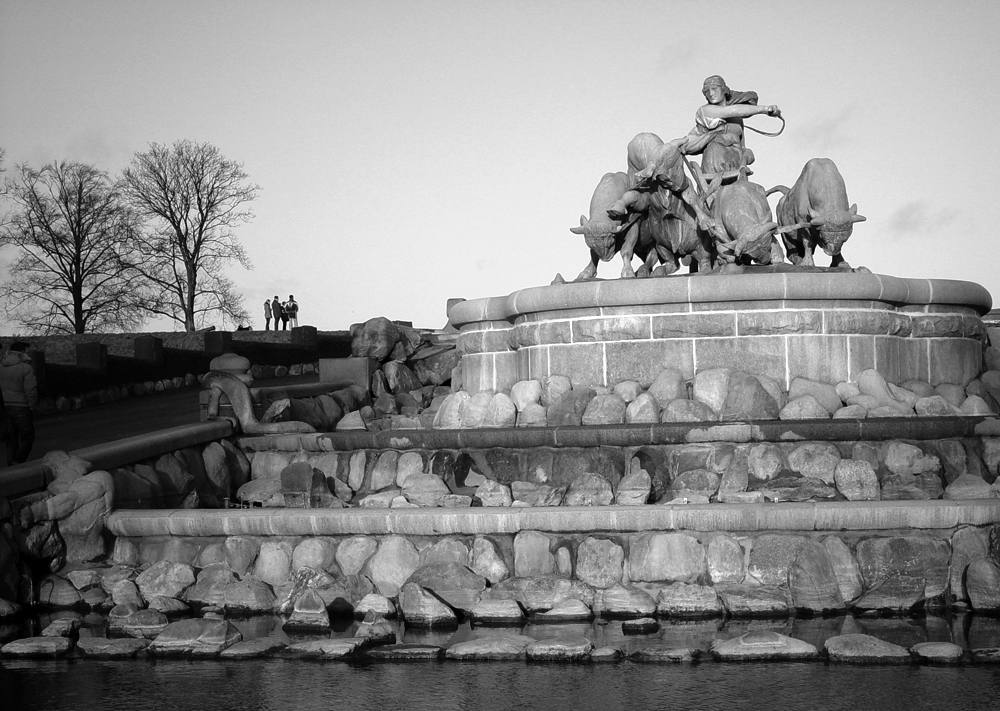
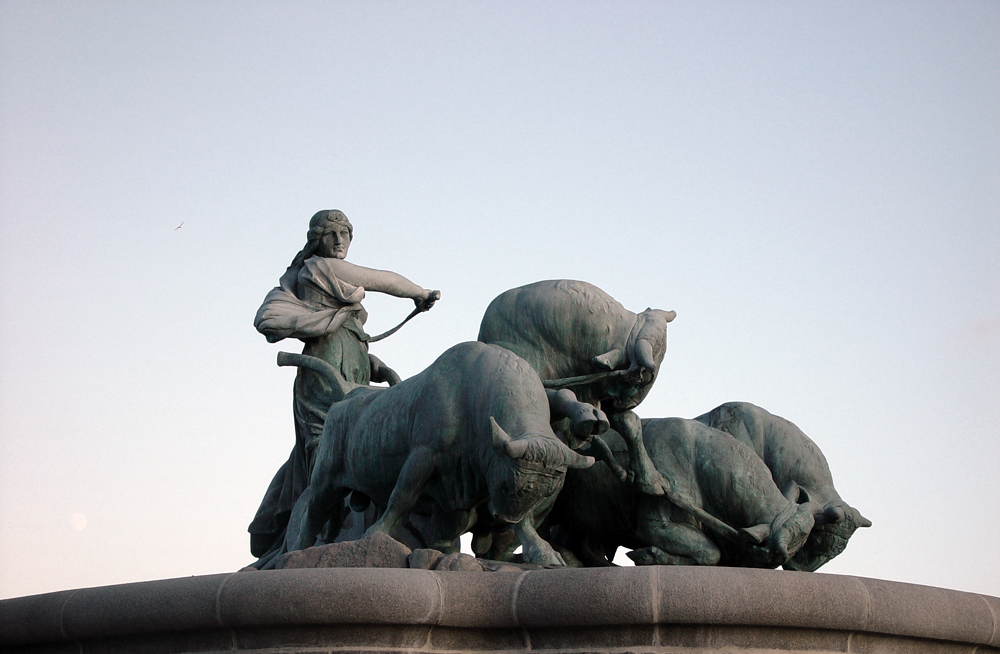
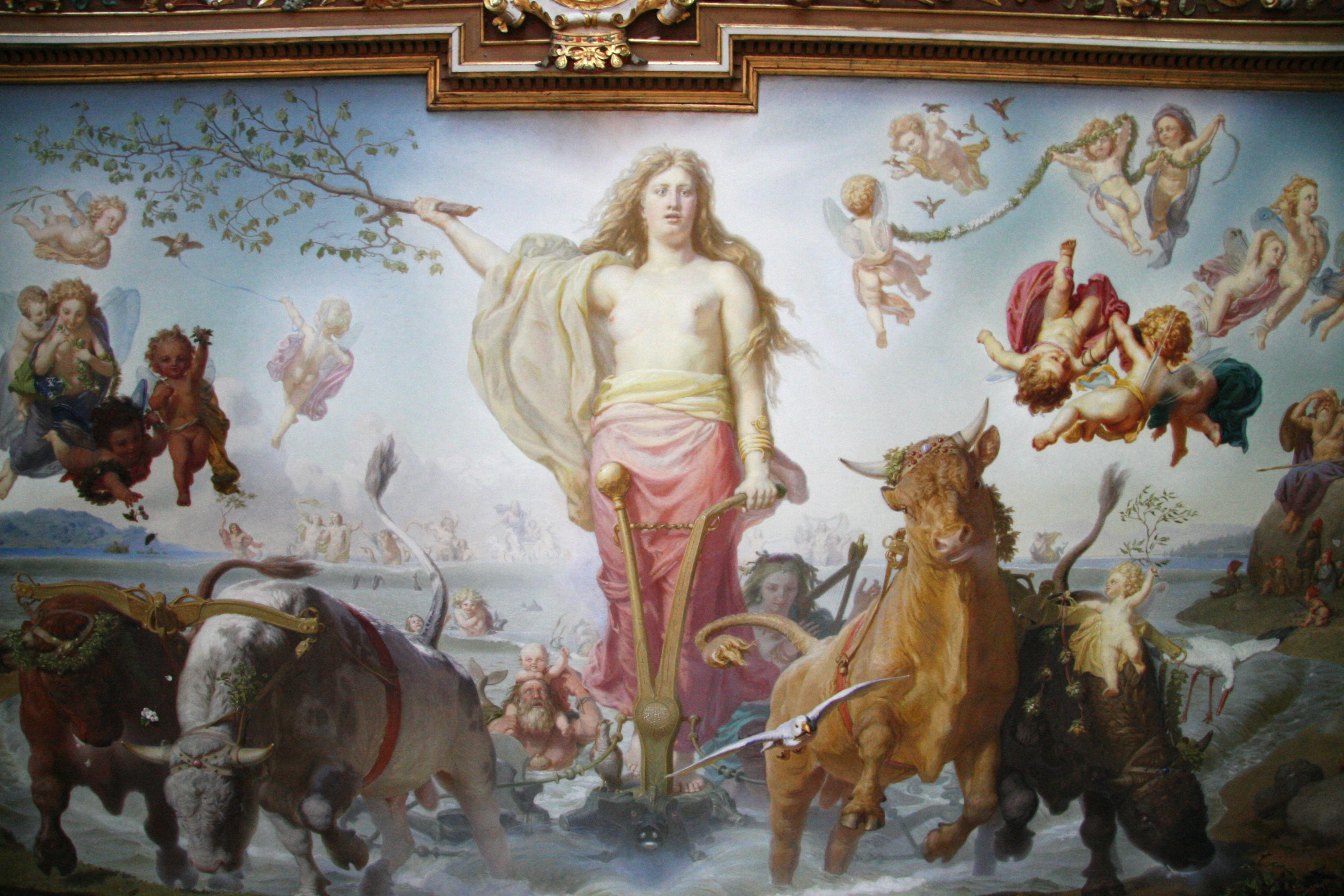
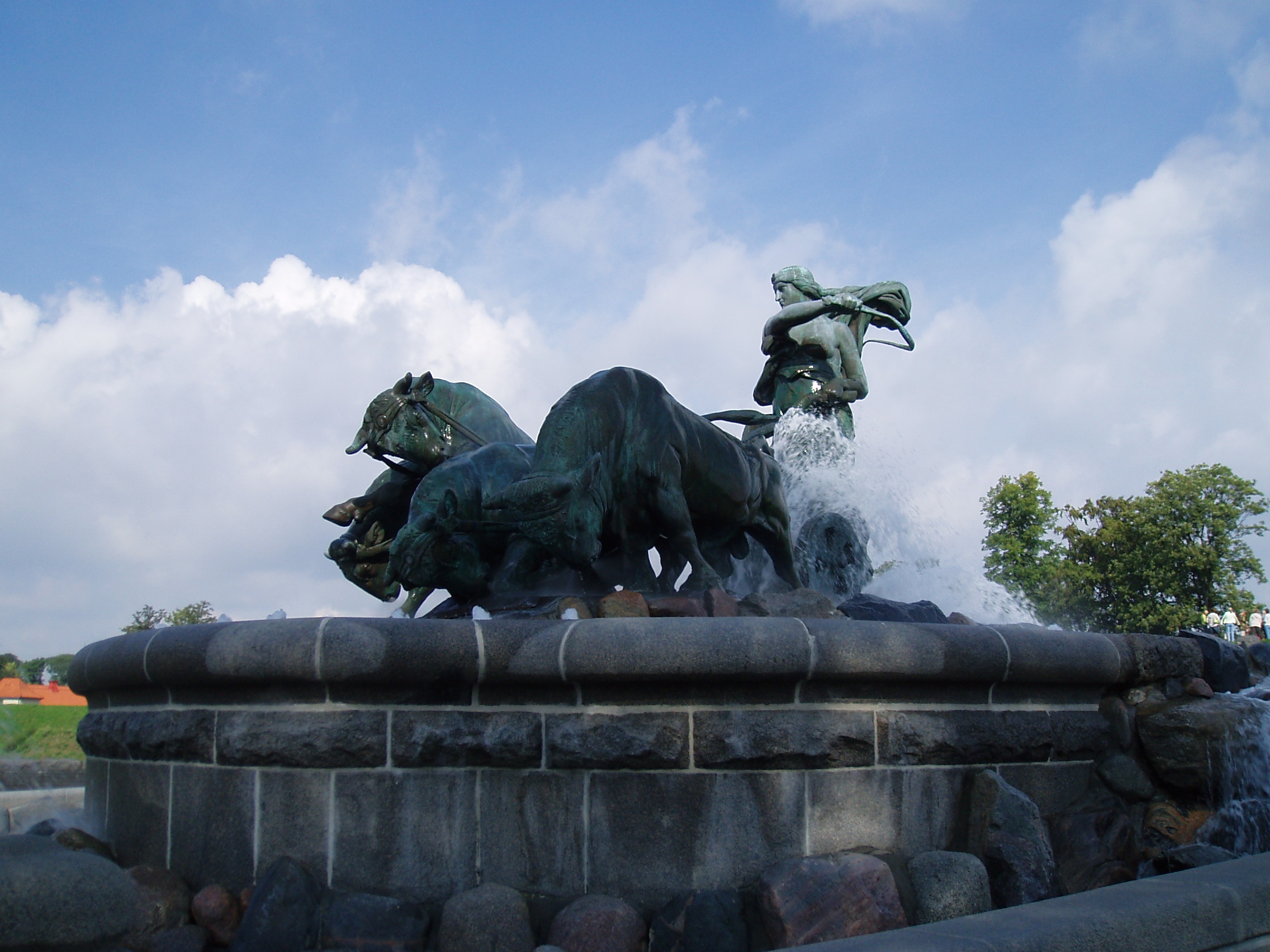
Gefjon features prominently in artistic and literary works. She is allegorically represented as the mother of Norway, Sweden, and Denmark in the forty-page Swedish Romantic poem Gefion, a Poem in Four Cantos by Eleonora Charlotta d'Albedyhll (1770-1835). A notable public artwork depicting Gefjon is the Gefion Fountain in Copenhagen, Denmark. This impressive fountain, sculpted by Anders Bundgaard in 1908, portrays Gefjon vigorously driving her four oxen sons as they pull her plough, capturing the dramatic moment of the creation of the island of Zealand from the Swedish mainland. The fountain's location in Copenhagen, on Zealand, directly connects it to the myth. Additionally, a ceiling decoration at Frederiksborg Palace in Denmark also depicts Gefjon ploughing the earth in Sweden, further illustrating her iconic mythological act.
6.2. In Astronomy and Geography
Gefjon's name has been adopted in the fields of astronomy and geography. The Gefion family, a distinct family of asteroids, derives its name from the goddess. Furthermore, the specific asteroid 1272 Gefion, discovered in 1931 by Karl Wilhelm Reinmuth, is also named after her. In geography, the highest mountain in Queen Louise Land (Dronning Louise LandDanish), located in Northeast Greenland, was named after Gefjon by the 1912-13 Danish Expedition to Queen Louise Land led by J.P. Koch.