1. Overview
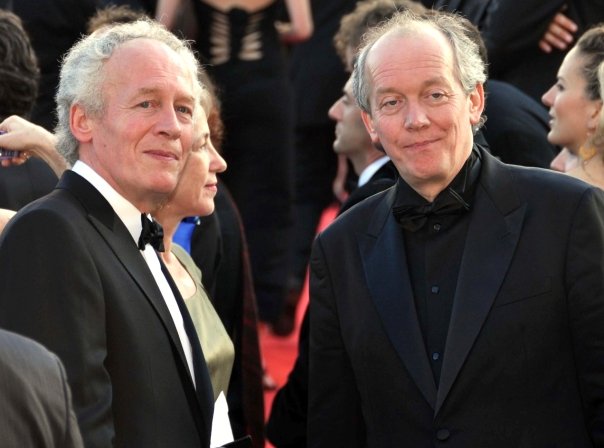
Jean-Pierre Dardenne (Jean-Pierre DardennedaʁdɛnFrench; born April 21, 1951) and Luc Dardenne (Luc DardennedaʁdɛnFrench; born March 10, 1954), collectively known as the Dardenne brothers, are a Belgian filmmaking duo celebrated for their distinctive style of social realism and their engagement with left-wing themes. They collaboratively write, produce, and direct their films, which frequently center on the lives of marginalized individuals and the working class, addressing issues of unemployment, poverty, and social integration with a profound sense of humanism.
Born and raised in Seraing, near Liège in the Wallonia region of Belgium, the Dardenne brothers began their careers in the late 1970s by making a substantial number of documentaries. They gained international prominence in the mid-1990s with La Promesse (1996). Their global acclaim was solidified when Rosetta (1999) won the prestigious Palme d'Or at the 1999 Cannes Film Festival. They achieved this rare feat a second time in 2005 with L'Enfant (The Child), placing them among an elite group of directors. Their consistent success at Cannes also includes the Grand Prix for The Kid with a Bike (2011), the Best Director Award for Young Ahmed (2019), and the Best Screenplay Award for Lorna's Silence (2008). In 2022, they received the 75th Anniversary Prize at the 2022 Cannes Film Festival for Tori and Lokita. Beyond critical accolades, their films have impacted social policy, most notably inspiring the "Rosetta Law" in Belgium, which aimed to protect young workers.
2. Life and Early Career
The Dardenne brothers' journey into filmmaking is deeply intertwined with their personal histories and early professional endeavors, which shaped their distinct approach to socially conscious cinema.
2.1. Early Life and Education
Jean-Pierre Dardenne was born on April 21, 1951, and his younger brother, Luc Dardenne, was born on March 10, 1954. Both were born and raised in the industrial town of Seraing, situated near Liège in the Wallonia region of Belgium, an area that would frequently serve as the backdrop for their films. Jean-Pierre initially studied drama, aspiring to become a stage director, and moved to Brussels. Luc, meanwhile, pursued studies in philosophy. During their time in Brussels, the brothers were significantly influenced by the work of Armand Gatti, a notable French playwright and director whose politically engaged and experimental theater resonated with them.
2.2. Entry into Filmmaking and Early Documentaries
The Dardenne brothers embarked on their filmmaking careers in the mid-1970s. Utilizing funds they earned from working at a nuclear power plant, they acquired the necessary equipment to start their cinematic projects. In 1975, they established their first production company, Derives. Through Derives, they extensively engaged in documentary filmmaking, producing approximately sixty documentaries before transitioning to narrative feature films. These early works delved into various social issues, including the experiences of Polish immigrants in Belgium, acts of resistance during World War II, and the significant general strike that took place in Belgium in 1960. Their directorial debut was the documentary Le Chant du rossignol in 1978. Other notable early documentaries included Lorsque le bateau de Léon M. descendit la Meuse pour la première fois (1979), Pour que la guerre s'achève, les murs devraient s'écrouler (1980), R... ne répond plus (1981), Leçons d'una université volante (1982), and Regarde Jonathan, Jean Louvet, son œuvre (1983). For some of these initial projects, they also took on roles as cinematographers, editors, and camera operators.
Their first two feature films were Falsch (1987), an adaptation of a play by René Kalisky that featured Bruno Cremer, and Je pense à vous (1992). These films are now rarely seen, with Je pense à vous reportedly suffering from production pressures that prevented it from reaching a satisfactory completion. The Dardenne brothers achieved their first major international success with La Promesse in 1996, which garnered global attention and established their distinct cinematic voice. In 1994, prior to this breakthrough, they founded their current production company, Les Films du Fleuve, which has since been responsible for producing all of their subsequent films and has also supported the works of other acclaimed European directors.
3. Filmmaking Philosophy and Style
The Dardenne brothers' cinema is defined by its intense naturalism and unique artistic principles, which prioritize authenticity, social engagement, and an immersive approach to storytelling.
3.1. Themes and Social Commentary
The Dardenne brothers are widely recognized for their creation of intensely naturalistic films that consistently portray the daily lives and struggles of the working class in Belgium. Their narratives often focus on young individuals navigating the challenging circumstances of society's margins, exploring recurring themes such as unemployment, poverty, immigration, and social precariousness. Through these portrayals, their films offer a critical examination of societal structures and power dynamics, underpinned by a clear left-wing perspective. They depict marginalized communities with profound dignity and humanism, highlighting the complex philosophical, spiritual, and psychological burdens faced by those striving for purpose and stability in a difficult world.
A notable example of their thematic depth is the 1999 film Rosetta. This film depicts a young woman's desperate quest for employment while living with her alcoholic mother in a trailer park. The narrative vividly illustrates Rosetta's relentless efforts to secure even the most menial jobs and her survival strategies, such as catching fish in muddy streams. The profound social impact of Rosetta extended beyond the cinematic realm; it served as a catalyst for a Belgian labor law aimed at protecting young workers, which informally became known as the "Rosetta Law" shortly after the film's release. While Jean-Pierre Dardenne stated that the law was already under consideration and they did not explicitly aim to change legislation, Luc Dardenne expressed their hope that their films would "speak to people, disturb them." Their 2019 film, Young Ahmed, further exemplifies their commitment to exploring complex social issues by delving into the subject of Islamic extremism through the story of a Belgian teenager.
3.2. Directing Style and Techniques
The Dardenne brothers employ a highly distinctive and influential directing style characterized by its minimalist aesthetic and an immersive, almost documentary-like approach. They are widely known for their consistent use of handheld cameras, which creates a sense of immediacy and draws the audience intimately into the characters' experiences, often following them closely from behind. They also predominantly use available light, contributing to the raw, unadorned realism of their visuals by eschewing artificial lighting setups in favor of capturing the natural environment. This approach is fundamental to their commitment to unfiltered reality.
Their collaborative process with actors is central to achieving their physical and unforced performances. Before involving the cinematographer, they work closely with actors to block movements and actions, trying several different versions. They emphasize physical instructions rather than dictating emotional tones, believing that the authentic tone will emerge naturally once filming begins. This method, often involving long takes, encourages organic and authentic performances, allowing actors the freedom to rediscover and refine their movements and subtle details during the shoot. The brothers work with a regular team of collaborators, including cinematographer Alain Marcoen and editor Marie-Hélène Dozo. Actor Jérémie Renier is a frequent presence in their films, appearing as Igor in La Promesse, Bruno in L'Enfant, Claudy in Lorna's Silence, Guy in The Kid with a Bike, and Bryan's father in The Unknown Girl. Olivier Gourmet, another recurring actor, played the main character in Le Fils and made brief cameos as a detective in L'Enfant and a bullying character in The Unknown Girl. Notably, they have a history of casting newcomers in lead roles, such as Émilie Dequenne in Rosetta and Déborah François in L'Enfant, both of whom were appearing in their first films and went on to win significant awards for their performances.
4. Major Works
The Dardenne brothers have built an internationally acclaimed filmography consisting of impactful feature films, documentaries, and short films, all unified by their signature style and thematic explorations.
4.1. Feature Films
Their feature-length narrative films have earned them widespread critical acclaim and numerous prestigious awards, cementing their status as influential figures in world cinema.
| Year | Title | Credited as | Notes | ||
|---|---|---|---|---|---|
| Directors | Screenwriters | Producers | |||
| 1987 | Falsch | Yes | Yes | Yes | |
| 1992 | Je pense à vous | Yes | Yes | Yes | |
| 1995 | Faute de soleil | Yes | Co-producers | ||
| 1996 | La Promesse (The Promise) | Yes | Yes | Yes | This film marked their significant international breakthrough, bringing them global attention and establishing their distinctive cinematic voice. |
| 1999 | Rosetta | Yes | Yes | Yes | A seminal work that earned them their first Palme d'Or at the 1999 Cannes Film Festival. The film also secured the Best Actress Award for its star, Émilie Dequenne. As the first Belgian film to win the Palme d'Or, it also notably influenced the creation of the "Rosetta Law" in Belgium, a piece of legislation aimed at protecting young workers. |
| 2001 | The Milk of Human Kindness | Yes | Co-producers | ||
| 2002 | Le Fils (The Son) | Yes | Yes | Yes | This film saw Olivier Gourmet win the Best Actor Award at Cannes for his leading performance. |
| 2003 | The Living World | Yes | Co-producers | ||
| 2003 | Stormy Weather | Yes | |||
| 2003 | The Sun Assassinated | Yes | |||
| 2005 | The Axe | Yes | Co-producers | ||
| 2005 | L'Enfant (The Child) | Yes | Yes | Yes | This film garnered their second Palme d'Or at the 2005 Cannes Film Festival, a rare achievement that placed them among an elite group of directors. It also received the André Cavens Award in 2005. |
| 2006 | The Colonel | Yes | |||
| 2007 | Vous êtes de la police? | Yes | Co-producers | ||
| 2008 | Lorna's Silence (Le Silence de Lorna) | Yes | Yes | Yes | This film was recognized with the Best Screenplay Award at the 2008 Cannes Film Festival. |
| 2009 | The Front Line | Yes | |||
| 2010 | K.O.R. | Yes | |||
| 2011 | The Kid with a Bike (Le gamin au vélo) | Yes | Yes | Yes | This film earned the prestigious Grand Prix at the 2011 Cannes Film Festival. It also received a Golden Globe nomination and eight Magritte Award nominations. Furthermore, it was honored with the Robert Bresson Prize at the 68th Venice International Film Festival in 2011. This film marked a historic achievement for the Dardenne brothers, as it was their fifth consecutive film to receive a major award at the Cannes Film Festival. |
| 2011 | The Minister | Yes | |||
| 2012 | Rust and Bone | Yes | Co-producers | ||
| 2012 | Beyond the Hills | Yes | Co-producers | ||
| 2013 | Marina | Yes | Co-producers | ||
| 2013 | Je fais le mort | Yes | Co-producers | ||
| 2014 | Two Days, One Night (Deux jours, une nuit) | Yes | Yes | Yes | This film competed for the Palme d'Or at the 2014 Cannes Film Festival. It received nine nominations at the 5th Magritte Awards, securing wins for Best Film and Best Director. Notably, Marion Cotillard received an Academy Award nomination for Best Actress for her performance, marking the first Oscar nomination for an actor in a Dardenne brothers film. Cotillard's performance also earned her Best Actress awards from the National Society of Film Critics and the New York Film Critics Circle in 2014. |
| 2014 | Wild Life | Yes | Co-producers | ||
| 2015 | Diary of a Chambermaid | Yes | Co-producers | ||
| 2015 | Cowboys | Yes | Co-producers | ||
| 2015 | Long Live the Bride | Yes | Co-producers | ||
| 2016 | Le Fils de Joseph | Yes | Co-producers | ||
| 2016 | Hedi | Yes | Co-producers | ||
| 2016 | Graduation | Yes | Co-producers | ||
| 2016 | Pericle | Yes | Co-producers | ||
| 2016 | The Unknown Girl (La Fille inconnue) | Yes | Yes | Yes | Starring Adèle Haenel, the film follows a young doctor's determined effort to uncover the identity of a young woman found dead after the doctor failed to answer her clinic's door buzzer outside of office hours. |
| 2016 | Les Carnivores | Yes | Co-producers | ||
| 2019 | Young Ahmed (Le Jeune Ahmed) | Yes | Yes | Yes | A film that explores the complex theme of Islamic extremism through the narrative of a Belgian teenager. It earned the Dardenne brothers the Best Director Award at the 2019 Cannes Film Festival. |
| 2022 | Tori and Lokita (Tori et Lokita) | Yes | Yes | Yes | This film was nominated for the Palme d'Or and was honored with the 75th Anniversary Prize at the 2022 Cannes Film Festival. |
| 2023 | Jeanne du Barry | Yes | Co-producers | ||
| 2023 | The Old Oak | Yes | Co-producers | ||
4.2. Documentaries
Before achieving renown for their feature films, the Dardenne brothers cultivated their distinctive style through a significant body of documentary and short film work, often addressing social and political themes that would become central to their later narratives.
| Year | Title | Credited as | Notes | ||
|---|---|---|---|---|---|
| Directors | Screenwriters | Producers | |||
| 1978 | Le Chant du rossignol | Yes | Their debut directorial work, a documentary. | ||
| 1980 | Pour que la guerre s'achève, les murs devraient s'écrouler | Yes | Yes | A documentary focusing on a major general strike in Belgium in 1960. | |
| 1981 | R... ne répond plus | Yes | Yes | Also cinematographers and editors. | |
| 1982 | Leçons d'une université volante | Yes | Yes | Also cinematographers. | |
| 1983 | Regarde Jonathan, Jean Louvet, son œuvre | Yes | Also editors and camera operators. | ||
| 1997 | Gigi, Monica... et Bianca | Yes | Executive producers. This film notably received the European Film Award for Best Documentary. | ||
| 2000 | La Devinière | Yes | Line producer. | ||
| 2002 | Brook by Brook | Yes | TV; co-producers. | ||
| 2002 | Romances de terre et d'eau | Yes | |||
| 2005 | Il fare politica | Yes | |||
| 2006 | Rwanda, les collines parlent | Yes | |||
| 2007 | Why We Can't See Each Other Outside When the Sun is Shining | Yes | |||
| 2009 | Children Without a Shadow | Yes | Executive producers. | ||
| 2012 | Un été avec Anton | Yes | TV. | ||
| 2013 | À ciel ouvert | Yes | Co-producers. | ||
4.3. Short Films
| Year | Title | Credited as | Notes | ||
|---|---|---|---|---|---|
| Directors | Screenwriters | Producers | |||
| 1979 | Lorsque le bateau de Léon M. descendit la Meuse pour la première fois | Yes | Yes | Documentary; also cinematographers. | |
| 1987 | Il court, il court, le monde | Yes | Yes | ||
| 1999 | L'Héritier | Yes | Executive producers. | ||
| 2002 | First Love | Yes | |||
| 2007 | Dans l'obscurité (In the Dark) | Yes | Yes | A segment featured in the anthology film To Each His Own Cinema. | |
| 2008 | Premier Jour | Yes | |||
| 2011 | Bloody Eyes | Yes | Yes | ||
5. Production Company: Les Films du Fleuve
Les Films du Fleuve is the film production company established by Jean-Pierre and Luc Dardenne in 1994. Based in Seraing, Belgium, the company serves as the primary production entity for all of their own films. Beyond their personal projects, Les Films du Fleuve also plays a significant role in European cinema by producing and co-producing films by other acclaimed directors. Notable filmmakers whose works have been produced by Les Films du Fleuve include Ken Loach, Jacques Audiard, and Benoît Jacquot. The company's existence reflects the Dardenne brothers' commitment not only to their own vision but also to supporting and fostering the broader landscape of independent and socially conscious filmmaking in Europe.
6. Awards and Recognition
The Dardenne brothers have received extensive critical acclaim and numerous prestigious awards throughout their distinguished careers, particularly at major international film festivals.
6.1. Major Film Festival Awards
Their consistent success at the Cannes Film Festival has made them one of the most celebrated filmmaking duos in contemporary cinema history.
- Palme d'Or
- 1999: Rosetta
- 2005: L'Enfant (The Child)
- Grand Prix
- 2011: The Kid with a Bike
- Best Director Award
- 2019: Young Ahmed
- Best Screenplay Award
- 2008: Lorna's Silence (Le Silence de Lorna)
- Cannes Film Festival 75th Anniversary Prize
- 2022: Tori and Lokita
- Best Actor Award
- 2002: Olivier Gourmet for Le Fils
- Best Actress Award
- 1999: Émilie Dequenne for Rosetta
- Robert Bresson Prize
- 2011: Awarded at the 68th Venice International Film Festival
- European Film Award for Best Screenwriter
- 2011: For The Kid with a Bike
- European Film Award for Best Documentary
- 1997: For Gigi, Monica... et Bianca
- National Society of Film Critics Award for Best Foreign Language Film
- 1997: For La Promesse
- Los Angeles Film Critics Association Award for Best Foreign Language Film
- 1997: For La Promesse
6.2. Other Honours
Beyond film festivals, the Dardenne brothers have received several significant distinctions recognizing their broader contributions to cinema and culture.
- In 2005, they were awarded the Grand-Cross of the Order of the Crown in Belgium.
- In 2008, they received the Film Award Cologne at the Cologne Conference.
- In June 2012, both brothers were invited to join the Academy of Motion Picture Arts and Sciences.
- In 2014, their collective body of work was honored with a special prize at the 40th Anniversary of the Ecumenical Jury at the Cannes Film Festival.
- Their film Two Days, One Night received an Academy Award nomination for Best Actress for Marion Cotillard, marking the first Oscar nomination for an actor in a Dardenne brothers film.
7. Legacy and Influence
The Dardenne brothers have left an indelible mark on both Belgian and global cinema, profoundly influencing the landscape of social realism and independent filmmaking. Their consistent dedication to depicting the unvarnished realities of marginalized lives has set a benchmark for contemporary realistic cinema. Their films are celebrated for their ethical depth, often prompting viewers to reflect on their own social responsibilities and empathy towards the less fortunate.
One of their most notable contributions to social change is the impact of their 1999 film, Rosetta. The film's stark portrayal of a young woman's desperate struggle for employment resonated deeply within Belgium, leading to the informal naming of a labor law as the "Rosetta Law." This legislation was designed to provide additional protections for young workers, offering a tangible example of how their art could directly contribute to policy discussions and social awareness regarding labor rights and youth unemployment. Their work has inspired a generation of filmmakers to explore similar themes with authenticity and a strong humanistic perspective, solidifying their legacy as masters of committed cinema that intertwines aesthetic rigor with profound social commentary.
8. Controversies
While largely lauded for their socially conscious cinema, the Dardenne brothers have also faced critical scrutiny over certain stances. A notable controversy arose in 2009 when they signed a petition in support of director Roman Polanski. Polanski had been detained while traveling to a film festival in relation to his 1977 sexual abuse charges. The petition argued that Polanski's detention would undermine the tradition of film festivals as platforms where works could be shown "freely and safely." It further contended that arresting filmmakers traveling to neutral countries could set a dangerous precedent, potentially leading to unforeseen negative consequences for the international film community. This action drew criticism from those who viewed it as insensitive to victims of sexual abuse and as prioritizing artistic freedom over accountability for serious criminal offenses. The brothers' involvement in the petition highlighted a broader debate within the film industry regarding the separation of an artist's work from their personal conduct and legal issues.