1. Early Life and Background
Danny Blanchflower's early life in Belfast laid the foundation for his future career, marked by both academic promise and a deep connection to football.
1.1. Birth and Family
Robert Dennis Blanchflower was born on 10 February 1926, in the Bloomfield district of Belfast, Northern Ireland. He was the eldest of five children born to John and Selina Blanchflower. His mother, Selina, had a notable background in sports herself, having played as a center-forward on a women's football team. Danny also shared his passion for football with his younger brother, Jackie Blanchflower (1933-1998). Jackie also became a Northern Irish international footballer, playing as a center-back for Manchester United under manager Matt Busby. Tragically, Jackie's promising playing career was cut short by severe injuries sustained in the Munich air disaster in February 1958. The Blanchflower brothers had played together as regular starters for the Northern Ireland national team during the qualifiers for the 1958 FIFA World Cup.
1.2. Education and Early Professions
Blanchflower received his early education at Ravenscroft public elementary school in Belfast. Demonstrating academic aptitude, he was awarded a scholarship to the Belfast College of Technology. However, he left his studies prematurely to pursue an apprenticeship as an electrician at Gallaher's cigarette factory, also located in Belfast. This period marked his initial professional activities before fully committing to his burgeoning football career.
1.3. Military Service
In 1943, during World War II, Blanchflower joined the Air Raid Precautions (ARP), a civilian defense organization. Displaying a determination characteristic of his later life, he lied about his age to enlist in the RAF. As a trainee navigator, he was sent for a course at St Andrews University in Scotland, an experience that cultivated a lifelong passion for golf. In the spring of 1945, he was posted to Canada for further training. While at St Andrews, Blanchflower also played for the University of Dundee football team, which was coached by Jack Qusklay, a former trainer for Celtic, Dundee United, and the Scotland national team. By 1946, at the age of 20, he returned to Belfast, resumed work at Gallaher's, and began building a formidable reputation as an exceptional footballer.
2. Playing Career
Danny Blanchflower's playing career was marked by his influential presence at both club and international levels, culminating in significant team and individual honors.
2.1. Club Career
Blanchflower's club career spanned several prominent teams, most notably his transformative decade at Tottenham Hotspur.
2.1.1. Early Club Career
Blanchflower began his professional football journey at his local club, Glentoran, in 1946, where he played 124 matches and scored 7 goals. In 1949, at the age of 23, he crossed the Irish Sea to England, signing for Barnsley for a transfer fee of 6.00 K GBP. During his time at Barnsley, he made 68 appearances and scored 2 goals. Two years later, in March 1951, he transferred from Barnsley to Aston Villa for a fee of 15.00 K GBP. For Aston Villa, he made 155 senior appearances, including 148 in the League, and scored 10 goals before being sold during the 1954-55 season.
2.1.2. Tottenham Hotspur
In 1954, Danny Blanchflower made his pivotal move to Tottenham Hotspur, with a transfer fee of 30.00 K GBP. He spent ten influential years at White Hart Lane, becoming a club legend. During this period, he made 337 League appearances, scoring 15 goals, and a total of 382 appearances across all competitions, scoring 21 goals. As captain and the team's central figure, he was considered the "brains" of the great Tottenham team of the 1960s.
His most remarkable achievement came in the 1960-61 season. Under Blanchflower's captaincy, Spurs achieved a record-breaking start in English top-flight football by winning their first 11 games. They ultimately secured the Football League title by an 8-point margin. Following this, they defeated Leicester City in the 1961 FA Cup final to become the first team in the 20th century to achieve the coveted League and Cup double, a feat not accomplished since Aston Villa in 1897. Blanchflower's leadership and brilliant tactical vision were instrumental in this success, which he achieved alongside key teammates such as center-forward Bobby Smith, winger Cliff Jones, and midfield partner Dave Mackay.
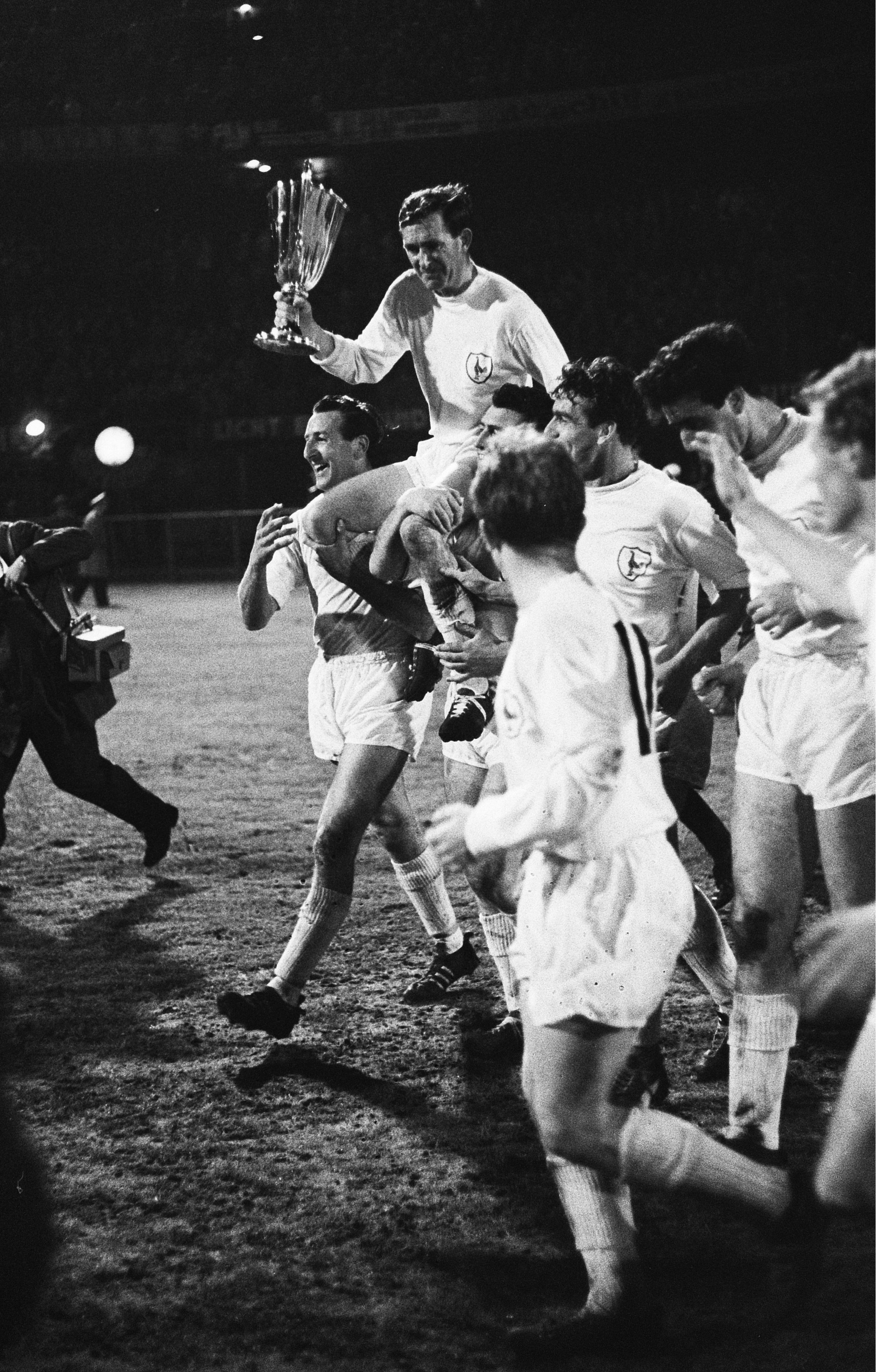
His excellence was recognized individually when he was voted FWA Footballer of the Year in both 1958 and 1961. The success continued into the following season, where he helped Spurs win the 1962 FA Cup final, scoring a penalty against Burnley in the final. In 1963, he captained his side to victory over Atlético Madrid in the final of the European Cup Winners' Cup, securing the club's first European trophy.
2.1.3. Brief Stints Abroad and Retirement
During his tenure with Spurs, Blanchflower also had a short playing spell abroad in 1961 with Toronto City, a team in the newly formed Eastern Canada Professional Soccer League. He played alongside fellow Football League stars Stanley Matthews and Johnny Haynes, making 12 appearances and scoring 3 goals. In 1962, he had a loan spell with Boksburg FC, where he played 4 matches and scored 1 goal.
He officially announced his retirement as a player on 5 April 1964, at the age of 38, having played a total of 693 matches and scored 38 goals in his professional club career, including nearly 400 games for Spurs where he captained them to four major trophies. However, in 1965, he briefly came out of retirement to play for Durban City in South Africa's National Football League (NFL), making 3 appearances.
2.2. Style of Play
Blanchflower played primarily as a defensive midfielder, often referred to as a right half in the football terminology of his era. He was celebrated for his distinctive playing style, characterized by his exceptional ability to dictate the tempo of the game and his accurate passing. His technical skills included remarkable vision and precision that allowed him to control the flow of matches from the midfield. Beyond his technical prowess, Blanchflower was known for his inspiring leadership on the field, which complemented his brilliant tactical insight. He was a player who valued artistic, flowing football, and his play reflected a focus on strategic accuracy and elegance rather than just brute force.
2.3. International Career
Danny Blanchflower had a distinguished international career, earning 56 caps for the Northern Ireland national football team. He made his debut in October 1949 against Scotland. A significant highlight of his international career came in 1958 when he captained Northern Ireland to the quarter-finals of the 1958 FIFA World Cup in Sweden, a remarkable achievement for a team often considered an underdog.
On 4 December 1957, he captained the Northern Ireland team against Italy in Belfast. This match gained notoriety as the "Battle of Belfast" due to its bad-tempered nature, characterized by intense physical play and skirmishes. Blanchflower notably attempted to maintain peace and calm amidst the escalating tensions during the game. In 1962, he became the first Northern Irishman to reach the milestone of 50 international caps, achieving this against Wales. He retired from international football in 1963, having scored 2 goals for his country.
3. Post-Playing Career
Following his retirement as a player, Danny Blanchflower transitioned into various roles, including coaching, management, and a prominent career in journalism and broadcasting, where his intelligent and outspoken nature truly shone.
3.1. Managerial Career
After hanging up his boots, Blanchflower served as a coach at Tottenham Hotspur for several years. Double-winning manager Bill Nicholson reportedly envisioned Blanchflower as his long-term successor. However, when Nicholson resigned from the club in 1974, Blanchflower was passed over in favor of Terry Neill, leading to his own departure from Spurs.
In 1976, he was appointed manager of the Northern Ireland national football team for a brief period, making his managerial debut in October of that year against the Netherlands in a 1978 FIFA World Cup qualifier. Subsequently, in 1978, he took on the managerial role at Chelsea. His tenure at Chelsea proved challenging; the team was struggling in the First Division. He managed to win only 5 of his 32 games in charge, and the club was relegated to the Second Division. He left Chelsea in September 1979.
3.2. Journalism and Broadcasting
Blanchflower developed an extensive and highly respected career in journalism and broadcasting, leveraging his keen intellect and articulate manner. He provided commentary for ITV as early as 3 January 1956, covering the Southern Junior Floodlit Cup final between West Ham and Chelsea. He also hosted editions of the BBC's Junior Sportsview in 1959 and ITV's Junior Criss Cross Quiz in the mid-1960s.
In 1967, Blanchflower served as the colour commentator for CBS television network broadcasts of National Professional Soccer League (NPSL) matches in the United States. His characteristic candor, particularly his critical remarks about the nascent league's shortcomings, reportedly distressed network executives. He later recounted this experience in a 10 June 1968 Sports Illustrated article he authored titled "Just One Truth For Me." In the 1968-69 season, he became the regular commentator for ITV Yorkshire. He also worked as a columnist for various newspapers, notably as a writer for the Sunday Express, a position from which he retired in 1988. His profound understanding of the game and eloquent expression made him a highly regarded figure in sports media.
4. Personal Life and Philosophy
Beyond his professional endeavors, Danny Blanchflower was known for his distinct personal philosophy, strong convictions, and notable personal anecdotes.
4.1. Personal Anecdotes and Beliefs
Danny Blanchflower's approach to football was famously encapsulated in his philosophy: "The great fallacy is that the game is first and last about winning. It is nothing of the kind. The game is about glory, it is about doing things in style and with a flourish, about going out and beating the lot, not waiting for them to die of boredom." This quote highlights his belief in the aesthetic and artistic aspects of the game over a purely results-driven mentality.
On 6 February 1961, Blanchflower became the first public figure to famously turn down an invitation to appear on the popular British television show This Is Your Life. When confronted by host Eamonn Andrews, he simply walked away, stating, "I consider this programme to be an invasion of privacy. Nobody is going to press gang me into anything." This incident, which was being recorded for later broadcast rather than live, became a widely discussed moment, further solidifying his reputation as an independent and principled individual unwilling to compromise his personal space for public spectacle.
4.2. Family and Relationships
Danny Blanchflower maintained a close relationship with his younger brother, Jackie Blanchflower. Jackie, a center-back, played professionally for Manchester United under the legendary manager Matt Busby from 1951. He also earned 12 caps for the Northern Ireland national team, scoring 1 goal. The brothers were instrumental in the Northern Ireland squad that qualified for the 1958 FIFA World Cup. Tragically, Jackie's career was cut short by severe injuries from the Munich air disaster, an event that deeply affected Danny and highlighted the bond between the two siblings.
4.3. Social Activism
Danny Blanchflower was a notable advocate for social justice, extending his influence beyond the football pitch to address significant societal issues. On 17 July 1958, he was among many signatories of a letter published in The Times newspaper. This letter staunchly opposed the policy of apartheid in international sport and actively defended "the principle of racial equality which is embodied in the Declaration of the Olympic Games." His willingness to take a public stand against such a discriminatory policy underscored his commitment to principles of human rights and equality, aligning with a progressive social viewpoint.
5. Later Life and Death
Blanchflower's later years were marked by health challenges, leading to his eventual passing.
5.1. Health Issues and Final Years
On 1 May 1990, Tottenham Hotspur held a testimonial match in his honor at White Hart Lane. However, by this time, Blanchflower was already showing the initial signs of what would later be diagnosed as both Alzheimer's disease and Parkinson's disease. These debilitating illnesses gradually affected his cognitive and motor functions. In his final years, he received care at Woodlands Nursing Home in Staines.
Despite his declining health, his intellectual contributions were recognized earlier. In 1985, he made an appearance in Anton Weinberg's Channel 4 documentary film The Keller Instinct, where he spoke approvingly of his late friend and musicologist Hans Keller's advocacy for inventive and tactically creative football, demonstrating his enduring passion for the strategic aspects of the game. He retired from his position as a writer for the Sunday Express in 1988, a few years before his testimonial match.
5.2. Death and Burial
Danny Blanchflower died from pneumonia on 9 December 1993, at the age of 67, while at Woodlands Nursing Home in Staines. He was laid to rest nearby at St. Jude's Cemetery, Englefield Green.
6. Legacy and Honours
Danny Blanchflower's impact on football and society endures through various memorials and the impressive list of honors he accumulated during his distinguished career.
6.1. Legacy and Memorials
Blanchflower's contributions are commemorated in his home city of Belfast. The Ulster History Circle installed a blue plaque at 49 Grace Avenue, his childhood home, recognizing his outstanding achievements in the world of sport. The unveiling of this memorial was attended by fellow Northern Irish football legend Pat Jennings.
Furthermore, the Danny Blanchflower Playing Fields in East Belfast, owned by Belfast City Council, were named in his honor. Plans to redevelop this site to include more professional football facilities began in the mid-2000s and have undergone several revisions. By 2020, construction of a new stadium and grounds for Harland & Wolff Welders F.C. was underway within the park, with future plans for nature trails and various community projects, ensuring his name remains connected to the development of local football and community life.
6.2. Honours and Individual Awards
Blanchflower's career was adorned with numerous team trophies and individual accolades:
- Tottenham Hotspur
- Football League First Division: 1960-61
- FA Cup: 1960-61, 1961-62
- FA Charity Shield: 1961, 1962
- UEFA Cup Winners' Cup: 1962-63
- Individual
- FWA Footballer of the Year: 1958, 1961
- FIFA World Cup All-Star Team: 1958
- English Football Hall of Fame: 2003
- World XI: 1961
- Ballon d'Or rankings: 14th in 1957, 19th in 1958, and 17th in 1961.
7. In Popular Culture
Danny Blanchflower's influential career and distinct personality have also seen him featured in various aspects of popular culture.
7.1. Filmography
Blanchflower has been depicted or appeared in films and documentaries, reflecting his lasting impact. He was notably featured in:
- Those Glory Glory Days (1983), a film that captures the spirit of Tottenham Hotspur's double-winning era.
- The Keller Instinct (1985), a Channel 4 documentary film by Anton Weinberg, where Blanchflower made an appearance discussing his friend Hans Keller's views on creative football.