1. Overview
Roh Hoe-chan was a prominent South Korean progressive politician and labor activist who served as a member of the National Assembly for three terms (17th, 19th, and 20th). Born in Busan in 1956, he dedicated his early life to the pro-democracy and labor movements, facing imprisonment for his activism. He played a foundational role in the establishment of various progressive political parties, including the Democratic Labor Party and the Justice Party, and was known for his sharp wit and unwavering commitment to social justice, workers' rights, and political reform. His career was marked by significant legislative activities, such as the exposure of the Samsung X-file incident, and later by the Druking political fund scandal which tragically led to his death in 2018. Roh Hoe-chan's passing sparked widespread mourning and solidified his legacy as a key figure who significantly contributed to broadening the scope of progressive politics in South Korea.
2. Early Life and Background
Roh Hoe-chan's early life laid the groundwork for his lifelong commitment to social justice and political activism, shaped by his family background, education, and early exposure to pro-democracy movements.
2.1. Childhood and Education
Roh Hoe-chan was born on August 31, 1956, in Suyeong-dong, Suyeong District, Busan, as the eldest of two sons and one daughter. His mother, 원태순Won Tae-sunKorean, was from Hungnam, Hamgyong Province, and had sought refuge in Geoje Island during the 1.4 Retreat of the Korean War, where she met his father, 노인모Noh In-moKorean, also from Hamgyong Province. Although his family was not wealthy, Roh experienced a culturally rich childhood.
He attended 초량국민학교Choryang Elementary SchoolKorean and Busan Middle School. After failing the entrance exam for Busan High School, he moved to Seoul and enrolled in Kyunggi High School in 1973, graduating in 1976. During his middle school years, he developed a passion for playing the cello, even performing at a festival for Ewha Girls' High School during his high school days. He was also an avid film enthusiast, reportedly watching every film released in a year during his high school period. Athletically, he excelled in fencing and track and field, though he was not skilled in ball sports. He earned the nickname "No Ji-shim" in high school due to rumors of his martial arts prowess. After completing his military service, he enrolled in Korea University in 1979, graduating with a Bachelor's degree in Political Science and Diplomacy in 1983.
2.2. Early Activism and Ideals
Roh Hoe-chan's political awakening began early. While a first-year student at Kyunggi High School in 1973, he actively participated in the democracy movement, producing and distributing leaflets that opposed Park Chung-hee's Yushin dictatorship. During this formative period, he read influential resistance magazines such as 씨알의 소리Ssi-al-ui SoriKorean (Voice of the People) and 다리DariKorean (Bridge), and encountered prominent dissident intellectuals like Ham Seok-heon, Baek Ki-wan, and Seonwoo Hwi. Among his classmates at Kyunggi High School who also engaged in activism were Jeong Gwang-pil and Lee Jong-geol.
The Gwangju Uprising in 1980 profoundly impacted Roh, solidifying his commitment to social change. Witnessing the public's defiance against military dictatorship, he realized that "only when workers are organized and empowered to lead can society be fundamentally transformed." This realization marked his full dedication to the labor movement and the development of his progressive political ideology. He once famously declared in court, "I am a socialist," reflecting his deep-seated progressive convictions.
3. Labor Movement and Early Political Engagement
Roh Hoe-chan's dedication to labor rights and his foundational efforts in progressive politics were central to his early career, preceding his formal entry into the National Assembly.
3.1. Entry into the Labor Movement
Following the profound impact of the Gwangju Uprising, Roh Hoe-chan committed himself to the labor movement. In 1982, he undertook practical training at the Yeongdeungpo Youth Vocational School (now Seoul Industrial Information School) to acquire an Electric Welder Level 2 certification, a deliberate step to enable him to work directly with laborers. He then engaged in 위장취업wiejang chwiyupKorean (covert employment), working as a welder in factories across Seoul, Bucheon, and Incheon. His initial employment at Kia Motors was short-lived as his identity as a university student was discovered, leading to his dismissal. Subsequently, he moved between various factories, where he began organizing workers and forming political discussion groups that evolved into influential circles.
During this period, Roh became a wanted man, pursued by authorities for leading demonstrations and distributing what were deemed "subversive documents." This led to a prolonged period of underground activism.
3.2. Incheon Democratic Workers' Federation and Imprisonment
The June Struggle of 1987 and the subsequent Labor Great Struggle (July-September) provided a crucial opening for the labor movement in South Korea. In this context, Roh Hoe-chan was instrumental in the establishment of the Incheon Democratic Workers' Federation (인천민주노동자연맹Incheon Minju Nodongja YeonmaengKorean, often abbreviated as 인민노련InminnoryeonKorean) in Bupyeong-gu, Incheon, on June 10, 1987. The federation's primary objective was to achieve independent political power for the working class through the formation of a progressive political party. Roh also served as an editor for the bi-weekly publication 사회주의자SahoejuuijaKorean (Socialist) for the federation.
{{Inminnoryeon}} distinguished itself from the more dogmatic 주체사상파Juche SasangpaKorean and 제헌의회파Jeheonuihoe-paKorean factions, focusing instead on practical, reality-oriented activities. This approach led to its classification as part of the 민중 민주Minjung MinjuKorean (People's Democracy, or PD) faction. The federation initially supported Baek Ki-wan as a presidential candidate in the 1987 election, but Baek's withdrawal for opposition unity prevented a direct political impact. Nevertheless, {{Inminnoryeon}} expanded its reach by uniting with other labor organizations like 노동계급Nodong GyegyeupKorean, 삼민동맹Sammin DongmaengKorean, and 안산노련Ansan NoryeonKorean, becoming the largest vanguard organization based on field workers at the time.
Roh Hoe-chan, as a central committee member of {{Inminnoryeon}} and editor of Socialist, was arrested on December 24, 1989. He was subsequently sentenced to 2 years and 6 months in prison for violating the National Security Act. He served his full term and was released in 1992. During his incarceration, he conceived the idea for his later book, 노회찬과 함께 읽는 조선왕조실록Roh Hoe-chan's Joseon Wangjo SillokKorean (Annals of the Joseon Dynasty Read with Roh Hoe-chan).
In December 1988, a year before his arrest, Roh married Kim Ji-sun, a fellow labor activist who served as the office head of the Incheon Discharged Workers' Council. The couple had no children. Notable figures who were active alongside Roh in {{Inminnoryeon}} include Song Young-gil, Shin Ji-ho, Joo Dae-hwan, and Cho Seung-soo.
3.3. Efforts in Progressive Party Formation
After his release from prison in 1992, Roh Hoe-chan immediately resumed his efforts to establish a progressive political party in South Korea. During his incarceration, {{Inminnoryeon}} had transformed into the Korea Socialist Labor Party Preparatory Committee in July 1991, which later became the Korea Labor Party Preparatory Committee in 1992 before merging with the Minjung Party. However, the unified Minjung Party suffered a significant defeat in the 1992 general election and was subsequently dissolved. While some former Minjung Party leaders, like Kim Moon-soo and Lee Jae-oh, abandoned the progressive movement to join conservative parties, Roh remained steadfast in his commitment to building an independent progressive force.
On April 15, 1992, Roh co-founded the Progressive Party Promotion Committee (진보정당추진위원회JinjeongchuKorean). He served as its Secretary-General from 1992 to 1993, and then as its Representative until September 1995. {{Jinjeongchu}} aimed to be a "quasi-party organization" - a stable intermediate stage before full party formation. This committee decided to engage with the 1992 presidential election, and Roh served as the organization chairman for Baek Ki-wan's campaign, though Baek ultimately lost with limited support. Despite this setback, Roh continued his efforts.
In September 1995, {{Jinjeongchu}} merged with the Minjung Political Alliance to form the Progressive Political Alliance (진보정치연합JinjeongnyeonKorean), where Roh again served as representative until its integration into People's Victory 21. From 1992 to 2003, he also served as the publisher of 매일노동뉴스Maeil Nodong NewsKorean (Daily Labor News), an endeavor that led to significant personal debt and, during the IMF financial crisis, even caused him to become a credit delinquent.
In 1996, Roh pursued an alliance with the reformist New Reform Party, a minority conservative opposition party, for the general election. This was seen as a strategic "election alliance" to preserve progressive forces and prepare for future party re-establishment. However, this tactic largely failed, as only one candidate ran under the alliance, and the New Reform Party eventually merged with the Democratic Party to form the United Democratic Party. Roh briefly served as a party affairs committee member of the United Democratic Party as a representative of the progressive forces.
A pivotal moment came after the 1996-97 general strike, which highlighted the limitations of relying solely on conservative opposition parties for labor rights. The Minju Labor Union (KCTU) and the National Alliance for Democracy and Reunification (전국연합JeongukyeonhapKorean) recognized the need for an independent progressive party. Roh proposed a broad alliance for the 1997 presidential election as a stepping stone to party formation, which was accepted. This led to the launch of People's Victory 21 (국민승리21Gungmin Seungni 21Korean) in 1997, with Roh serving as its policy planning committee chairman. People's Victory 21 nominated Kwon Young-ghil as its presidential candidate, who garnered 306,026 votes (1.19%). Despite the modest outcome, the organization remained committed to building a progressive party.
People's Victory 21 then established the Democratic Labor Party (DLP) Preparatory Committee on August 29, 1999, which officially founded the Democratic Labor Party (DLP) on January 30, 2000. Roh Hoe-chan became the DLP's inaugural Vice-Representative and later served as its Secretary-General from March 2002 until his election to the National Assembly in 2004. He also directed most of the DLP's election campaigns, serving as campaign headquarters chief for the 16th General Election (2000), the 3rd Local Elections (2002), and the 17th General Election (2004). While the DLP's initial electoral performance was modest, it demonstrated potential in labor-dense regions like Ulsan and achieved significant gains in the 2002 local elections, securing 8.13% of the party vote.
4. Political Career
Roh Hoe-chan's political career transitioned from dedicated activism to influential parliamentary leadership, marked by his consistent advocacy for progressive values and significant legislative actions.
4.1. 17th National Assembly (Democratic Labor Party)
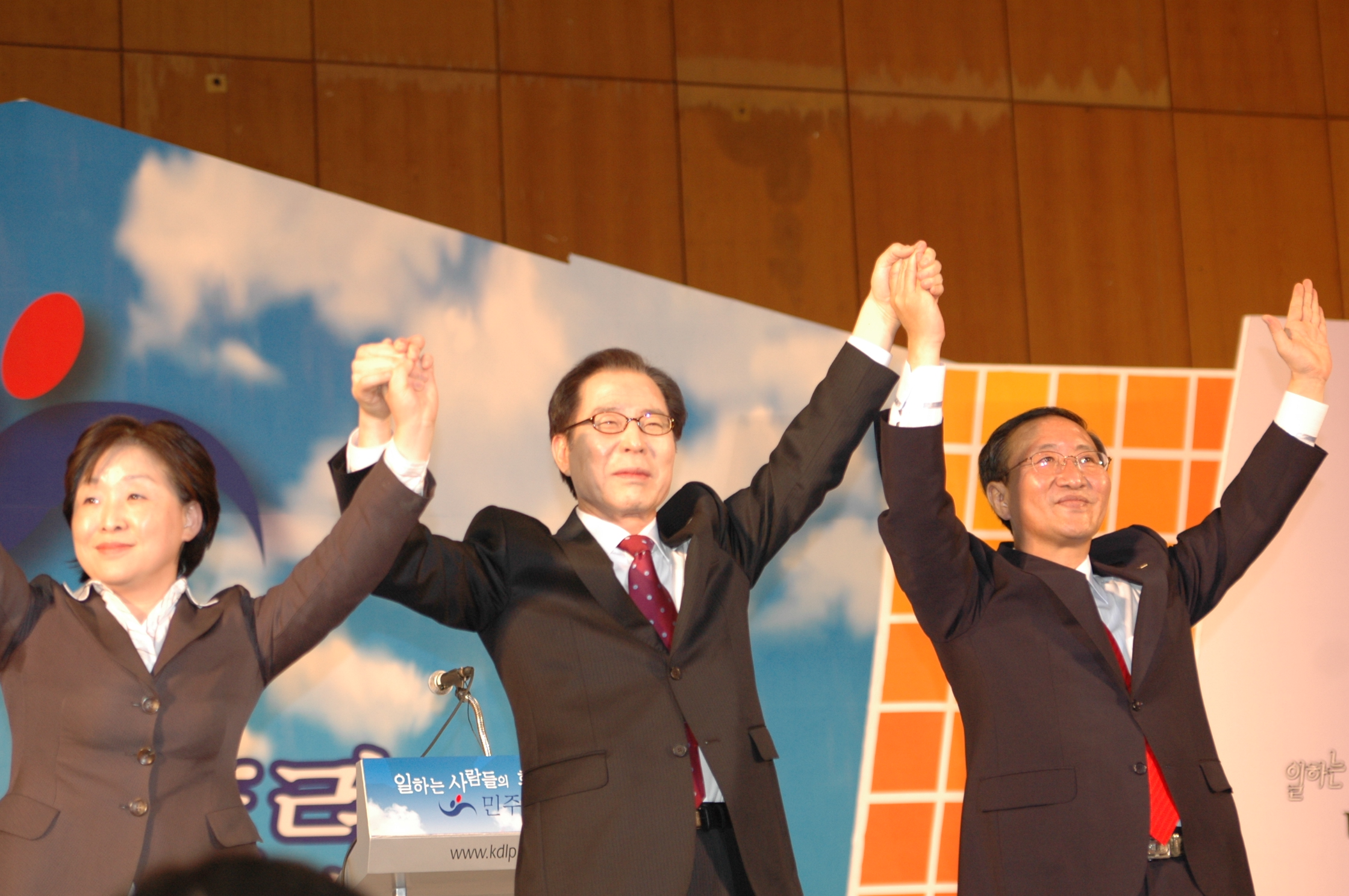
In 2004, Roh Hoe-chan was elected as a proportional representative to the 17th National Assembly under the banner of the Democratic Labor Party (DLP). He was placed 8th on the party's proportional list, securing a seat as the DLP made significant gains. His election, alongside the DLP's overall strong performance, contributed to the political shift that saw the defeat of 10-term incumbent Kim Jong-pil and the symbolic end of the "Three Kims" era in South Korean politics.
During his tenure in the 17th National Assembly (2004-2008), Roh was assigned to the Legislation and Judiciary Committee and the Budget and Accounts Special Committee. He quickly gained recognition for his diligent work, being selected as the "Best Lawmaker" by audited organizations during the 2004 National Assembly inspection. In 2007, he was named among the "Top 10 Gentlemanly Lawmakers" by political journalists, receiving the Baekbong Gentleman Award.
Roh's contributions and public image were further bolstered by numerous accolades: he was voted the #1 female-friendly male lawmaker in 2005, ranked #1 for political donations received via credit card points in 2006, and came in second as a presidential candidate in a 2006 survey of progressive intellectuals. Civic activists and television producers also recognized him as the top lawmaker for his outstanding legislative activities in 2005. He received commendations for his efforts in abolishing the Hoju system (a male-centered family registry system), promoting the Hangul alphabet, advocating for disability rights (leading to the Disability Discrimination Act), and supporting international aid efforts like the Southeast Asia tsunami relief. He also received a commendation from the Buddhist community for his role in the repatriation of the Annals of the Joseon Dynasty.
Roh Hoe-chan's legislative agenda focused on critical social issues. He famously exposed the Samsung X-file incident, which revealed alleged corruption involving Samsung Group and high-ranking prosecutors. He also championed policies aimed at improving the lives of ordinary citizens, including advocating for lower credit card merchant fees, enhancing the treatment of irregular workers, promoting direct management of school meals, ensuring free vaccinations for children under six, launching the "Atopy Zero Project," expanding local welfare finances, advocating for the public disclosure of apartment pre-sale costs, and pushing for the enactment of the Disability Discrimination Act and a tenant protection law. Over his four-year term in the 17th National Assembly, he initiated a total of 467 bills, with 31 of them passing into law.
During the 2004 general election campaign, where he served as the campaign headquarters chief, Roh kept a diary titled "Campaign Headquarters Diary," which became widely known as "Roh Hoe-chan's 난중일기Nanjung IlgiKorean" (War Diary). This diary was later published as a book, 힘내라 진달래Himnaera JindallaeKorean (Cheer Up, Azalea), which received the 13th Jeon Tae-il Literature Award in November 2004.
4.2. Party Splits and New Formations
Roh Hoe-chan's political journey was marked by significant shifts and new formations within the progressive movement. In the 2007 presidential election, he ran in the Democratic Labor Party (DLP) primary, finishing third behind Kwon Young-ghil and Sim Sang-jung. After his defeat, he supported Sim Sang-jung. The internal conflicts within the DLP, particularly between the 자주파JajupaKorean (Juche faction) and 평등파PyeongdeungpaKorean (Egalitarian faction), intensified after the DLP's poor performance in the 2007 election (Kwon Young-ghil garnered only 3.0% of the vote). When Sim Sang-jung's reform plan was rejected by the party's National Delegates' Conference in February 2008, the cohabitation between the factions effectively ended. Consequently, Roh, Sim Sang-jung, and other members of the People's Democracy faction left the DLP on February 5, 2008, which resulted in Roh losing his proportional representative seat.
Following their departure, Roh Hoe-chan, along with Sim Sang-jung, Cho Seung-soo, Lee Deok-woo, Park Kim Young-hee, and Kim Seok-jun, co-founded the New Progressive Party (NPP) on March 16, 2008. Roh served as a co-representative from March 2008 to March 2009, and later as the sole representative from March 2009 to October 2010.
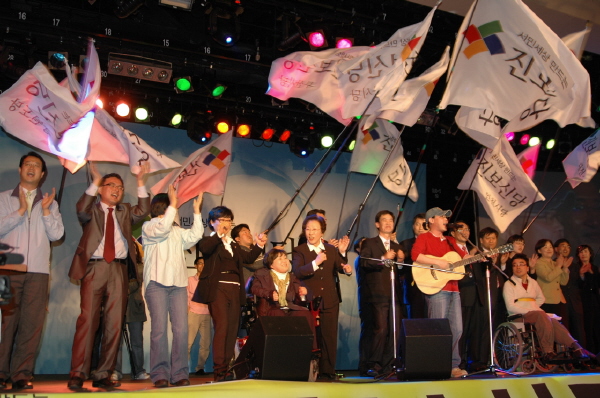
Immediately after the NPP's formation, Roh ran as the party's candidate for the Nowon C constituency in Seoul during the 18th National Assembly general election in 2008. Despite leading in opinion polls against the Grand National Party's Hong Jung-wook, he ultimately lost by 2,343 votes, securing 40.05% against Hong's 43.10%. However, his strong performance in Seoul was seen as a significant indicator of the potential for progressive parties in the capital. His defeat also led to a surge in support for him and the NPP, characterized by the "Jimohtmi" (지못미JimohtmiKorean, an abbreviation for "Sorry for not protecting you") effect, which saw a notable increase in party membership.
| Rank 2 vs. Rank 1 | Constituency | Vote Share | Votes |
|---|---|---|---|
| Roh Hoe-chan vs. Hong Jung-wook (Grand National Party) | Nowon C | 40.05% 43.10% | 32,111 (vs. 34,454) |
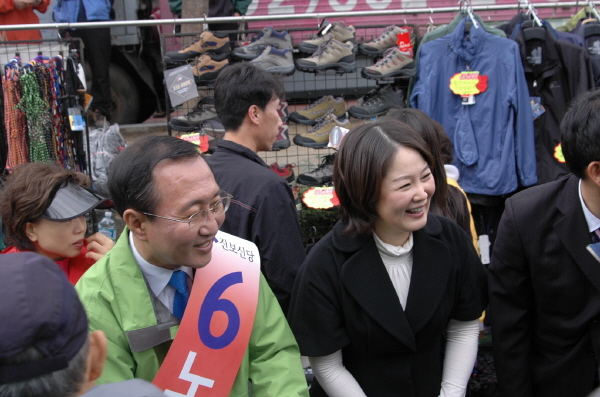
Roh and the NPP actively participated in the 2008 Candlelight protests against US beef imports, with Roh frequently appearing as a reporter for "NPP Color TV" and asserting that the Lee Myung-bak government was the "real instigator" of the protests. The NPP's support for the protests further boosted its membership. In March 2009, Roh was elected as the sole representative of the NPP, initiating a "Second Founding" of the party. He proposed a "Welfare Alliance for the Common People" and emphasized policy-driven politics. In a 2009 by-election, Cho Seung-soo's victory in Ulsan Buk-gu brought the NPP into the National Assembly.
In 2010, Roh ran as the NPP's candidate for Mayor of Seoul, campaigning on the motto "Seoul where mothers and children are happy" and advocating for universal welfare policies over large-scale construction projects. He received 3.3% of the vote and lost the election. While some Democratic Party supporters criticized him for not unifying with their candidate, Han Myeong-sook, Roh later stated that there had been no contact from Han's side regarding unification. He resigned as NPP representative in October 2010.
In 2011, discussions for a merger between the NPP and the DLP failed due to disagreements over the so-called "종북주의JongbukjuuiKorean" (pro-North Korea) issue and the NPP's rejection of the merger proposal. Consequently, Roh, Sim Sang-jung, and Cho Seung-soo left the NPP to form the "New Progressive Political Alliance." This alliance then merged with the National Participation Party and the DLP to establish the United Progressive Party (UPP) on December 5, 2011, with Roh appointed as a co-spokesperson.
4.3. 19th National Assembly (United Progressive Party, Justice Party)
In the April 2012 19th National Assembly general election, Roh Hoe-chan was re-elected for the Nowon C constituency in Seoul, securing 57% of the votes. However, his tenure in the United Progressive Party (UPP) was short-lived due to internal conflicts that erupted after the election. Allegations of manipulation in the proportional representative nominations by the faction led by party leader Lee Jung-hee caused significant turmoil within the UPP. Roh, along with Sim Sang-jung and Kang Gi-gap, became a leading voice in the "non-party power" faction, advocating for party reform. When their efforts to reform the party were obstructed by the dominant faction, Roh decided to leave the UPP on September 13, 2012, to participate in the formation of a new progressive party.
On October 7, 2012, the founding preparatory committee for the Progressive Justice Party was launched, with Roh Hoe-chan serving as a co-chairman. The party officially inaugurated as the Progressive Justice Party on October 21, and Roh was appointed as a co-representative. However, his parliamentary career was cut short on February 14, 2013, when the Supreme Court upheld his conviction in the Samsung X-file incident. He was sentenced to 4 months in prison, with a 1-year suspended sentence and a 1-year disqualification from public office, leading to the loss of his parliamentary seat. Following this, he stepped down from his leadership role when the Progressive Justice Party was renamed the Justice Party on July 21, 2013.
In 2014, Roh considered running for the Seoul mayoral election but ultimately decided against it, stating it would be "inhumane" to challenge incumbent Park Won-soon, whom he believed should be re-elected. Instead, he ran in the July 30, 2014, by-election for the Dongjak B constituency in Seoul as a Justice Party candidate. He secured a de facto opposition unity candidacy after Ki Dong-min of the New Politics Alliance for Democracy withdrew. Despite garnering 48.69% of the vote, he narrowly lost to Na Kyung-won of the Saenuri Party by a margin of 928 votes.
4.4. 20th National Assembly (Justice Party)
In the 2016 20th National Assembly general election, Roh Hoe-chan faced a decision between running in his former constituency of Nowon C in Seoul or the Changwon Seongsan constituency in South Gyeongsang Province. Ultimately, he chose Changwon Seongsan, a region known for its manufacturing industries and high unionization rates, following the recommendation of Justice Party leader Sim Sang-jung. With the support of the Democratic Party of Korea, including a campaign appearance by then-leader Moon Jae-in, Roh was elected as the unified opposition candidate, defeating incumbent Kang Gi-yun of the Saenuri Party with 51.50% of the vote. This victory marked his return to the National Assembly for a third term.
From May 30, 2016, until his death, Roh Hoe-chan served as the Justice Party's floor leader, a position to which he was re-elected in June 2018 for a third consecutive term.
4.5. Key Legislative Activities and Policy Advocacy
Throughout his parliamentary career, Roh Hoe-chan was a vocal advocate for transparency, social welfare, and political reform. In the 20th National Assembly, he notably championed the abolition of special activity funds (특활비teukwalbiKorean) for National Assembly members. He publicly stated that these funds should be excluded from future budgets and that any remaining funds from the current year should have their usage details disclosed by each political party monthly. He also spearheaded a proposed amendment to the National Assembly Act to legally mandate the abolition of these funds. The Justice Party continues to pursue this policy, and the special activity funds allocated to Roh as floor leader for July 2018 were not used.
In 2017, as the Justice Party's floor leader, he notably gifted a copy of the feminist novel Kim Ji-young, Born 1982 to President Moon Jae-in, highlighting his commitment to gender equality and social issues.
Beyond legislative work, Roh was a prominent public figure. From July 2018, he became a regular guest on JTBC's popular current affairs talk show Sseoljeon, where his insightful commentary and sharp wit further enhanced his public profile. His legislative efforts and policy advocacy consistently reflected his progressive ideals, focusing on improving the lives of workers, promoting social justice, and ensuring greater accountability in governance.
5. Major Events and Controversies
Roh Hoe-chan's political career was significantly shaped by critical incidents and public debates, particularly the Samsung X-file incident and the Druking political fund scandal.
5.1. The Samsung X-file Incident
The Samsung X-file incident was a defining moment in Roh Hoe-chan's career, showcasing his commitment to exposing corruption at the highest levels. On August 18, 2005, during a meeting of the National Assembly's Legislation and Judiciary Committee, Roh publicly exposed the "ANSP X-file." This file contained wiretapped conversations from 1997 between Lee Hak-soo, then Vice Chairman of Samsung Group, and Hong Seok-hyun, then President of JoongAng Ilbo. The recordings, made by the Agency for National Security Planning (ANSP, a predecessor to the National Intelligence Service), detailed alleged illicit lobbying activities by Samsung during the 1997 presidential election, including discussions about providing "떡값tteok-gapKorean" (bribes) to high-ranking prosecutors.
While the media initially reported on the file without naming the implicated prosecutors, Roh Hoe-chan took the unprecedented step of publicly revealing the names of seven former and current prosecutors mentioned in the wiretaps, distributing the information to the press and publishing it online. In response, the prosecution charged Roh and MBC reporter Lee Sang-ho with violating the Communication Secrecy Act and defamation, notably without prosecuting the high-ranking prosecutors implicated in the scandal.
The legal battle that followed was protracted. In the first trial, Roh was sentenced to 6 months in prison, with a 1-year suspended sentence and a 1-year disqualification from public office. However, the Seoul Central District Court overturned this verdict in December 2009, acquitting him. This acquittal was short-lived. On February 14, 2013, the Supreme Court overturned the appellate court's decision, upholding the original guilty verdict. This ruling led to Roh's immediate loss of his parliamentary seat.
Roh Hoe-chan vehemently criticized the Supreme Court's decision, calling it "anachronistic sophistry." He argued that the ruling protected the interests of powerful groups rather than the public's right to know, stating, "In an era where everyone uses smartphones and is a one-person media, if a press release is distributed to the media, it is covered by parliamentary immunity, but if it is disclosed to the general public via the internet, it leads to the loss of a parliamentary seat. What kind of sophistry is this?" He questioned the judiciary's integrity, asking, "Is there justice, conscience in the Korean judiciary today? For what, for whom does the judiciary exist?" He highlighted the irony that the very act of exposing corruption, which he believed was his duty as a lawmaker, resulted in his punishment, while those who gave and received bribes went unpunished. He also pointed out that Hwang Kyo-ahn, who had led the investigation that cleared Samsung and prosecuted Roh in 2005, was later nominated as Minister of Justice in 2013, further underscoring the perceived injustice. Roh also revealed that over 280 additional ANSP X-files remained undisclosed at the Seoul Central District Prosecutor's Office.
5.2. Druking Political Fund Scandal and Death
In July 2018, Roh Hoe-chan became embroiled in the "Druking" political fund scandal. He was accused of having received illegal political funds from the "Druking" group, led by an influential blogger who was at the center of a 2018 opinion-rigging scandal. The special prosecutor's team, led by Heo Ik-beom, launched an investigation into these allegations.
On July 23, 2018, at approximately 9:38 AM, Roh Hoe-chan committed suicide by jumping from an apartment building in Sindang-dong, Jung-gu, Seoul, where his brother-in-law lived. His body was discovered by an apartment security guard. At the scene, between the 17th and 18th floors of the apartment building, his coat, wallet containing his identification, a Justice Party business card, and three suicide notes were found. Two of the notes were addressed to his family and were not publicly disclosed. The third note, addressed to the Justice Party, was released.
In this final message, Roh admitted to receiving a total of 40.00 M KRW (approximately 35.30 K USD) in two installments from the "Kyunggongmo" (경공모KyunggongmoKorean, Druking's economic interest group) in March 2016. He explicitly stated that there was "no solicitation" and "no promise of a quid pro quo." However, he acknowledged that the funds, which he later learned were voluntary donations from many members, should have been processed through legitimate sponsorship procedures. He expressed deep remorse, calling it a "truly foolish choice" and a "shameful judgment," and stated that he had to take responsibility. He conveyed his profound regret for causing trouble to the Justice Party, which had come so far with great difficulty, and apologized to party members and supporters. He concluded by stating that his "wrongdoing is great and responsibility is heavy," and that "the legal penalty and party disciplinary action are not enough." He urged the Justice Party to "move forward with dignity" even as he stopped there. His last message, conveyed through an aide, was a congratulatory note to the KTX flight attendants who had finally been reinstated after a 12-year struggle. Under the Political Fund Act, which Roh himself had supported, receiving funds exceeding legitimate scope is illegal, regardless of whether favors were exchanged.

6. Personal Life
Roh Hoe-chan's personal life reflected his deep connections to the labor movement and his broader aspirations for a harmonious society.
6.1. Marriage and Family
Roh Hoe-chan married Kim Ji-sun, a fellow labor activist, in December 1988. Kim Ji-sun also served as the office director for the Incheon Discharged Workers' Council and later as the head of the Seoul Gangseo-Yangcheon Women's Hotline and the organization committee chair for the Women's Hotline Alliance. The couple had no children.
6.2. Personal Interests
Beyond his political and activist endeavors, Roh Hoe-chan harbored a lifelong passion for playing the cello, an instrument he began learning in elementary school. He often expressed a dream of a society where every citizen could have the opportunity to learn and play a musical instrument, reflecting his belief in the importance of cultural enrichment for all. He was also known to be an avid film enthusiast from his high school days, reportedly watching every film released in a year.
7. Death and Legacy
Roh Hoe-chan's death sent shockwaves across South Korea, prompting widespread tributes and reflection on his significant impact on the nation's progressive political landscape.
7.1. Circumstances of Death
Roh Hoe-chan died by suicide at the age of 61 on July 23, 2018. He jumped from an apartment building in Sindang-dong, Jung-gu, Seoul, where his brother-in-law resided. His body was discovered by an apartment security guard at approximately 9:38 AM. At the scene, between the 17th and 18th floors of the building, his coat, wallet containing his identification, a Justice Party business card, and three suicide notes were found. Two of these notes were addressed to his family and were not publicly disclosed, respecting his family's wishes. The third note, addressed to the Justice Party, was released.
In the note to the Justice Party, Roh admitted to receiving 40.00 M KRW from the "Kyunggongmo" (Druking's group) in March 2016, stating that while there was no solicitation or promise of favors, it was a "foolish choice" and a "shameful judgment" to not follow proper donation procedures. He expressed deep remorse for causing trouble to the party and urged it to continue its journey with dignity. His death occurred amidst a special prosecutor's investigation into the illegal political funds connected to the "Druking" opinion-rigging scandal.
7.2. Social and Political Reactions
Roh Hoe-chan's death elicited a profound outpouring of grief and tributes from across the political spectrum and the public. Moon Jae-in, the President of South Korea, expressed his deep sorrow, stating that Roh had made "big contributions to widening the spectrum of [South] Korean politics" and had elevated the "dignity of language" in the nation's political discourse. President Moon canceled a scheduled SNS live broadcast in response to the news.
Political figures from diverse backgrounds offered their condolences. Kim Sung-tae, the floor leader of the conservative Liberty Korea Party, expressed his sorrow, remarking on Roh's sincerity in representing the struggles of marginalized workers. Baek Hye-ryun, spokesperson for the Democratic Party of Korea, affirmed that Roh's progressive and democratic values would be carried forward by future politicians. Even the Liberty Korea Party, a right-wing party, released a statement calling Roh a "symbol of progressive politics" who had "exemplified parliamentary activities for the common people and workers" and "spearheaded political reform," describing his death as a "tragedy for Korean politics." Park Jie-won, a lawmaker from the Democratic Peace Party, poignantly stated, "Roh Hoe-chan is alive even in death. Park Geun-hye and Lee Myung-bak are dead even in life," contrasting Roh's legacy with that of the imprisoned former presidents.
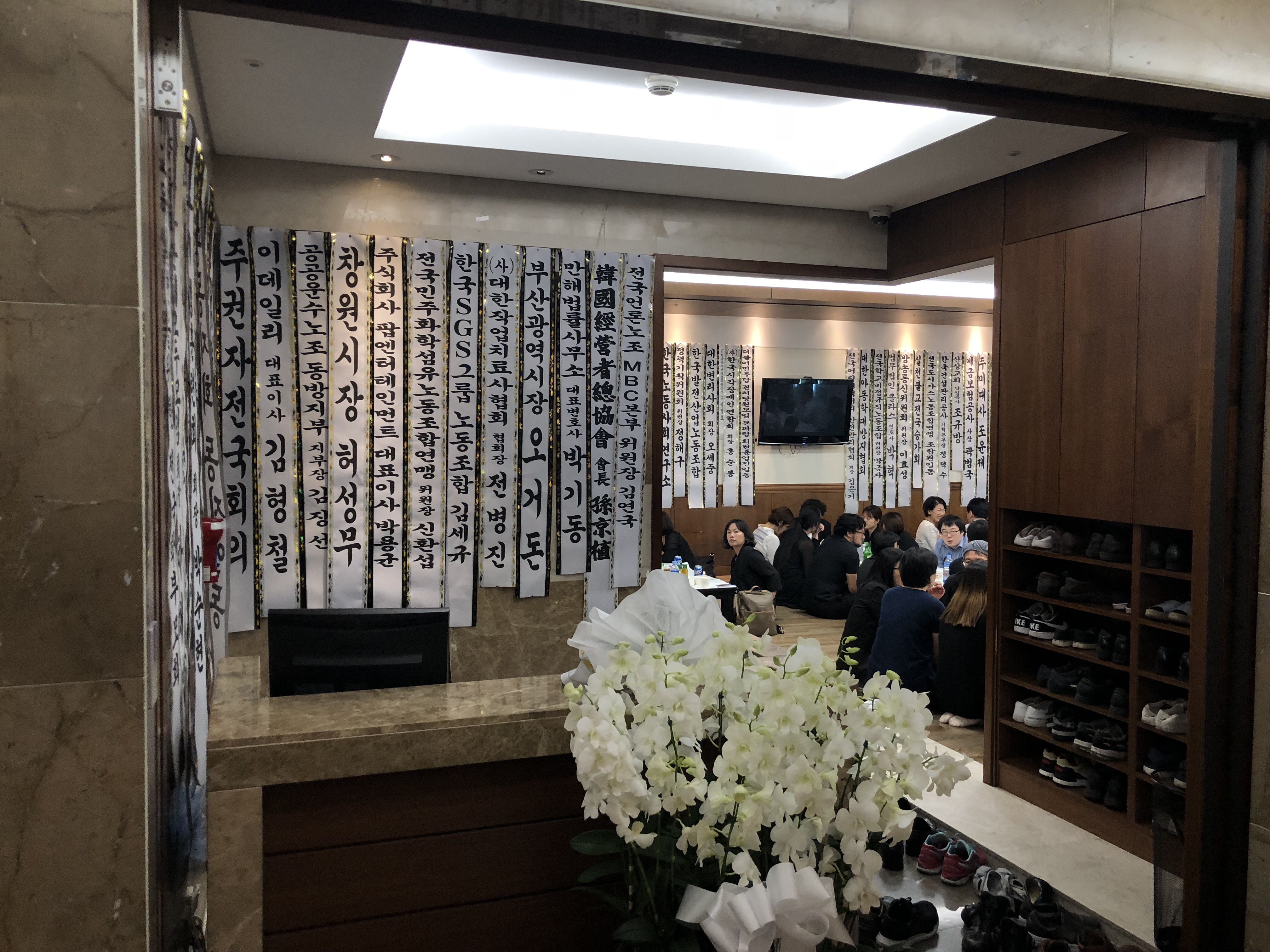
The public's reaction was equally strong. Thousands of mourners, including students, families, and workers in their uniforms, visited his funeral at Severance Hospital in Seoul, expressing their sorrow for a politician who consistently spoke for the common people and bravely challenged powerful entities like Samsung. Some online communities, such as Ilbe and WOMAD, posted derogatory comments mocking his death, which sparked widespread public outrage.
Initially, the Justice Party announced a five-day funeral under the party's auspices. However, at the suggestion of National Assembly Speaker Moon Hee-sang, the funeral was elevated to a National Assembly funeral for the final two days (July 26-27), following the Justice Party funeral (July 23-25). The funeral procession departed from Severance Hospital on July 27, with emotional farewells from Justice Party leaders Lee Jeong-mi and Sim Sang-jung, and writer Rhyu Si-min. The procession then visited the National Assembly building, including Roh's office, where citizens gathered to throw yellow flowers and paper airplanes as a final farewell. The National Assembly flew flags at half-mast. Roh's body was cremated at Seoul Memorial Park and interred at Maseok Moran Park, where the ceremony concluded with attendees singing "March for the Beloved".
In the immediate aftermath of his death, public support for the Justice Party surged. A Gallup Korea poll in the first week of August 2018 showed the Justice Party's approval rating reaching a record high of 15%, temporarily surpassing the Liberty Korea Party to become the largest opposition party.
7.3. The Roh Hoe-chan Foundation
To honor and continue his legacy, the establishment of the Roh Hoe-chan Foundation was proposed on September 9, 2018. The proposal was put forth by a group of 18 prominent figures, including former and current leaders of progressive parties such as Kwon Young-ghil, Sim Sang-jung, and Lee Jeong-mi, as well as lawmakers from the Democratic Party like Lee Jong-geol and Song Young-gil, and writer Rhyu Si-min. The foundation aims to perpetuate Roh's political ideals and continue his work for social justice.
In a symbolic continuation of his legacy, a by-election was held in Roh's former constituency of Changwon Seongsan on April 3, 2019. Yeo Yeong-gug, the Justice Party candidate, won the election by a narrow margin. The day after his victory, Yeo Yeong-gug visited Roh Hoe-chan's grave with his certificate of election, affirming his commitment to continuing Roh's work.
8. Writings and Publications
Roh Hoe-chan was a prolific writer, contributing numerous books and articles that reflected his political philosophy and experiences. His works provide valuable insight into his intellectual contributions to the progressive movement in South Korea.
8.1. Major Works
- 우리가 꿈꾸는 나라The Country We Dream OfKorean (2018)
- 진보의 재탄생Rebirth of ProgressivismKorean (2010)
- 나를 기소하라Indict MeKorean (2008)
- 법은 만명한테만 평등하다Law is Equal Only to Ten Thousand PeopleKorean (2007)
- 힘내라 진달래Cheer Up, AzaleaKorean (2004)
- 노회찬과 함께 읽는 조선왕조 실록Joseon Wangjo Sillok Read with Roh Hoe-chanKorean (2004)
- 정운영이 만난 우리시대 진보의 파수꾼 노회찬Roh Hoe-chan, the Watchman of Progressivism in Our Time, Met by Jeong Un-yeongKorean (2004)
- 지역감정과 정치발전Regionalism and Political DevelopmentKorean (1995)
- 산업별 노동조합과 한국노동조합운동Industrial Unions and Korean Labor Union MovementKorean (1994)
- 민주노조운동과 전노협Democratic Labor Movement and JeonnohyeopKorean (1990)
- 87,88 정치위기와 노동운동87, 88 Political Crisis and Labor MovementKorean (1989)
- 노동자와 노동절Workers and Labor DayKorean (1983)
9. Evaluation and Impact
Roh Hoe-chan is widely regarded as a pivotal figure in South Korean progressive politics, known for his unwavering commitment to social justice and his distinctive communication style. His career, marked by both significant achievements and controversies, left an indelible mark on the nation's political landscape.
9.1. Positive Contributions
Roh Hoe-chan's political career was defined by his steadfast dedication to workers' rights and social justice. From his early days as a labor activist, engaging in covert factory work and organizing laborers, to his parliamentary career, he consistently championed the cause of the marginalized and vulnerable. He played a foundational role in establishing key progressive political organizations and parties, including the Democratic Labor Party and the Justice Party, thereby contributing significantly to the institutionalization and growth of progressive politics in South Korea.
His legislative activities were particularly impactful. He gained national recognition for exposing the Samsung X-file incident, a courageous act that revealed alleged corruption at the highest echelons of power. This act, though it ultimately led to his temporary disqualification from office, solidified his image as a fearless advocate for transparency and accountability. He also actively pushed for the abolition of special activity funds (특활비teukwalbiKorean) for National Assembly members, advocating for greater financial transparency in politics.
Beyond policy and legislation, Roh was celebrated for his unique communication style. He possessed a sharp wit and eloquent speaking ability, often using relatable analogies to explain complex political issues to the public. He was praised for elevating the "dignity of language" in politics, making political discourse more accessible and engaging. His commitment to the Korean language was also notable; he rejected wearing a National Assembly badge with Chinese characters (Hanja) until it was changed to Hangul, actively promoted the use of pure Korean in legal terminology, and advocated for Hangul Day to be reinstated as a public holiday. In recognition of these efforts, the Hangeul Society honored him in 2014 as "Hangeul Nara Keunbyeol" (한글나라 큰별Great Star of Hangeul CountryKorean). Posthumously, in 2018, he was awarded the Mugunghwa Medal, the highest class of the Order of Civil Merit, in recognition of his significant contributions to public service.
9.2. Criticisms and Controversies
While widely respected, Roh Hoe-chan's career also encountered criticisms and controversies. The most significant was the Samsung X-file incident, which, despite his intentions to expose corruption, led to his conviction for violating the Communication Secrecy Act and the subsequent loss of his parliamentary seat in 2013. This legal outcome sparked considerable debate, with many, including fellow politicians and legal experts, criticizing the ruling as an overreach that prioritized the protection of privacy over the public's right to know about corporate and judicial corruption.
Another major controversy that overshadowed the end of his life was the allegation of receiving illegal political funds from the "Druking" group. Although Roh admitted to receiving 40.00 M KRW and expressed deep remorse in his suicide note, he denied any quid pro quo or involvement in the group's opinion-rigging activities. Nevertheless, the illegality of the funds under the Political Fund Act, which he himself supported, placed him under intense scrutiny and contributed to the circumstances leading to his death.
Earlier in his career, Roh faced criticism during the 2010 Seoul mayoral election. Despite his progressive platform, he was criticized by some supporters of the Democratic Party for not unifying with their candidate, Han Myeong-sook, which some argued led to a split in the progressive vote and Han's narrow defeat. Roh, however, stated that no unification offer was made from Han's side. In 2013, after losing his seat, he also drew criticism for his strong opposition to Ahn Cheol-soo's decision to run in the by-election for his former constituency, Nowon C. Roh famously likened Ahn's move to a "big corporation entering a local bakery," implying that Ahn was taking away a political space hard-won by progressives. This stance was even criticized by some within his own party, such as Seo Ki-ho, when Roh's wife considered running in the same constituency.
In April 2009, Roh also publicly criticized Kwon Yang-suk, the wife of former President Roh Moo-hyun, for allegedly receiving money from businessman Park Yeon-cha, calling the situation "truly severe." In 2001, he was fined 1.00 M KRW for violating the Road Traffic Act due to drunk driving. In February 2018, conservative lawmakers Kim Sung-tae and Kim Jin-tae raised allegations of preferential employment for Roh's former secretary at the Ministry of Justice. Roh vehemently denied the claims, stating he would resign his parliamentary seat if any involvement was proven, and dismissed the accusations as an attempt to divert attention from other corruption scandals involving conservative politicians. His former secretary also denied the allegations, asserting that their qualifications were sufficient for the position.
9.3. Influence on Progressive Politics
Roh Hoe-chan's influence on South Korean progressive politics is profound and enduring. He is widely considered an icon of the progressive movement, having dedicated his life to advocating for social justice, labor rights, and democratic reform. His ability to articulate progressive ideals with clarity, wit, and conviction resonated deeply with the public, making him one of the most recognizable and beloved figures in the progressive camp.
His activism and political philosophy significantly shaped the trajectory of progressive parties in South Korea. He was instrumental in the formation and development of the Democratic Labor Party and the Justice Party, contributing to the establishment of a robust multi-party democratic system. His persistent efforts to expose corruption, advocate for the vulnerable, and promote transparency set a high standard for ethical governance within the progressive movement.
Roh's tragic death in 2018 sparked a national outpouring of grief and, ironically, led to a temporary surge in support for the Justice Party, which briefly surpassed the main conservative opposition party in approval ratings. This phenomenon underscored the deep public affection and respect he commanded. The subsequent establishment of the Roh Hoe-chan Foundation by prominent progressive figures and civic leaders further cemented his legacy, aiming to continue his work and promote the ideals he championed throughout his life. His former constituency, Changwon Seongsan, also elected a Justice Party successor in a by-election, demonstrating the lasting impact of his presence and the continued resonance of his political vision in the region. Roh Hoe-chan remains an inspirational figure whose activism and philosophy continue to influence the discourse and direction of progressive politics in South Korea.