1. Overview
Mustafa Dağıstanlı (Mustafa DağıstanlıTurkish) was a highly acclaimed Turkish wrestler and politician, celebrated for his exceptional achievements in freestyle wrestling and his subsequent career in public service. Born on April 11, 1931, in Söğütpınar, Samsun Province, he rose to prominence as one of the world's leading wrestlers in the 1950s. Dağıstanlı notably secured gold medals at both the 1956 Melbourne Olympics and the 1960 Rome Olympics, alongside winning three World Championship titles in 1954, 1957, and 1959. Beyond his athletic prowess, he transitioned into politics, serving as a Justice Party deputy for his hometown of Samsun in the Turkish Grand National Assembly from 1973 to 1980. After his retirement from wrestling, he also contributed to the sport as a coach and became involved with the Turkish Wrestling Federation, in addition to establishing a successful overland coach business. Dağıstanlı's legacy is defined by his significant contributions to Turkish sports and his commitment to public life, earning him a place in the FILA International Wrestling Hall of Fame. He passed away on September 18, 2022, at the age of 91.
2. Life
Mustafa Dağıstanlı's life began in a rural village before he discovered his remarkable talent for wrestling, which would lead him to international fame and a career in politics.
2.1. Birth and Childhood
Mustafa Dağıstanlı was born on April 11, 1931, in Söğütpınar, a village located in Çarşamba, Samsun Province, Turkey. Information regarding his family background or specific childhood environment is limited, but he developed a strong connection to traditional Turkish sports from an early age.
2.2. Introduction to Wrestling and Early Activities
Dağıstanlı began wrestling at the relatively late age of 18. Prior to this, he had already gained significant experience in Turkish oil wrestling, a traditional form of wrestling popular in Turkey. His involvement in this traditional sport provided him with a foundational understanding of wrestling techniques and competitive spirit. Despite his late start in competitive wrestling, he rapidly developed into one of the world's premier freestyle wrestlers throughout the 1950s. He was a formidable athlete, standing at 5.5 ft (1.68 m) and weighing 137 lb (62 kg) during his competitive years. He also demonstrated proficiency in the Greco-Roman wrestling style. In 1952, he narrowly missed qualifying for the Olympic Games in Helsinki, indicating his early potential on the national stage.
3. Wrestling Career
Mustafa Dağıstanlı's wrestling career was marked by extraordinary success, including multiple Olympic and World Championship titles across various weight categories.
3.1. National Team and International Debut
By 1953, Mustafa Dağıstanlı had already become a member of the Turkish national wrestling team. He demonstrated his burgeoning talent during a trip to Sweden for two international matches, where he secured victories on points against prominent wrestlers Edvin Vesterby and Göte Persson in the bantamweight division. His official debut at an international championship came in 1954 at the World Championship in Tokyo, competing in the bantamweight freestyle category. He immediately made an impact by winning the world title, achieving three victories by shoulder and two by points, finishing ahead of Lajos Bencze of Hungary and Tauno Jaskari from Finland.
3.2. Performance at the Olympics
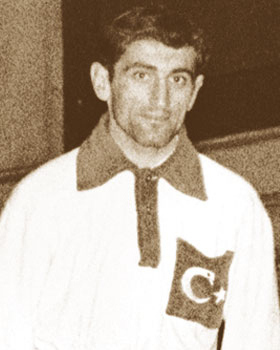
Dağıstanlı achieved his first Olympic glory in 1956 at the Melbourne Olympics. He showcased his superior skill by becoming the Olympic bantamweight champion, securing five decisive victories throughout the tournament. He successfully repeated this remarkable feat at the 1960 Rome Olympics, this time competing in the featherweight category. In Rome, he was even more dominant, achieving six victories. A single draw in his seventh and final fight against the Japanese wrestler Tamiji Sato did not deter his triumph, allowing him to claim his second consecutive Olympic gold medal.
3.3. World Championships and Other Major Competitions
Between his Olympic victories, Dağıstanlı continued to dominate the international wrestling scene. He became the freestyle featherweight world champion in 1957 at the World Championship in Istanbul, where he won all of his fights. He successfully defended this title in 1959 at the World Championship in Tehran, although he accepted a draw against Muhamad Ahkbar from Pakistan during that competition. World Championships in freestyle wrestling were not held in 1955 or 1958. In 1958, Dağıstanlı also visited the Federal Republic of Germany with the Turkish wrestling team, where he secured four friendly bout victories by putting his opponents, including Klaus Rost, Erwin Schuster, Johann Argstatter, and Gawlinski, onto their shoulders.
His achievements extended beyond the Olympics and World Championships. At the 1956 World Cup held in Istanbul, he secured a gold medal in the 57 kg category. He later won a silver medal at the 1958 World Cup in Sofia, competing in the 62 kg featherweight division; his second-place finish was due to two draws, compared to the single draw of the Soviet athlete Nurik Muschegijan, who took the gold. Dağıstanlı also earned a gold medal at the 1960 Balkan Championships in Burgas, again in the 62 kg category. Furthermore, he demonstrated his versatility by winning a gold medal in Greco-Roman wrestling at the 1955 Mediterranean Games in Barcelona, competing in the 57 kg class.
3.4. Match Records and Wrestling Style
Mustafa Dağıstanlı is renowned for his exceptional match record. Throughout his active career, he compiled an impressive total of 389 wins and 4 draws in 393 matches, demonstrating remarkable consistency and dominance. His wrestling style was characterized by a potent combination of strength, technique, and strategic acumen, making him a formidable opponent in both freestyle and Greco-Roman disciplines. He was particularly effective in both the bantamweight and featherweight divisions.
3.5. Retirement from Active Career
Mustafa Dağıstanlı officially concluded his illustrious active wrestling career after the 1960 Summer Olympics in Rome. Having achieved the pinnacle of his sport with two Olympic gold medals and multiple World Championship titles, he chose to retire from competitive wrestling at the peak of his abilities.
4. Post-Wrestling Retirement Activities
After concluding his wrestling career, Mustafa Dağıstanlı dedicated his time to various social and professional endeavors, impacting the sports community, politics, and business.
4.1. Coach and Wrestling Federation Activities
Following his retirement from active competition, Dağıstanlı remained deeply connected to the sport that brought him fame. He transitioned into a coaching role, sharing his extensive knowledge and experience with aspiring wrestlers. Furthermore, he actively participated in the Turkish Wrestling Federation, contributing to the development and administration of wrestling in Turkey. His involvement helped shape the next generation of Turkish wrestlers and reinforced the sport's infrastructure within the country.
4.2. Political Activities
In 1973, Mustafa Dağıstanlı transitioned into the political arena, leveraging his national recognition and popularity. He was elected as a deputy for his hometown of Samsun, representing the Justice Party in the Turkish Grand National Assembly. He served in this capacity until 1980. During his tenure as a parliamentarian, Dağıstanlı utilized his platform to advocate for issues pertinent to his constituents and the broader Turkish society, continuing his public service beyond the wrestling mat.
4.3. Business Activities
In addition to his political and sports administration roles, Mustafa Dağıstanlı also ventured into the business world. He established and operated an overland coach business in Ankara. This enterprise notably bore his surname, "Dağıstanlı," and symbolically incorporated the iconic Olympic rings as its logo, a testament to his enduring legacy as an Olympic champion and his continued association with the values of sportsmanship and excellence.
5. Death
Mustafa Dağıstanlı's passing marked the end of an era for Turkish sports and public life.
5.1. Circumstances of Death and Funeral
Mustafa Dağıstanlı passed away on September 18, 2022, at the age of 91, in Antalya, Turkey. His death brought widespread mourning throughout Turkey, particularly within the sports community. His funeral prayer was held on September 20, 2022, at the historic Kocatepe Mosque in Ankara. Following the ceremony, he was laid to rest in the Karşıyaka Cemetery, a prominent burial ground in Ankara.
6. Assessment and Legacy
Mustafa Dağıstanlı is remembered as one of the most dominant and respected figures in the history of Turkish wrestling, with a legacy that extends beyond the sport into public service.
6.1. Major Achievements and Positive Assessment
Mustafa Dağıstanlı is widely regarded as one of the greatest freestyle wrestlers of his generation, particularly in the bantamweight and featherweight divisions between 1954 and 1960. He secured victories in all but one of the major championships and tournaments he competed in during this period, a testament to his consistent excellence. His profound impact on the sport and his exceptional achievements were formally recognized in September 2009, when he was inducted into the prestigious FILA International Wrestling Hall of Fame. His career not only brought numerous medals to Turkey but also inspired a generation of athletes and contributed significantly to the nation's sporting prestige on the international stage. His transition into politics further solidified his role as a public figure committed to serving his country.
6.2. Criticism and Controversy
No significant criticisms or controversies related to Mustafa Dağıstanlı's actions, decisions, or ideologies during his wrestling career or his time as a politician are mentioned in the available source materials. His public and athletic life appears to have been largely celebrated for his achievements and contributions.