1. Overview
James Patrick Edmonds, born on June 27, 1970, is an American former professional baseball player who spent 17 seasons as a center fielder in Major League Baseball (MLB) from 1993 to 2010. Known affectionately by fans as "Jimmy Baseball" or "Jimmy Ballgame", Edmonds was celebrated for his exceptional defensive abilities, earning eight Gold Glove Awards, and was also a formidable power hitter throughout his career. After retiring as a player, he transitioned into a broadcasting career, primarily serving as an analyst and color commentator for Bally Sports Midwest's coverage of the St. Louis Cardinals.
2. Early life
James Patrick Edmonds was born on June 27, 1970, in Fullerton, California. His parents divorced during his childhood, sharing joint custody. Edmonds' father lived only a few miles from Angel Stadium, which was then known as Anaheim Stadium. He attended Diamond Bar High School in Diamond Bar, California, located in eastern Los Angeles County, California. During his senior year of high school, Edmonds sustained a shoulder injury, a factor that reportedly caused him to fall lower in the Major League Baseball draft.
3. Professional career
Jim Edmonds' professional baseball career spanned from 1993 to 2010, playing for six different Major League Baseball teams. He was particularly renowned for his defensive prowess in center field, earning eight Gold Glove Awards, alongside his significant contributions as a power hitter.
3.1. California / Anaheim Angels (1988-1999)
Edmonds began his professional journey with the California Angels organization, progressing through their minor league system before making his impactful Major League debut. During his time with the Angels, he established himself as a key player, demonstrating both offensive power and defensive excellence, which eventually led to multiple Gold Glove selections despite facing internal team dynamics and injuries.
3.1.1. Minor leagues (1988-1993)
Edmonds was initially selected by the California Angels in the seventh round of the 1988 Major League Baseball draft. Following the draft, he began his minor league career with the Bend Bucks, the Angels' Class A-Short Season affiliate in the Northwest League, where he played 35 games in 1988, batting .221 with no home runs and 13 RBIs.
The following year, he was promoted to the Quad Cities Angels, the Class-A affiliate in the Midwest League, playing 31 games and hitting .261 with one home run and 4 RBIs. In 1990, Edmonds advanced to the Palm Springs Angels, the High-A affiliate in the California League, where he played 91 games, batting .293 with 3 home runs and 56 RBIs. He remained with Palm Springs in 1991, playing 60 games and batting .294 with two home runs and 27 RBIs.
In 1992, Edmonds was promoted to Double-A with the Midland Angels in the Texas League, hitting .313 with eight home runs and 32 RBIs in 70 games. Later that year, he was further promoted to the Triple-A Edmonton Trappers for 50 games, batting .299 with six home runs and 36 RBIs. In 1993, Edmonds played for the Angels' new Triple-A affiliate, the Vancouver Canadians, appearing in 95 games and batting .315 with nine home runs and 74 RBIs.
3.1.2. MLB debut and emergence (1993-1996)
On September 7, 1993, Jim Edmonds received his first call-up to the major leagues by the California Angels. He made his MLB debut on September 9, starting in left field against the Detroit Tigers at Tiger Stadium, where he went 0-for-4 with two strikeouts. Edmonds recorded his first major league hit on September 10 against the Toronto Blue Jays at the SkyDome, a pinch-hit double in the ninth inning. His first major league RBI came on September 14 against Seattle Mariners pitcher Roger Salkeld, when he hit a single that drove in Chad Curtis. In his 1993 September call-up season, Edmonds played 18 games and batted .246 in 61 at-bats.
Despite the offseason signings of outfielders Bo Jackson and Dwight Smith, Edmonds secured a spot on the Angels' 1994 Opening Day roster. He received sporadic playing time during the first half of the season, often appearing as a pinch hitter and rarely starting. His first major league home run was hit on May 11, 1994, a two-run shot off Rick Helling against the Texas Rangers. Through his first 50 games in 1994, Edmonds boasted a .328 batting average and a .405 on-base percentage. By June, he began to receive more regular playing time as the primary left fielder after Bo Jackson was benched and Dwight Smith was traded. Midway through the season, media outlets considered Edmonds a strong candidate for the AL Rookie of the Year Award. Although his high batting averages regressed with increased playing time, he concluded the strike-shortened season batting .273 with five home runs and 37 RBIs, finishing eighth in the AL Rookie of the Year voting.
With the departure of Chad Curtis in the offseason, Edmonds became the Angels' everyday center fielder for the 1995 season. In this new role, he emerged as a formidable power hitter, despite having only 29 home runs in his six-year minor league career and five in his rookie season, which initially led him to be recognized as a contact hitter. After not hitting any home runs in the first 17 games of the 1995 season, he hit six with an .857 slugging percentage during an eight-game stretch from May 15 to May 23. Edmonds earned his first All-Star Game selection in 1995, batting .291 with 13 home runs and 52 RBIs by the All-Star break. He finished the 1995 season with a .290 batting average, 33 home runs, and 107 RBIs.
In 1996, Edmonds returned to the Angels as one of their top all-around hitters. On March 7, he signed a four-year, 9.50 M USD contract extension with the Angels, which included a team option for a fifth year. He suffered groin and stomach injuries on May 25, sidelining him for a month. Upon his return on June 10, he sprained his thumb the very next day, causing him to miss another month. He rejoined the lineup on July 18, going 2-for-5 with a home run against the Seattle Mariners. Edmonds concluded the 1996 season batting .304 with 27 home runs and 66 RBIs.
3.1.3. Gold Glove selections and team dynamics (1997-1999)
During the mid-1990s, the Angels developed a strong group of four outfielders: Jim Edmonds, Tim Salmon, Garret Anderson, and Darin Erstad. This presented a challenge for the team's management, who aimed to have all four as everyday starters. To create playing time, the Angels traded designated hitter Chili Davis and first baseman J. T. Snow for pitching in the 1996-97 offseason. Amidst these changes, Edmonds remained in center field, while Erstad moved to first base.
In 1997, Edmonds gained significant recognition for his defensive skills, frequently appearing on highlight reels. One particularly memorable play occurred on June 10, 1997, in a game against the Kansas City Royals at Kauffman Stadium. Edmonds ran straight back towards the center field wall and executed an outstretched, diving catch of a fly ball over his head on the warning track. This play is widely regarded as one of the greatest defensive plays in baseball history; Joe Posnanski of The Athletic ranked it as the 29th-greatest moment in all of baseball history. For the 1997 season, Edmonds batted .291 with 26 home runs and 80 RBIs. Following the season, he received his first career Gold Glove Award.
In September 1998, the Angels, who had been leading their division, fell behind the Texas Rangers and ultimately missed the playoffs. Despite batting .340 with five home runs and 20 RBIs that month, Edmonds faced criticism from some teammates for what they perceived as his nonchalant attitude towards the team's late-season collapse. In an interview, Edmonds stated that he was not "going to come in the next day and want to kill himself" if the Angels were eliminated from contention. In 1998, he played a career-high 154 games, hitting .307 with 25 home runs and 91 RBIs, and was awarded his second career Gold Glove Award.
During spring training in 1999, Edmonds tore the labrum in his right shoulder while lifting weights, aggravating an injury he had been playing through for several years. He underwent surgery to correct the injury, which sidelined him for the first half of the season. In addition to the injury, tensions rose in the clubhouse, as some teammates took exception to Edmonds's alleged nonchalant and dismissive attitude. These factors led to doubts about whether the Angels would retain Edmonds after the 1999 season. Newcomer Mo Vaughn, who had not yet played alongside Edmonds, publicly accused him of not taking responsibility for the team's struggles. Edmonds returned to play as a designated hitter on August 2, 1999, going 2-for-4 with a double against the Texas Rangers. He returned to center field on August 7. He concluded his abbreviated 1999 season with a .250 batting average, 5 home runs, and 23 RBIs in 55 games.
3.2. St. Louis Cardinals (2000-2007)
Jim Edmonds' time with the St. Louis Cardinals marked a highly impactful period in his career, characterized by immediate offensive production, multiple All-Star selections, significant postseason achievements, and a World Series championship.
3.2.1. Immediate production and All-Star selections (2000-2003)
On March 23, 2000, the Angels traded Edmonds to the St. Louis Cardinals in exchange for second baseman Adam Kennedy and pitcher Kent Bottenfield. This trade occurred despite Angels general manager Bill Stoneman having previously assured Edmonds he would not be traded, with plans reportedly changing when St. Louis made Kennedy available.
Edmonds made his Cardinals debut on April 3, 2000, going 0-for-3 with two walks against the Chicago Cubs. He recorded his first hit, home run, and RBI as a Cardinal the following day. Through his first 50 games, Edmonds batted an impressive .371 with 16 home runs and 39 RBIs. He earned his second career All-Star selection, starting in the game in place of the injured Ken Griffey Jr. and going 1-for-2 with a hit off David Wells. Edmonds finished the 2000 season batting .295 with 42 home runs and 108 RBIs. He received his third career Gold Glove Award and finished fourth in the voting for the National League Most Valuable Player Award. In the postseason, Edmonds maintained strong performance, batting .361 with 3 home runs and 12 RBIs in 8 games.
In 2001, Edmonds batted .304 with 30 home runs and 110 RBIs. He earned his second consecutive Gold Glove Award, which was the fourth of his career. In the 2001 National League Division Series, Edmonds batted .235 with two home runs and three RBIs.
In 2002, Edmonds achieved a career-high batting average of .311, along with 28 home runs and 83 RBIs. He was honored with his third consecutive Gold Glove Award, the fifth of his career. During the 2002 postseason, Edmonds batted .355 with two home runs and six RBIs across eight games.
For the 2003 season, Edmonds received his third career All-Star selection. By the All-Star break, he was batting .303 with 28 home runs and 67 RBIs. Edmonds started in center field for the All-Star game and batted second, contributing a first-inning single off AL starter Esteban Loaiza. However, Edmonds experienced a slump after the All-Star break, batting .214 with 11 home homes and 22 RBIs. He concluded the season batting .275 with 39 home runs and 89 RBIs. He also earned his fourth consecutive Gold Glove Award, which was the sixth of his career.
3.2.2. Postseason success and World Series championship (2004-2007)
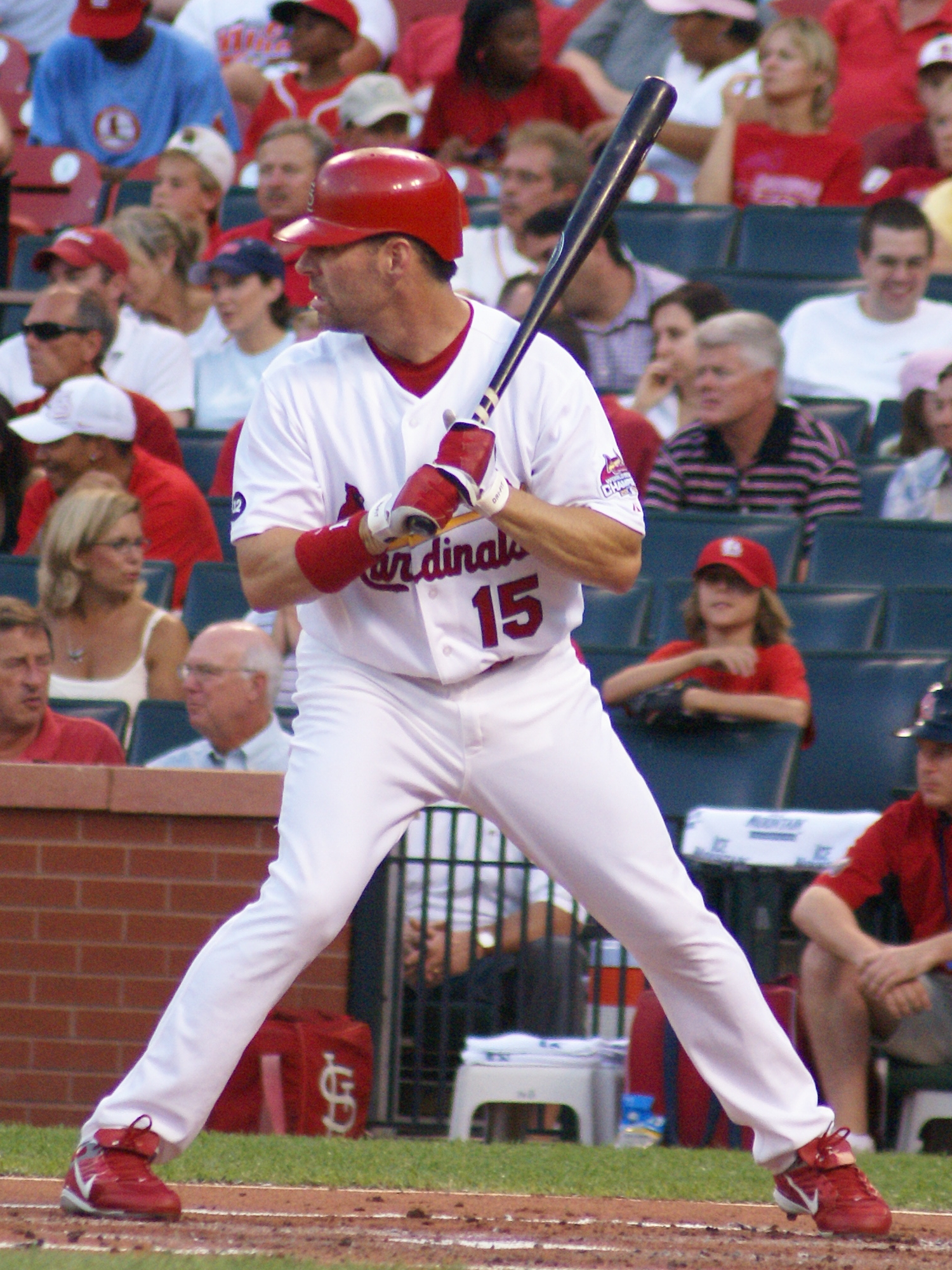
The 2004 season stood out as one of Jim Edmonds' statistically best performances. He posted a .301 batting average, a .643 slugging percentage, 42 home runs, and 111 RBIs; all but his batting average were career highs. His outstanding performance earned him a Silver Slugger Award and another Gold Glove Award, and he finished fifth in the voting for the NL Most Valuable Player Award. During a Chicago Cubs-Cardinals game at Wrigley Field on July 19, 2004, Cubs pitcher Carlos Zambrano was ejected for intentionally throwing at Edmonds. Zambrano aggressively yelled at Edmonds as he rounded the bases after hitting a home run, an incident that led to Zambrano receiving a five-game suspension. Edmonds, along with teammates Albert Pujols and Scott Rolen, became known as "MV3" due to their exceptional individual performances during the 2004 season. Edmonds was also featured on the cover of the video game MLB Slugfest in 2004. A defining moment of Edmonds' career occurred in the 2004 National League Championship Series, when he hit a walk-off home run in the twelfth inning to win Game 6. In Game 7, Edmonds made a spectacular defensive play in center field, contributing significantly to the Cardinals winning the pennant.
In 2005, Edmonds hit .263 with 29 home runs and 89 RBIs, earning his fourth career All-Star selection. During Game 4 of the 2005 National League Championship Series, Edmonds was ejected in the eighth inning for arguing a strike call made by home plate umpire Phil Cuzzi. Edmonds later stated that he "wasn't trying to show up" Cuzzi and claimed that Cuzzi responded profanely, a claim that was not disputed. In 9 postseason games in 2005, Edmonds batted .267 with a home run, one RBI, and three doubles.
On Mother's Day in 2006, Edmonds participated in a special initiative by using a pink bat alongside more than 50 other hitters, in support of the Susan G. Komen for the Cure foundation. Later in the 2006 season, Edmonds began experiencing fielding difficulties that persisted throughout the remainder of his tenure with St. Louis. On June 21, while playing against the Chicago White Sox at U.S. Cellular Field, he crashed into the outfield wall in an attempt to rob a home run. In the following weeks, he experienced intermittent bouts of nausea, dizziness, and blurred vision, which intensified particularly during diving attempts. Two months after the crash, he was diagnosed with post-concussion syndrome. In the 2006 postseason, Edmonds played a crucial role in helping the St. Louis Cardinals secure their first World Series title since 1982, collecting 13 hits and two home runs across all 16 postseason games.
In 2007, Edmonds batted .252 in 117 games, hitting 12 home runs and driving in 53 runs.
3.3. Later career and retirement (2008-2011)
After his significant tenure with the St. Louis Cardinals, Jim Edmonds entered the final phase of his professional baseball career, which included brief stints with multiple teams before ultimately leading to his retirement due to injury.
3.3.1. San Diego Padres and Chicago Cubs (2008)
On December 14, 2007, the Cardinals traded Jim Edmonds to the San Diego Padres in exchange for prospect David Freese. As part of this agreement, the Cardinals also committed to paying a portion of Edmonds' 2008 salary. His 241 home runs with the Cardinals rank as the fourth-most in the franchise's history. On May 9, 2008, the Padres released Edmonds after he batted only .178 with one home run in 90 at-bats.
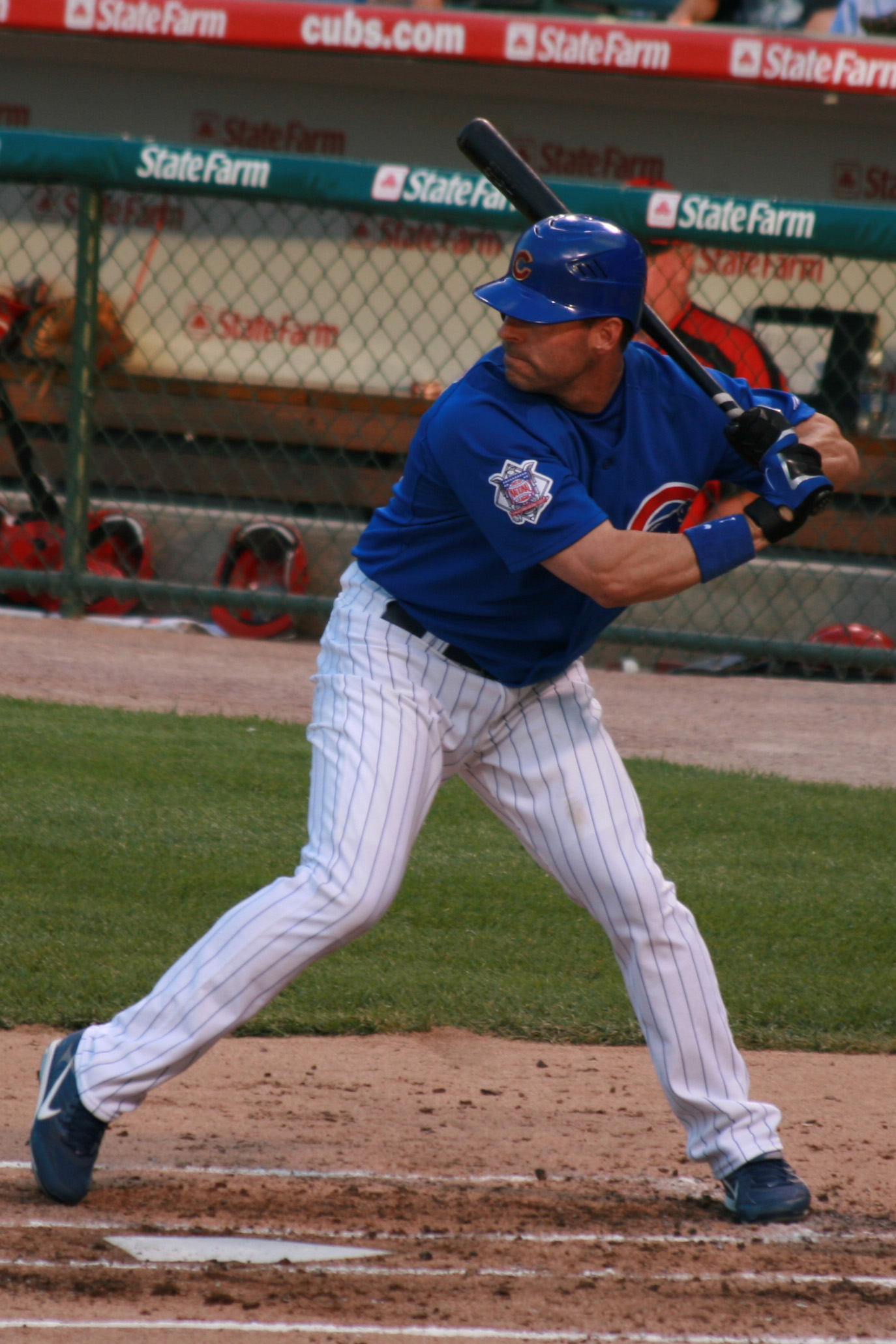
Five days later, on May 14, 2008, the Chicago Cubs, who were in need of a left-handed bat, signed Edmonds to a one-year contract, with the Cubs responsible only for the league minimum salary. He made his debut with the Cubs the following day against his former team, the Padres, going 1-for-4. Initially, Edmonds did not receive a warm welcome from Chicago fans, but his performance quickly won them over. After joining the Cubs, he hit over .300 with eight home runs in his first six weeks. On June 21, 2008, Edmonds remarkably hit two home runs in a single fourth inning against the Chicago White Sox.
Edmonds did not play during the 2009 season, as he did not receive an offer he considered suitable. In January 2010, he publicly announced his intention to return to Major League Baseball, stating that his absence the previous year "was a mistake" and that he "should have played somewhere."
3.3.2. Milwaukee Brewers and Cincinnati Reds (2010)
On January 28, 2010, Jim Edmonds signed a minor league contract with the Milwaukee Brewers. The Brewers added him to their major league roster on March 25.
On August 9, 2010, Edmonds was traded to the Cincinnati Reds in exchange for Chris Dickerson. Both players had to clear waivers as the non-waiver trade deadline had already passed.
3.3.3. Retirement
On February 4, 2011, Edmonds signed a minor league contract to return to the St. Louis Cardinals. However, due to persistent symptoms from a strained Achilles tendon that he had sustained during the 2010 season, Jim Edmonds officially announced his retirement from professional baseball on February 18, 2011.
4. Broadcasting career
On March 14, 2013, Fox Sports Midwest announced that they had hired Jim Edmonds to join their St. Louis Cardinals broadcasting team. Edmonds initially served as an analyst during the "Cardinals Live" pre-game and post-game broadcasts. He took over this role from Cal Eldred, a former Cardinals pitcher who had broadcast for FSM for four years and was moving on to become a special assistant within the Cardinals organization. Since 2016, Edmonds has alternated between his studio role on "Cardinals Live" and serving as a color commentator in the booth for select games. Edmonds has also expressed a long-term aspiration to become part of the Cardinals ownership group one day.
5. Personal life
Jim Edmonds' personal life includes multiple marriages, children, and residences, as well as ventures into the restaurant business.
5.1. Family and relationships
Jim Edmonds has two daughters from his first marriage to Lee Ann Horton, who passed away from cancer in 2015.
He has a son and a daughter from his second marriage to Allison Jayne Raski, which spanned from 2008 to 2014.
On October 24, 2014, Edmonds married Meghan O'Toole King. She joined the cast of The Real Housewives of Orange County in 2015, and Edmonds also appeared on the show. They welcomed a daughter on Thanksgiving Day 2016, followed by twin boys on June 5, 2018. On October 25, 2019, the day after their fifth wedding anniversary, Edmonds filed for divorce from Meghan O'Toole King.
Edmonds married Kortnie O'Connor in 2022.
Edmonds and his family currently reside in Frontenac, Missouri, a suburb of St. Louis.
5.2. Business ventures
Jim Edmonds embarked on several restaurant ventures with his business partner, Mark Winfield. Their first establishment, named Jim Edmonds 15 Steakhouse, opened in 2007 while Edmonds was still playing for the Cardinals. This restaurant closed its doors in September 2013.
Within a few months of the steakhouse's closure, they opened a new restaurant called The Precinct in the same location. However, The Precinct also closed in May 2015.
In 2015, Edmonds and Winfield ventured into a BBQ-style restaurant, naming it Winfield's Gathering Place, located in Kirkwood, Missouri. This establishment ceased operations on July 2, 2016.
6. Awards and honors
Jim Edmonds' exceptional fielding ability garnered significant recognition from Major League coaches and managers, resulting in him being voted a Rawlings Gold Glove winner eight times in nine seasons, spanning from 1997 to 2005.
ESPN's Rob Neyer ranked Edmonds as No. 12 among the top 100 players of the first decade of the 21st century, acknowledging his consistent offensive productivity and elite defensive skills in center field.
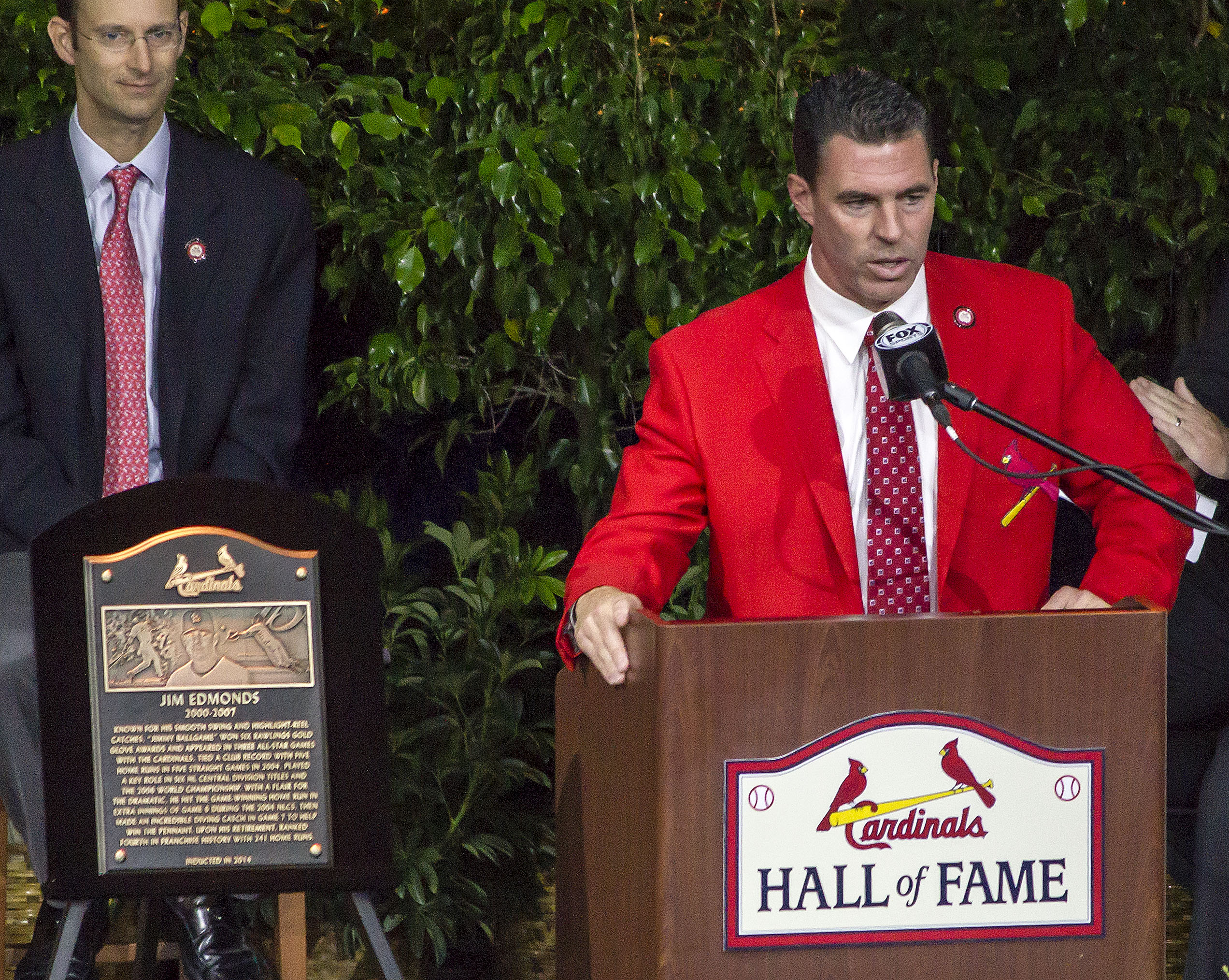
On August 8, 2014, Jim Edmonds was inducted into the St. Louis Cardinals Hall of Fame. He was announced as a candidate for the National Baseball Hall of Fame and Museum on November 9, 2015. However, he was removed from the ballot on January 6, 2016, after receiving only 2.5% of the vote in his first year of eligibility, which is below the threshold for continued consideration. Edmonds also received the GIBBY/This Year in Baseball Defensive Player of the Year Award in both 2003 and 2004. In July 2004, he was named the National League Player of the Month. He also earned the National League Outfielder Silver Slugger Award in 2004.
7. External links
- [https://www.mlb.com/player/jim-edmonds-113744 Jim Edmonds at MLB.com]
- [https://www.espn.com/mlb/player/stats/_/id/2993/jim-edmonds Jim Edmonds at ESPN]
- [https://www.baseball-reference.com/players/e/edmonji01.shtml Jim Edmonds at Baseball-Reference.com]
- [https://www.fangraphs.com/players/jim-edmonds/1153/stats Jim Edmonds at FanGraphs]
- [https://www.baseball-reference.com/register/player.fcgi?id=edmond001jam Jim Edmonds at Baseball-Reference.com (Minors)]