1. Life and Background
This section details Guisin's origins, including his parentage and early life, and the circumstances surrounding his ascension to the Baekje throne.
1.1. Birth and Family
Guisin was the eldest son of King Jeonji, the eighteenth monarch of Baekje, and Lady Palsu (팔수부인Palsu BuinKorean). Lady Palsu is believed by some recent scholars to have been of Wa (Japanese) origin. It is speculated that Guisin was born on an island in the Yellow Sea while his father, Jeonji, was temporarily residing there, having learned of the rebellion by Seolnye through Haechung. Guisin's personal name, according to the Book of Song (宋書SòngshūChinese) and Book of Liang (梁書LiángshūChinese), was 'Yeong' (映YìngChinese).
1.2. Early Life and Accession
Guisin ascended to the throne following the death of his father, King Jeonji. Historical records suggest he was quite young at the time of his accession. The precise details of his early life are not extensively documented in the Samguk Sagi, which primarily records his enthronement and death. However, other historical texts, particularly the Nihon Shoki, indicate that his youth played a significant role in the governance of Baekje during his early reign.
2. Reign
Guisin's reign was marked by significant diplomatic engagement with Chinese dynasties, internal political dynamics involving a regency, and strategic efforts to strengthen Baekje's position against regional rivals.
2.1. Reign Dates and Source Comparison
The traditional dates for Guisin's reign, as recorded in the Samguk Sagi, are 420 CE to 427 CE, spanning eight years. However, the Samguk Sagi provides only these two dates-his enthronement and death-without further details of his accomplishments. In contrast, the historian J. W. Best, drawing upon more contemporaneous Chinese records, has proposed an alternative chronology, suggesting that Guisin's rule more plausibly extended from 414 CE to 429 CE or 430 CE. The Nihon Shoki also aligns with an earlier accession, stating he became king in 414 CE and died in 429 CE. The Book of Song notably omits Guisin as king, directly listing Biyu (餘毗Yú PíChinese) as the successor to Jeonji (餘映Yú YìngChinese).
2.2. Foreign Relations and Enfeoffment
During Guisin's reign, Baekje actively engaged in diplomatic relations, particularly with the newly established Song Dynasty in China. In 416 CE, even before the traditional 420 CE accession date, Guisin was enfeoffed by the Eastern Jin Dynasty with the title of "Envoy with Staff, Grand Governor of All Military Affairs of Baekje, General Stabilizing the East, King of Baekje" (使持節 都督百濟諸軍事 鎮東將軍 百濟王Shǐ Chíjíe Dūdū Bǎijì Zhūjūnshì Zhèndōng Jiāngjūn Bǎijì WángChinese).
Upon the establishment of the Southern Song Dynasty in 420 CE, they sent envoys to Baekje and other neighboring states to reaffirm or strengthen the titles previously granted by the fallen Eastern Jin. Guisin was promoted to "Grand General Stabilizing the East" (鎮東大將軍Zhèndōng DàjiāngjūnChinese) in 420 CE. In 424 CE, Guisin reciprocated by sending a tribute mission to the Song court. The Book of Song records that in 425 CE, Emperor Wen of Song praised Guisin for his annual loyalty and tribute. Baekje continued to send tribute missions annually thereafter. This robust diplomatic relationship with Song China was strategically aimed at counterbalancing Goguryeo's influence and its own relations with various northern dynasties during this period. In 430 CE, the Song court officially permitted Biyu to inherit Guisin's (Yeong's) noble title, further solidifying Baekje's standing.
2.3. Regency and Governance
Due to Guisin's young age at the time of his accession, historical accounts, particularly the Nihon Shoki, suggest that a prominent figure named Mokumanchi (木満致MokumanchiJapanese) acted as a regent, governing the state on his behalf. Mokumanchi was the son of Mokurakonshi (木羅斤資MokurakonshiJapanese), a general whose origins are debated, possibly from Wa or Mimana. There are theories that Mokumanchi might be an ancestor of the Soga clan in Japan, though this remains speculative. The Korean historical record further suggests that Mokumanchi's regency involved a period of "disorderly administration" (난정nanjongKorean). Some interpretations even propose that Guisin's death may have occurred during a counter-rebellion or political upheaval initiated by Biyu to remove Mokumanchi's influence.
2.4. Major Events During Reign
Beyond diplomatic activities, Guisin's reign saw some notable internal developments and regional engagements. In July 417 CE, Baekje undertook the construction of Sakou Castle (沙口城Sakō-jōJapanese) in the northeastern border region. This fortification effort indicates Baekje's strategic measures to strengthen its defenses against Goguryeo. In 428 CE, a significant diplomatic exchange with the polity of Wa (Japan) occurred, as Guisin sent his father Jeonji's sister, Princess Shinsaido-hime (新斉都媛Shinsaido-himeJapanese), along with seven other women, to Wa.
3. Family
This section explores Guisin's family lineage, tracing his ancestry and detailing the historical controversies surrounding the succession of his son, King Biyu.
3.1. Ancestry and Parents
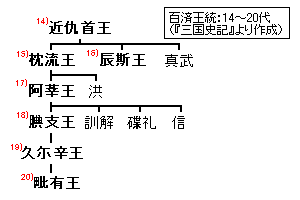
Guisin's immediate ancestry traces back to King Geunchogo, a powerful monarch who expanded Baekje's territory and influence. Guisin's father was the eighteenth king, King Jeonji, and his mother was Lady Palsu (팔수부인Palsu BuinKorean). Lady Palsu is recorded as being from the Jin clan, and some modern research suggests she may have been of Wa (Japanese) descent. His paternal lineage can be traced through King Jeonji to King Asin and King Chimnyu, and further back to King Geungusu.
3.2. Descendants and Succession Controversy
The succession of King Biyu after Guisin's death is a subject of historical debate, particularly regarding Biyu's exact relationship to Guisin. The Samguk Sagi presents two conflicting theories in a marginal note within Biyu's biography: one states that Biyu was Guisin's eldest son, while the other suggests he was an illegitimate son of King Jeonji, making him Guisin's half-brother. The Samguk Sagi itself acknowledges the uncertainty, stating "it is unknown which is correct."
Modern scholarship, particularly in Japan, tends to favor the theory that Biyu was Guisin's half-brother, an illegitimate son of Jeonji. This perspective considers it unlikely for Guisin, who died at a relatively young age, to have had a son old enough to immediately succeed him as king. Another historical text, the Shinsen Shōjiroku (新撰姓氏録Shinsen ShōjirokuJapanese), provides an alternative lineage, suggesting that Guisin had a son named Buyeo-ju (부여주Buyeo-juKorean), and that Biyu was in fact Buyeo-ju's son, making Biyu Guisin's grandson. This further complicates the dynastic continuity and highlights the challenges in establishing a definitive family tree for this period.
4. Historical Evaluation and Interpretation
Scholarly assessments of Guisin's reign highlight its importance for Baekje's foreign relations, while also addressing the significant discrepancies and challenges in interpreting primary historical sources.
4.1. Scholarly Assessment
Guisin's reign is generally viewed as a period of continued diplomatic engagement with China, which was crucial for Baekje to maintain its international standing and balance the growing power of Goguryeo. Despite the brevity of his documented reign in the Samguk Sagi, the information gleaned from other sources like the Nihon Shoki and various Chinese dynastic histories provides a more nuanced picture. These external records indicate a period of internal political maneuvering, particularly concerning the regency, and strategic actions such as castle construction and diplomatic missions to Wa. Scholars emphasize the importance of cross-referencing these diverse historical texts to reconstruct a more complete understanding of Baekje's history during Guisin's time.
4.2. Discrepancies and Criticisms
The historical understanding of Guisin's reign is significantly challenged by the discrepancies and limited information found in primary sources. The most prominent issues include the conflicting reign dates, with the Samguk Sagi (420-427 CE) differing from the Nihon Shoki and scholarly interpretations (414-429/430 CE). The role of Mokumanchi's regency is another point of contention, with some accounts suggesting a period of political instability or "disorderly administration." Furthermore, the controversy surrounding the succession of King Biyu-whether he was Guisin's son or half-brother-creates ambiguity in the dynastic lineage. The Korean historical speculation that Guisin may have been assassinated during a political upheaval further underscores the fragmented and often contradictory nature of the available records, making a definitive historical narrative difficult to establish.