1. Overview
Denis Law (February 24, 1940 - January 17, 2025) was a celebrated Scottish footballer who played as a forward. His illustrious career, spanning from the 1950s to the 1970s, saw him become the only Scottish player to win the prestigious Ballon d'Or award in 1964. Law was a prolific goalscorer, notably for Manchester United, where he is the third-highest goalscorer in the club's history with 237 goals in 404 appearances, behind only Wayne Rooney and Bobby Charlton. He was affectionately known as "The King" and "The Lawman" by supporters, and formed part of the iconic "United Trinity" alongside Charlton and George Best.
Law's career was marked by several record-breaking transfers, moving from Huddersfield Town to Manchester City, then to Torino in Italy, and finally to Manchester United. Despite a challenging period in Italy, his return to English football cemented his legacy. He also proudly represented the Scotland national team 55 times, jointly holding the national record for international goals with 30. Beyond his on-field achievements, Law dedicated his later life to charitable endeavors, establishing the Denis Law Legacy Trust to support community engagement and youth development, reflecting his commitment to social progress and positive influence.
2. Early life and background
Denis Law's early life was shaped by his humble beginnings in Aberdeen, Scotland, where he developed a profound passion for football despite facing personal and financial challenges.
2.1. Birth and family
Denis Law was born in Aberdeen, Scotland, on February 24, 1940. He was the youngest of seven children, with four brothers and three sisters, born to George Law, a fisherman, and his wife, Robina. The Law family experienced poverty, residing in a council tenement flat located at Printfield Terrace in Woodside.
2.2. Childhood and education
Law's childhood was characterized by financial hardship; he went barefoot until the age of 12 and wore handed-down shoes throughout his adolescence. His first pair of football boots was a second-hand birthday present from a neighbor, received during his teenage years. He was a fervent supporter of Aberdeen and would attend their matches whenever he could afford it, otherwise watching local non-league teams. His intense devotion to football led him to decline a place at Aberdeen Grammar School, as it would have required him to play rugby. Instead, he opted to attend Powis Academy in Aberdeen. Despite having a serious squint, he displayed immense promise on the football pitch, particularly after transitioning from a full-back to an inside-left position, which eventually earned him a selection for the Scotland Schoolboys team. An operation to correct his squint, performed during his time at Huddersfield, significantly boosted his self-confidence.
3. Playing career
Denis Law's professional football career spanned several prominent clubs, where he consistently demonstrated his exceptional goal-scoring ability and contributed significantly to team successes.
3.1. Huddersfield Town
Law's professional journey began during the 1954-55 season when he was scouted by Archie Beattie of Huddersfield Town. At just 14 years old, Law was invited for a trial, where the manager initially expressed skepticism, describing him as "a freak. Never did I see a less likely football prospect - weak, puny and bespectacled." Despite this initial assessment, Huddersfield Town signed him on April 3, 1955. The club's subsequent relegation to the Second Division facilitated Law's opportunity to play first-team football. He made his debut on December 24, 1956, at the age of 16, in a 2-1 victory against Notts County. During this period, Manchester United manager Matt Busby made a substantial offer of £10.00 K GBP for Law, a considerable sum for a teenage footballer at the time, but Huddersfield rejected the bid. Bill Shankly, who managed Huddersfield between 1956 and 1959, also sought to bring Law with him to Liverpool upon his departure, but Liverpool could not afford the transfer fee at that time.
3.2. Manchester City
In March 1960, Law made a significant move to Manchester City for a British record transfer fee, estimated at £55.00 K GBP. Notably, Law himself received "precisely nothing" from this fee. Matt Busby had again attempted to sign Law for Manchester United, but City, their cross-city rivals, secured his signature. Despite City having narrowly avoided relegation from the First Division the previous season, Law initially felt that Huddersfield had a stronger team. He debuted for City on March 19, scoring in a 4-3 defeat to Leeds United. In April 1961, he scored two goals in a 4-1 victory over Aston Villa, which proved crucial in securing City's survival in the First Division.
Although he had considered leaving, Law was playing well. In 1961, he famously scored six goals in an FA Cup tie against Luton Town; however, the match was abandoned with 20 minutes remaining, nullifying his six goals. Luton won the replay 3-1, knocking City out of the Cup, with Law scoring City's only goal. Despite enjoying his time at City, Law desired to play for a more successful team and was subsequently sold to the Italian club Torino in the summer of 1961 for £110.00 K GBP, setting a new British record fee for a transfer involving a British player.
3.3. Torino
Law's move to Torino in 1961 for £110.00 K GBP marked a new record for a British player's transfer fee. He was joined by Joe Baker, who had signed from Scottish club Hibernian. Upon his arrival, another Italian club, Internazionale, attempted to prevent him from becoming a Torino player, claiming he had signed a pre-contract agreement with them, though this claim was dropped before the season began.
Law was initially surprised by the luxurious pre-season training facilities in a hotel in the Alps, a stark contrast to the treatment of players in the UK at the time, where the maximum wage for footballers had only recently been abolished. However, Torino's performance-related pay scheme, which offered large sums for wins but little for losses, proved challenging. Like many British footballers who played in Italy, Law struggled to adapt to the prevalent catenaccio (ultra-defensive) style of football, which limited scoring opportunities for forwards. He found the football joyless and overly defensive, frequently subjected to violent man-marking and heavy tackling.
On February 7, 1962, Law was involved in a car crash when his teammate Joe Baker drove the wrong way around a roundabout, flipping the car. Baker was severely injured, but Law's injuries were not life-threatening. By April, Law had submitted a transfer request, which was ignored. The final catalyst for his departure occurred in a match against Napoli when he was sent off. Law later claimed that Torino's coach, Beniamino Santos, had instructed the referee to send him off because he was angry at Law for taking a throw-in, which he had been told not to do. Law left the club and was informed he would be transferred to Manchester United. However, days later, he was told he was being sold to Juventus, with a clause in his contract compelling him to go. In response, Law flew home to Aberdeen, knowing that Torino would not receive any transfer fees if he refused to play for Juventus. He eventually signed for Manchester United on July 10, 1962, for a new British record fee of £115.00 K GBP. Despite his difficulties, Law's total of 10 Serie A goals stood as a record for a Scottish player for 61 years, until Lewis Ferguson of Bologna surpassed it.
3.4. Manchester United
Law's eleven-year tenure at Manchester United marked the most significant period of his career, where he achieved legendary status through prolific goal-scoring and major team successes, despite battling recurring injuries.
3.4.1. Glory years
Upon returning to Manchester, Law lodged with the same landlady he had stayed with during his time at Manchester City. His debut for United took place on August 18, 1962, against West Bromwich Albion, where he made an immediate impact by scoring after only seven minutes in a 2-2 draw. However, United's form had been inconsistent since the Munich air disaster in 1958, leading them to battle relegation throughout the season. In a league match against Leicester City, Law scored a hat-trick, yet United still lost. The team found their stride in the FA Cup, with Law scoring another hat-trick in a 5-0 victory against his former club, Huddersfield Town. United advanced to the final against Leicester City, who were favorites after finishing fourth in the league. Law scored the opening goal as United secured a 3-1 win, marking his only FA Cup final triumph. That season, on December 11, 1962, he also married his wife, Diana.
An incident during that season, on December 15, 1962, in a match against West Brom, involved referee Gilbert Pullin repeatedly taunting Law. Following the match, Law and manager Matt Busby reported the matter to the Football Association. A disciplinary committee severely censured Pullin, who then quit the game. Law later claimed this incident led to him being "a marked man" in the eyes of some referees, attributing it to the "staggeringly heavy punishments" he received later in his career.
Law started the 1963-64 season with a flurry of goals and was selected to play for a World XI team against England at Wembley, scoring their only goal in a 2-1 defeat. He later described this as the greatest honor of his career. His season was interrupted by a 28-day suspension after being sent off against Aston Villa. The unusually cold winter forced United to play many fixtures in a short period, affecting their results. Law believed this contributed to United's failure to win a trophy that season. Despite the lack of silverware, Law had a prolific goal-scoring campaign, finishing with 46 goals in all competitions, a club record that stands to this day.
In 1964-65, Law was awarded the Ballon d'Or, and Manchester United secured their first league title since the Munich disaster. Law's 28 league goals made him the First Division's top scorer. The following season, on October 21, 1965, Law injured his right knee while playing for Scotland against Poland. He had undergone a previous operation on the same knee at Huddersfield, and this injury would plague him for the remainder of his career.
In 1966, Law sought a pay rise during his contract renewal with United, threatening to leave if his demands were not met. Manager Matt Busby promptly placed Law on the transfer list, publicly stating, "no player will hold this club to ransom, no player." When Law confronted him, Busby presented a written apology for him to sign, which he then showed to the press. Law later revealed that Busby had used the incident to deter other players from similar actions, while secretly granting him the pay rise. Law scored 23 goals in 36 league appearances during 1966-67, helping United clinch another league title.
In 1968, United won the European Cup for the first time, but Law's knee injury severely hampered him. He missed both the semi-final second leg and the final, with John Aston taking his place. Law frequently received cortisone injections to alleviate the pain, but playing with the injured knee caused long-term damage. A specialist in January 1968 wrote to United, stating that a prior cartilage removal operation had failed and recommending a second surgery; however, Law was not shown this report for several years and was forced to continue full training. In 1968-69, United reached the European Cup semi-final, losing to AC Milan. Law finished as the tournament's top scorer with 9 goals, including seven in the 10-2 aggregate first-round victory over Waterford United.
3.4.2. Injury problems
Wilf McGuinness assumed the role of first-team coach at the beginning of the 1969-70 season. Manchester United finished eighth in the league, but Law missed nearly the entire season due to his persistent injury. In April 1970, he was placed on the transfer list for £60.00 K GBP, but no club made a bid, leading him to remain at United.
Following a poor 1970-71 season, Frank O'Farrell was appointed manager. United started the 1971-72 season strongly, finishing 1971 five points clear at the top of the league, with Law contributing 12 goals. However, results declined, and they ended the season in eighth place. Law scored in the opening match of the subsequent 1972-73 season, but his knee injury resurfaced, preventing him from scoring for the rest of the campaign. The team's poor performance continued, and O'Farrell was dismissed in December 1972 after a 5-0 defeat by Crystal Palace.
Law recommended that United replace O'Farrell with Tommy Docherty, whom he knew from his time with the Scottish national team. The club followed his advice, and the team's performance initially improved, lifting them into mid-table. However, Law was given a free transfer by Tommy Docherty in the summer of 1973. He left Manchester United after 11 years, having scored a total of 237 goals in 404 games across all competitions, and collecting two league title medals and an FA Cup winner's medal. Only Bobby Charlton (who retired in 1973) and Wayne Rooney have scored more goals for United.
3.5. Return to Manchester City
After leaving Manchester United, Denis Law was offered a contract by Manchester City manager Johnny Hart. He made an immediate impact, scoring two goals on his second debut for City against Birmingham City in the opening game of the 1973-74 season. He made 27 full appearances and two as a substitute that season, including City's 2-1 defeat in the League Cup final against Wolves.
In City's final game of the 1973-74 season against Manchester United at Old Trafford, Law's 81st-minute back-heeled goal gave City a 1-0 lead. Believing his goal might relegate United, Law famously did not celebrate. At the time, he was unaware that results from other matches meant United would be relegated regardless of their outcome. A series of pitch invasions by United fans followed, and Law walked off the pitch with his head down as he was substituted. The pitch invasions forced the referee to abandon the game in the 85th minute, though the Football League later decided that the 1-0 result should stand.
Law had a contract with Manchester City for the 1974-75 season, but new manager Tony Book informed him that he would only be playing reserve team football if he remained at the club. Unwilling to end his career in this manner, Law retired from professional football in the summer of 1974. He played two games for Manchester City in the 1974-75 pre-season Texaco Cup tournament, scoring the last goal of his career against Sheffield United at Bramall Lane on August 6, 1974. His final professional game was a 2-1 victory against Oldham Athletic at Maine Road on August 10, 1974. He formally announced his retirement on August 26, 1974.
4. International career
Denis Law made significant contributions to the Scotland national football team, representing his country at the highest level and achieving notable goal-scoring records.
4.1. Scotland debut and activities
Although not selected for the 1958 FIFA World Cup, Denis Law was given his debut for Scotland by interim manager Matt Busby on October 18, 1958, in a British Home Championship match against Wales. Law scored Scotland's second goal in a 3-0 victory over the Welsh at Ninian Park. However, he played in Scotland's infamous match against England on April 15, 1961, which Scotland lost 9-3. Law later described this defeat as his "blackest day."
Law was selected for the World XI team that faced England in the FA Centenary match in 1963, where he scored the only goal for the Rest of the World in a 2-1 defeat. He also scored in Scotland's famous 3-2 victory over England on April 15, 1967, in the 1967 British Home Championship, less than a year after England had become world champions. Despite Manchester United winning the league that season, Law considered the victory over England even more satisfying.
4.2. Participation in major tournaments
Scotland qualified for the World Cup finals in the summer of 1974, marking their first appearance since 1958. Despite having played limited first-team football in the preceding season, Law was included in the squad. He featured in Scotland's opening match against Zaire, which they won 2-0, though he did not score. Law expressed significant disappointment at not being selected for the subsequent match against Brazil and was also omitted from the game against Yugoslavia. Although Scotland remained undefeated in all their group matches, they failed to qualify for the second phase and were eliminated from the World Cup. The match against Zaire proved to be Law's last of his 55 appearances for Scotland.
4.3. Records
Denis Law jointly holds the Scottish international record goal tally with 30 goals. This record is shared with Kenny Dalglish, who achieved the same number of goals but in 102 matches compared to Law's 55 appearances.
5. Personal life
Beyond his celebrated football career, Denis Law's personal life was marked by a strong family foundation and a significant commitment to charitable endeavors following his retirement from playing.
5.1. Family
Denis Law first met his wife, Diana, in an Aberdeenshire dancehall when they were both teenagers. They married in December 1962 and went on to have five children. Their daughter, also named Diana, notably worked for several years in the Manchester United press office.
5.2. Post-retirement activities
After retiring as a player, Law frequently worked in radio and television, providing commentary and presenting football matches. He was one of the inaugural sports news presenters for Granada Reports and served as the sub-presenter for Granada Television's Kick Off Match, which was the equivalent of LWT's The Big Match. He was featured as a special guest on the TV show This Is Your Life on February 19, 1975, just months after his retirement from playing.
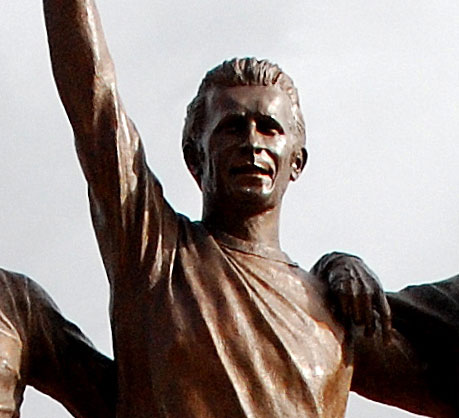
In recognition of his profound impact on English football, Law was made an Inaugural Inductee of the English Football Hall of Fame in 2002. On February 23, 2002, a statue depicting Law alongside George Best and Bobby Charlton - collectively known as the "United Trinity" - was unveiled at Old Trafford, specifically at the Scoreboard End of the stadium. In November 2003, he underwent a successful operation to treat prostate cancer. His contributions were further recognized with honorary degrees from the Universities of Aberdeen and St. Andrews in 2005, and from Robert Gordon University in 2017.
The emergence of Dutch international Dennis Bergkamp in the 1990s brought to light a story that Bergkamp's parents, who were fans of Law, named their son after him. However, Dutch authorities initially refused to register the name unless it was spelled with two 'n's (Dennis) to avoid confusion with the female name Denise. On November 25, 2005, Law was at the bedside of his former United teammate George Best when Best passed away from multiple organ failure. In May 2008, at the City of Manchester Stadium, Law, alongside UEFA president Michel Platini, presented the medals to the winners of the UEFA Cup, Zenit Saint Petersburg, and their opponents, Scottish side Rangers.
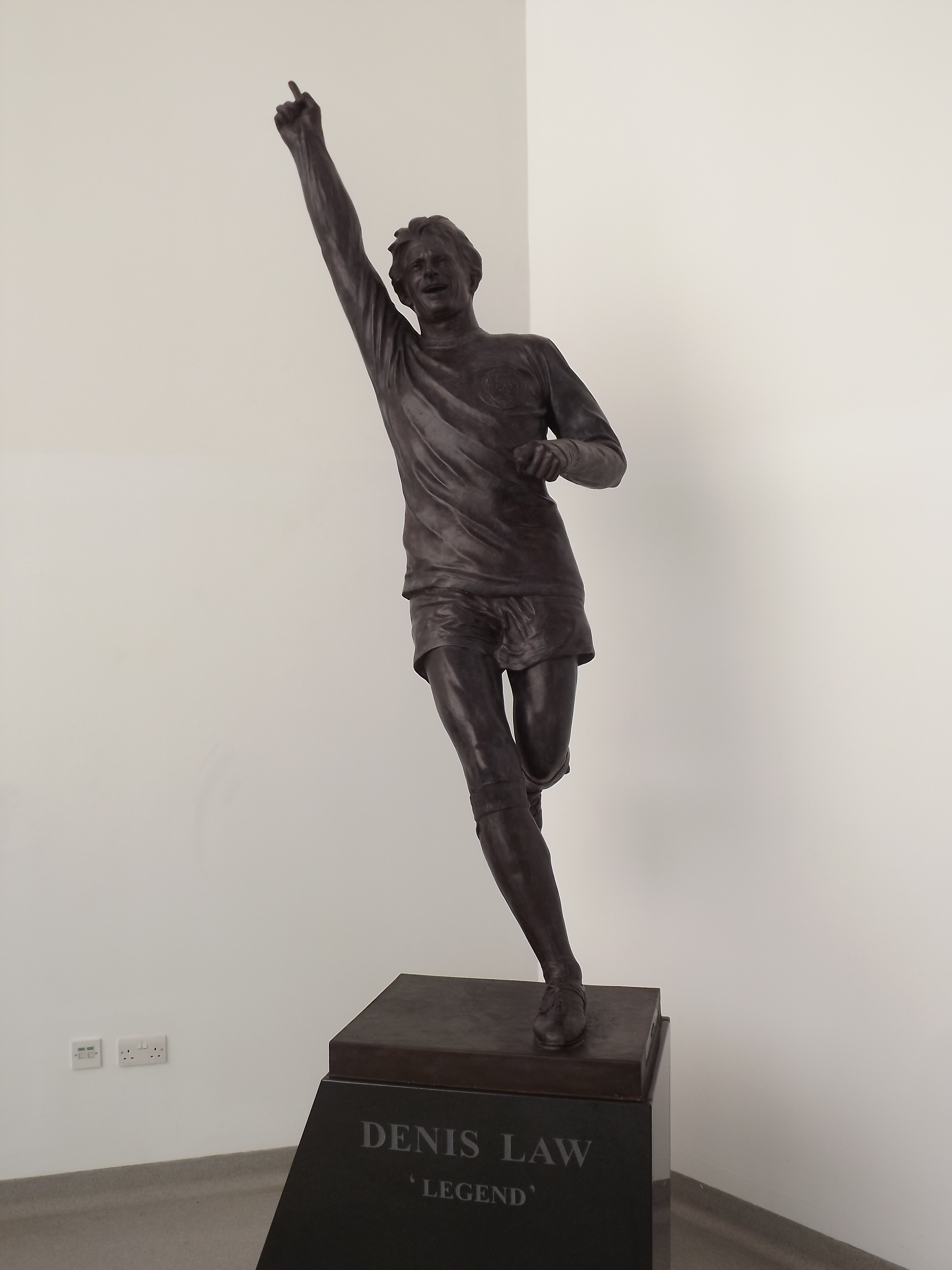
In February 2010, Law was named as the patron of the UK-based charity Football Aid, succeeding the late Sir Bobby Robson. In 2012, he established the Denis Law Legacy Trust, a registered charity focused on community engagement and broadening participation in sports. The trust aims to reduce youth crime and anti-social behavior, promote health and wellbeing, and encourage inclusivity through sport, physical activity, and creative endeavors. This includes collaborations on community projects such as Scotland's first Cruyff Court in Aberdeen. Also in 2012, a statue of Law, commissioned by the Denis Law Legacy Trust, was unveiled at the entrance to Aberdeen Sports Village (a facility he had formally opened two years prior), depicting his iconic pose after scoring for Scotland against England in 1967.
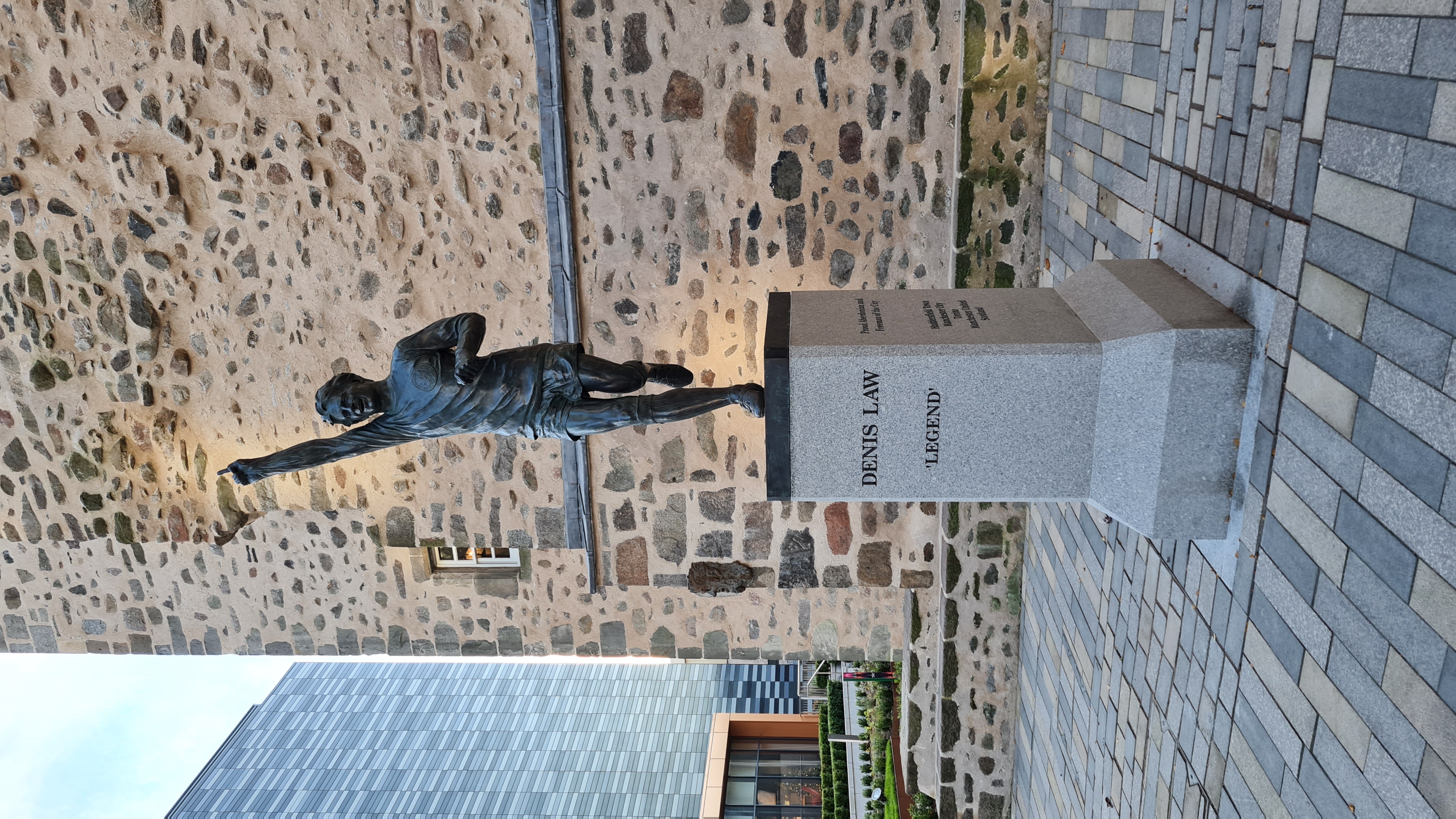
Law was appointed Commander of the Order of the British Empire (CBE) in the 2016 New Year Honours for his extensive services to football and charity. In 2017, he received the Freedom of the City of Aberdeen. On November 18, 2021, a second bronze statue of Law, created by sculptor Alan Herriot, was unveiled in Aberdeen by Law and Sir Alex Ferguson. Commissioned by Aberdeen City Council, it is located next to Provost Skene's House in Marischal Square.
6. Later life and health
Denis Law's later years were marked by significant health challenges, culminating in his passing in 2025.
6.1. Illness and death
In August 2021, it was publicly announced that Denis Law had been diagnosed with both Alzheimer's disease and vascular dementia. He died on January 17, 2025, at the age of 84.
7. Legacy and evaluation
Denis Law's legacy is profound, characterized by his exceptional achievements on the football pitch, numerous awards and honors, and significant contributions to society through his charitable work.
7.1. Awards and honors
Denis Law received numerous accolades throughout his career and in recognition of his lasting impact on football and society.
Manchester United
- Football League First Division: 1964-65, 1966-67
- FA Cup: 1962-63
- FA Community Shield: 1965, 1967
- European Cup: 1967-68
Scotland
- British Home Championship: 1959-60 (shared), 1961-62, 1962-63, 1963-64 (shared), 1966-67, 1971-72 (shared)
Individual
- Ballon d'Or: 1964
- World Soccer World XI: 1964
- European Cup top scorer: 1968-69
- Football League 100 Legends: 1998
- PFA Merit Award: 1975
- Scottish FA International Roll of Honour (players with 50+ caps): inducted in 1988
- FWA Tribute Award: 1994
- Inaugural Inductee of the English Football Hall of Fame: 2002
- Scotland's Golden Player: Most Outstanding Player of the past 50 years by the Scottish Football Association (November 2003, to celebrate UEFA's Jubilee)
- Scottish Football Hall of Fame: inducted in 2004
- PFA Team of the Century (1907-1976): 2007
- Freedom of Aberdeen: 2017
- Commander of the Order of the British Empire (CBE): 2016
7.2. Monuments and tributes
Denis Law's enduring legacy is commemorated through several monuments and tributes. A statue honoring him, alongside George Best and Bobby Charlton as the "United Trinity", was unveiled at Old Trafford in 2002. In his hometown of Aberdeen, a statue was erected at the entrance to the Aberdeen Sports Village in 2012, capturing his iconic pose after scoring for Scotland against England in 1967. A second bronze statue in Aberdeen, created by sculptor Alan Herriot, was unveiled in 2021 near Provost Skene's House in Marischal Square. Additionally, Law received honorary degrees from the Universities of Aberdeen and St Andrews in 2005, and from Robert Gordon University in 2017, acknowledging his significant contributions.
7.3. Social contributions and influence
Beyond his remarkable football career, Denis Law made substantial social contributions, particularly through his involvement in charitable initiatives. He became a patron of Football Aid in February 2010, a UK-based charity that allows football fans to play in matches at professional stadiums, raising money for various causes. In 2012, Law established the Denis Law Legacy Trust, a registered charity focused on community engagement and broadening participation in sports. The trust actively works to reduce instances of youth crime and anti-social behavior, promotes health and wellbeing, and fosters inclusivity through physical activity and creative endeavors. A notable collaboration of the trust is the establishment of Scotland's first Cruyff Court in Aberdeen, providing safe and accessible sports facilities for young people. These efforts highlight Law's commitment to using his influence for positive societal impact, particularly in supporting youth development and community welfare.
8. Statistics
8.1. Club
| Club | Season | League | National cup | League cup | Continental | Other | Total | |||||||
|---|---|---|---|---|---|---|---|---|---|---|---|---|---|---|
| Division | Apps | Goals | Apps | Goals | Apps | Goals | Apps | Goals | Apps | Goals | Apps | Goals | ||
| Huddersfield Town | 1956-57 | Second Division | 13 | 2 | 5 | 1 | - | - | - | 18 | 3 | |||
| 1957-58 | Second Division | 18 | 5 | 2 | 1 | - | - | - | 20 | 6 | ||||
| 1958-59 | Second Division | 26 | 2 | 0 | 0 | - | - | - | 26 | 2 | ||||
| 1959-60 | Second Division | 24 | 7 | 3 | 1 | - | - | - | 27 | 8 | ||||
| Total | 81 | 16 | 10 | 3 | - | - | - | 91 | 19 | |||||
| Manchester City | 1959-60 | First Division | 7 | 2 | 0 | 0 | - | - | - | 7 | 2 | |||
| 1960-61 | First Division | 37 | 19 | 6 | 4 | 0 | 0 | - | - | 43 | 23 | |||
| Total | 44 | 21 | 6 | 4 | 0 | 0 | - | - | 50 | 25 | ||||
| Torino | 1961-62 | Serie A | 27 | 10 | 1 | 0 | - | - | - | 28 | 10 | |||
| Manchester United | 1962-63 | First Division | 38 | 23 | 6 | 6 | - | - | - | 44 | 29 | |||
| 1963-64 | First Division | 30 | 30 | 6 | 10 | - | 5 | 6 | 1 | 0 | 42 | 46 | ||
| 1964-65 | First Division | 36 | 28 | 6 | 3 | - | 10 | 8 | - | 52 | 39 | |||
| 1965-66 | First Division | 33 | 15 | 7 | 6 | - | 8 | 3 | 1 | 0 | 49 | 24 | ||
| 1966-67 | First Division | 36 | 23 | 2 | 2 | 0 | 0 | - | - | 38 | 25 | |||
| 1967-68 | First Division | 23 | 7 | 1 | 0 | - | 3 | 2 | 1 | 1 | 28 | 10 | ||
| 1968-69 | First Division | 30 | 14 | 6 | 7 | - | 7 | 9 | 2 | 0 | 45 | 30 | ||
| 1969-70 | First Division | 11 | 2 | 2 | 0 | 3 | 1 | - | - | 16 | 3 | |||
| 1970-71 | First Division | 28 | 15 | 2 | 0 | 4 | 1 | - | - | 34 | 16 | |||
| 1971-72 | First Division | 33 | 13 | 7 | 0 | 2 | 0 | - | - | 42 | 13 | |||
| 1972-73 | First Division | 11 | 1 | 1 | 0 | 2 | 1 | - | - | 14 | 2 | |||
| Total | 309 | 171 | 46 | 34 | 11 | 3 | 33 | 28 | 5 | 1 | 404 | 237 | ||
| Manchester City | 1973-74 | First Division | 24 | 9 | 1 | 2 | 4 | 1 | - | - | 29 | 12 | ||
| Career total | 485 | 227 | 64 | 43 | 15 | 4 | 33 | 28 | 5 | 1 | 602 | 303 | ||
8.2. International
| National team | Year | Apps | Goals |
|---|---|---|---|
| Scotland | 1958 | 2 | 1 |
| 1959 | 4 | 0 | |
| 1960 | 4 | 2 | |
| 1961 | 3 | 2 | |
| 1962 | 3 | 5 | |
| 1963 | 7 | 11 | |
| 1964 | 5 | 1 | |
| 1965 | 6 | 2 | |
| 1966 | 2 | 2 | |
| 1967 | 3 | 1 | |
| 1968 | 1 | 1 | |
| 1969 | 2 | 0 | |
| 1970 | 0 | 0 | |
| 1971 | 0 | 0 | |
| 1972 | 7 | 2 | |
| 1973 | 3 | 0 | |
| 1974 | 3 | 0 | |
| Total | 55 | 30 | |