1. Early life and education
Daniil Kazakevich was born on December 16, 1902, in the village of Radzetse, located in the Vilna Governorate. His childhood and teenage years were spent in Omsk. After completing his high school education, he initially worked as a factory carpenter before embarking on his military career.
2. Early military career (1920-1923)
In June 1920, Kazakevich was conscripted into the Red Army. From June to December of that year, he served with the 186th Rifle Regiment, actively participating in the Polish-Soviet War and the campaign against the army led by Stanisław Bułak-Bałachowicz. Following these initial engagements, he continued his service in various military districts, including the Belomorsky Military District and the Siberian Military District. In 1923, he transferred to the Soviet Border Troops, marking a significant shift in his military focus.
3. Interwar period (1923-1941)
During the interwar period, Daniil Kazakevich steadily advanced his career within the Soviet Border Troops, gaining extensive experience through various training programs and ascending through a series of leadership positions.
3.1. Border Troops service and training
Upon joining the Border Troops in 1923, Kazakevich underwent specialized training, graduating from the Minsk Infantry Training Courses that same year. From 1923 to 1924, he served as an assistant chief of a border post within the Belorussian Border District. In 1924, he was appointed head of a border post for the 42nd Jabrayil Border Detachment. His dedication and performance led him to become head of a border post of the 38th Akhaltsikhe Border Detachment in 1926. To further his military education, he was sent to the Higher School of Border Troops in 1927, completing his studies in 1929. Subsequently, he became the chief of the 21st Yampol Border Detachment. Between 1932 and 1934, he took on an instructional role as the head of courses at the 2nd Kharkov Border School. His pursuit of higher military education continued as he attended the M. V. Frunze Military Academy, graduating in 1937.
3.2. Promotions and leadership roles
Kazakevich officially joined the Communist Party of the Soviet Union in 1925, aligning himself with the ruling political body. His professional advancements were consistent; he was promoted to captain on March 14, 1936. Following his graduation from the Frunze Military Academy, he assumed command of an NKVD motor rifle regiment in the Khabarovsk Border District. On November 29, 1938, he was promoted to major. By 1939, Kazakevich was serving as the chief of staff of the border district, demonstrating his growing strategic importance. His leadership continued to be recognized, leading to his promotion to Colonel on March 13, 1940. Shortly before the outbreak of World War II, on February 14, 1941, he was awarded the Order of the Badge of Honour.
4. World War II (1942-1945)
During World War II, Daniil Kazakevich played a pivotal role in the Soviet military, commanding rifle divisions in several crucial offensives and distinguishing himself through his leadership.
4.1. Command of 102nd Rifle Division
In December 1942, Kazakevich was appointed chief of staff of the Far Eastern NKVD Rifle Division, a unit primarily formed from border troops. In February 1943, this division was officially renamed the 102nd Rifle Division. In the summer of 1943, the division, under Kazakevich's leadership, saw combat in significant engagements, including the Battle of Kursk and Operation Kutuzov. For his service during this period, he was awarded his first Order of the Red Banner on August 27, 1943.
4.2. Command of 399th Rifle Division and major offensives
In September 1943, Kazakevich assumed command of the 399th Rifle Division. He led this division through a series of major operations. It participated in the Chernigov-Pripyat Offensive, which was part of the larger Battle of the Dnieper, and contributed to the capture of Novozybkov in September 1943. In November, the division was engaged in the Gomel-Rechitsa Offensive. On June 3, 1944, Kazakevich was promoted to major general and concurrently awarded the Order of Kutuzov 2nd class.
From June 1944, the 399th Rifle Division played a key role in Operation Bagration, a massive Soviet offensive. In late June, it fought in the Bobruysk offensive, helping to capture the city of Babruysk. Subsequently, the division participated in the Minsk offensive in early July. For his distinguished service, Kazakevich received the Order of Suvorov 2nd class on July 23, 1944. The division then moved on to the Lublin-Brest Offensive. Between September 3 and September 8, the 399th Rifle Division successfully breached German defenses leading to the Narew River, advanced to the river near Różan, and established a critical bridgehead. The division reportedly repelled several determined counter-attacks by German forces, demonstrating its resilience and effectiveness under Kazakevich's command. On November 3, 1944, he was awarded a second Order of the Red Banner. From January 1945, the division was involved in the final stages of the war, participating in the East Prussian offensive. In late January, it contributed to the Mlawo-Elbing Offensive. His continued exemplary leadership during these intense battles led to him being awarded a third Order of the Red Banner on February 10, 1945.
q=Różan|position=left
4.3. Hero of the Soviet Union award
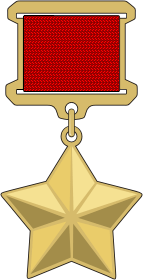
For his decisive leadership during the Battle of the Narew bridgeheads in September 1944, Daniil Kazakevich was recognized with the highest military honor in the Soviet Union. His ability to lead the 399th Rifle Division in breaking through enemy lines and securing a vital river crossing, despite strong German resistance and repeated counter-attacks, was deemed critical to the Soviet advance. As a direct result of these actions, he was awarded the title Hero of the Soviet Union and the Order of Lenin on April 6, 1945, a testament to his tactical skill and bravery.
5. Postwar career (1945-1959)
After the conclusion of World War II, Daniil Kazakevich continued his dedicated service within the Soviet military, primarily returning to the Border Troops and taking on significant command and advisory roles until his retirement.
5.1. Return to Border Troops and command
In 1945, Kazakevich returned to the Border Troops and was appointed deputy chief of the Black Sea Border District. His continued contributions were recognized with a second Order of Lenin on December 10, 1945. In 1946, he transferred to the same position within the Moldovan Border District. By September 1948, he had risen to become the commander of the district stationed at Chișinău. His long-standing service was further acknowledged with the award of the Order of the Red Banner of Labour on October 11, 1949. On November 24, 1950, Kazakevich received his fourth Order of the Red Banner in recognition of his 30 years of military service. A fifth Order of the Red Banner followed on February 14, 1951. While continuing his military duties, he also pursued further education, graduating from the All-Union Correspondence Institute of Law in 1952. In April 1954, he transferred to command the Southwestern Border District, which was based in Lviv. Demonstrating his influence beyond military command, Kazakevich served as a deputy of the Supreme Soviet of the Soviet Union during its 4th convocation, from 1954 to 1958.
5.2. Advisor in East Germany and final assignments
From October 1955 to October 1957, Kazakevich undertook an important international assignment as the chief advisor to the East German Border Troops. This role reflected the Soviet Union's significant influence in the military structures of its satellite states. During this period, on July 15, 1957, he was promoted to Lieutenant general. After completing his advisory duties in East Germany, he returned to the Soviet Union in October 1957, taking on the responsibility as chief of the military educational institutions of the Border Troops, overseeing the training and development of future border officers.
5.3. Retirement
Daniil Kazakevich officially retired from military service in October 1959, concluding a distinguished career spanning nearly four decades.
6. Later life and death
After his retirement from the military in October 1959, Daniil Kazakevich continued to be active, working in the Intourist Directorate, a state-controlled travel agency responsible for foreign tourism in the Soviet Union. He resided in Moscow during his later years. On December 6, 1982, he was awarded the Order of the October Revolution, and on April 6, 1985, he received the Order of the Patriotic War 1st class, commemorating the 40th anniversary of the end of World War II. Daniil Kazakevich passed away on November 28, 1988, and was interred at the Mitino cemetery in Moscow.
7. Legacy and memorials
Daniil Kazakevich's contributions to the Soviet military and Border Troops are commemorated in various ways. On March 25, 2011, a Belarusian Presidential Decree honored his memory by naming the 12th Border Post of the Grodno Border Group after him. Further solidifying his legacy, a bust of Kazakevich was unveiled at this border post on January 4, 2013, serving as a lasting tribute to his distinguished service.